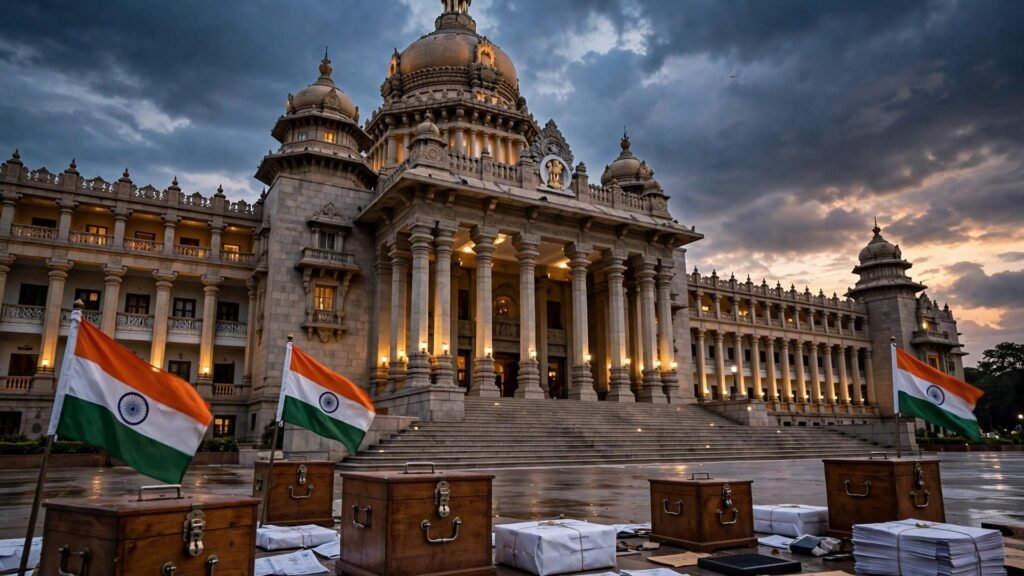
The Bharatiya Janata Party (BJP) and Janata Dal (Secular) alliance, which contests elections in Karnataka as part of the National Democratic Alliance (NDA), has won all four seats in the state’s Legislative Council elections, handing the ruling Congress a clean defeat in polls decided by teachers and graduates.
The results, reported on October 28, 2026, cover two Graduates’ constituencies and two Teachers’ constituencies. The BJP won three of the four seats, while its ally, the JD(S), won the fourth. For the Congress, which governs Karnataka, the outcome is a setback in an electorate made up of educated professionals rather than the general voting public.
Key Takeaways
- The BJP-JD(S) alliance won all four Karnataka Legislative Council seats contested, a 4-0 sweep across Graduates’ and Teachers’ constituencies.
- The BJP took three seats and the JD(S) took one, wresting the Bengaluru Teachers’ seat from the Congress.
- Union Minister H. D. Kumaraswamy framed the result as a message from teachers and graduates ahead of the 2028 Assembly elections.
The four results
In the Bengaluru Teachers’ constituency, JD(S) candidate A. P. Ranganath defeated Congress veteran and sitting member Puttanna, taking a seat the Congress had held. Ranganath secured 10,810 votes against Puttanna’s 9,902, a margin of 908 votes, according to results reported by Outlook.
In the North-East Teachers’ constituency, BJP candidate Shashil G. Namoshi won for a fifth time, defeating Congress candidate Sharanappa Mattur by 3,297 votes, with 15,596 votes to 12,299. Counting in that contest finished in Kalaburagi, where about 30,253 people voted, of which 28,380 votes were valid and 1,873 were rejected, according to a syndicated report carried by Asianet News.
The two Graduates’ seats completed the sweep. BJP candidate S. V. Sankanur won the West Graduates’ constituency for a third straight time, defeating the Congress candidate Mohan Limbikai, while BJP candidate K. M. Suresh won the South-East Graduates’ constituency. Together, the four results gave the NDA a clean sweep of the seats on offer.
What Kumaraswamy said
Reacting to the results, Union Minister H. D. Kumaraswamy congratulated the Prime Minister and the four winning candidates, and said the NDA had won by a big margin in all the constituencies. He said the result reflected the hard work of the Prime Minister for the development of the country, and that Karnataka’s educated graduates and teachers had voted in favour of that work.
Targeting the state government, Kumaraswamy said the Chief Minister was making assurances without implementing them, and that voters had delivered their answer through the ballot. He also projected the sweep forward, saying the verdict suggested voters would back the NDA alliance in the 2028 Assembly elections.
The BJP’s Karnataka unit celebrated in sharper language on social media, posting “DK, it’s done, bro!” — a swipe at Chief Minister D. K. Shivakumar that borrowed a viral catchphrase. The post declared: “NDA SWEEPS 4/4 Teachers’ and Graduates’ constituencies in the MLC elections!”
Why these seats matter — and why they do not tell the whole story
Legislative Council elections for Graduates’ and Teachers’ constituencies are unlike ordinary Assembly elections. Only registered graduates and teachers vote in them, so the electorate is narrow, organised and highly literate. A sweep here is a genuine signal about how those professional groups are leaning, but it is not a direct measure of opinion across Karnataka as a whole.
That distinction matters for both sides. For the NDA, the result is a morale boost and a talking point: it can argue that teachers and graduates, two groups that follow politics closely, have backed it over the ruling party. The elections spanned 19 districts, covering nearly two-thirds of the state, including the home districts of senior Congress leaders, which gives the alliance a broad geographical claim as well.
For the Congress, the defeat raises questions about organisation rather than about its broader popular support. These elections reward ground-level mobilisation among a small, defined electorate — enrolment of voters, booth-level work and candidate familiarity often matter more than statewide campaign themes. Losing all four seats, including one it held, suggests that machinery did not deliver on the day.
The result also lands in a busy week for Indian politics, from India’s invitation to Pakistan for a dialogue forum in New Delhi to India’s diplomatic engagements abroad. In that context, a state-level council result may seem small, but council seats shape the upper house in Karnataka and give the opposition a platform inside the legislature.
For the Congress, which governs Karnataka, the outcome is a setback in an electorate made up of educated professionals rather than the general voting public.
- NDA: 4 seats — BJP 3, JD(S) 1; Congress: 0.
- Bengaluru Teachers’: A. P. Ranganath (JD(S)) beat Puttanna by 908 votes.
- North-East Teachers’: Shashil G. Namoshi (BJP) won by 3,297 votes.
- West Graduates’: S. V. Sankanur (BJP) won a third straight term.
- South-East Graduates’: K. M. Suresh (BJP) completed the sweep.
- Next big test both sides are pointing to: the 2028 Karnataka Assembly elections.
A setback the Congress will have to answer
The Congress had reason to hope for better. It governs the state, and in Graduates’ and Teachers’ elections the ruling party usually benefits from its organisational reach. Instead, it lost every seat on offer, and the BJP was quick to frame the outcome as a verdict on the state government itself.
Whether that framing holds will depend on what happens next. Council by-elections and local contests are poor predictors of Assembly elections on their own, and the 2028 campaign is still some distance away. But a 4-0 defeat gives the opposition a story it will repeat, and it gives the Congress an organisational problem it cannot ignore: in a contest decided by its most educated voters, its message did not win.
For now, the immediate consequence is simpler. The NDA gains four council seats and a headline, the Congress loses ground in the upper house, and both parties head into the run-up to 2028 with a fresh data point about where Karnataka’s teachers and graduates stand.
What to Watch Next
Attention now turns to how the Congress responds organisationally to losing all four seats, and whether the NDA can carry the momentum from teachers and graduates into wider contests. Both sides have already framed the result as a pointer to the 2028 Assembly elections, and the coming months will show whether that claim holds or whether a narrow-electorate result fades as a broader campaign takes shape.