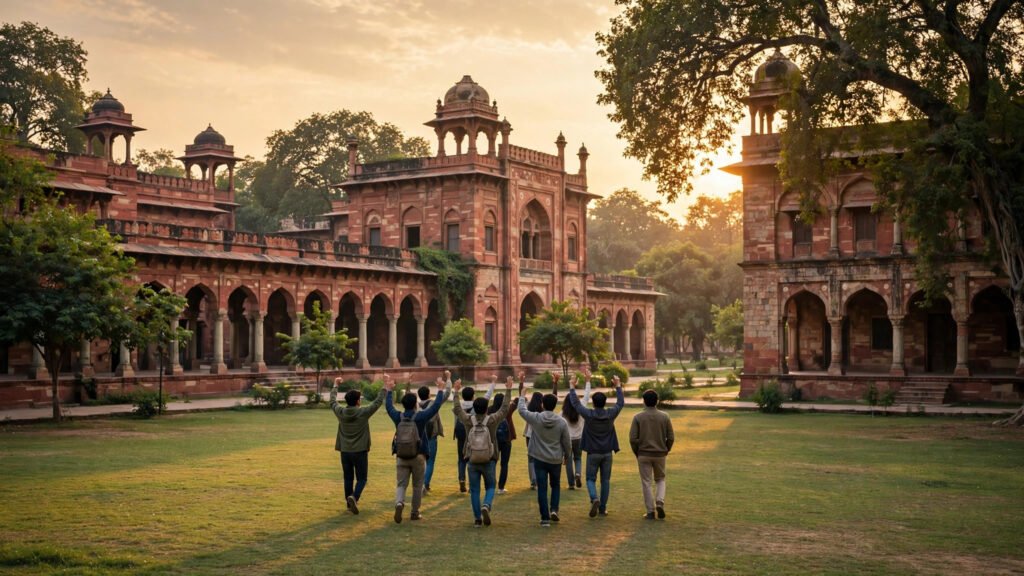
Students at Jamia Millia Islamia in Delhi have ended an 18-day protest after the university administration agreed to a time-bound process for restoring the elected students’ union, a body that has not held elections since 2006. The agreement, announced on Thursday, October 29, sets May 15, 2027, as the deadline for approving and implementing the union’s constitution, with elections to follow in the next academic session.
The protest began on October 12, with students demanding the restoration of the Jamia Millia Islamia Students’ Union (JMISU). The agitation included a hunger strike and, at times, a campus closure, as students pressed for a concrete timetable rather than a general promise. Celebrations broke out on campus after senior university officials met the protesters and announced that their demands had been accepted.
Key Takeaways
- Jamia Millia Islamia students have ended an 18-day protest after the administration agreed to restore the students’ union.
- The union constitution must be approved and implemented by May 15, 2027, under the university’s order.
- Elections will be held within six weeks of the start of the next academic session, scheduled to begin around July 16, 2027, and disciplinary action linked to the protest will be revoked.
What the Administration Agreed
Under the order issued by the university on October 29, the approval and implementation of the Jamia Millia Islamia Students’ Union constitution shall be completed by May 15, 2027. The drafting process will include student representatives and faculty, alongside professors or legal experts, with representatives from every faculty.
Once the constitution is approved, the university will issue a notification for elections in accordance with the Lyngdoh Committee recommendations. Those elections will be held within six weeks of the commencement of the next academic session, which is scheduled to begin around July 16, 2027.
Vice-Chancellor Mazhar Asif and Registrar Mahtab Alam Rizvi approached the protesters near Gate No. 7, in the Gulistan-e-Ghalib lawns, to make the announcement. Registrar Rizvi confirmed that the administration had accepted all three of the students’ main demands.
The drafting process will include student representatives and faculty, alongside professors or legal experts, with representatives from every faculty.
Why the Protest Lasted 18 Days
The length of the protest reflected a dispute over detail, not just principle. Students had been seeking a dated, written framework for reviving the union, and an earlier announcement that elections would be held within 15 days of the constitution being approved did not satisfy them, because it lacked a specific deadline for the constitution itself.
The October 29 order changed that by fixing May 15, 2027, as the deadline. It also addressed the consequences students had faced during the agitation. The university agreed to revoke ongoing show-cause notices, disciplinary proceedings, rustications, suspensions and campus-ban orders issued against students in connection with the protest.
On October 16, the university had rusticated one student on hunger strike, suspended two others and banned all three from entering the campus for a year, according to reports of the protest. Those actions are now covered by the revocation agreed on Thursday.
A Union Dormant Since 2006
The significance of the agreement lies in how long Jamia has gone without an elected student body. The university has not held student union elections since 2006, and the union was dissolved in March 2006. For nearly two decades, students at one of India’s prominent central universities have had no elected union of their own.
That gap is why the timeline matters as much as the promise. A constitution approved by May 2027, followed by elections in the next academic session, would restore a formal channel for student representation that current students have never experienced at Jamia.
The case also sits in a wider pattern of student protests shaping campus politics, and of student movements pressing institutions for elections and representation. In Serbia, a student movement recently played a central role in a contested election outcome, a reminder that campus organising can carry weight well beyond university gates.
- Protest began on October 12 and ended on October 29 after the administration’s order.
- Constitution deadline: May 15, 2027.
- Elections: within six weeks of the next academic session, starting around July 16, 2027.
- Disciplinary action linked to the protest to be revoked.
- Last student union elections at Jamia: none since 2006.
Campus Life During the Agitation
The protest disrupted normal campus life. The campus had been closed during parts of the agitation, and on October 28 the administration announced that classes would remain online until November 24, citing safety concerns and disruption on campus.
Students celebrated after Thursday’s announcement, bringing the 18-day agitation to an end. The focus now shifts from protest to process: drafting a constitution that students, faculty and legal experts can agree on, and then holding an election under it.
What to Watch Next
What to watch next is whether the constitution is drafted and approved by May 15, 2027, whether the election notification follows once that framework is in place, and whether elections are then held within six weeks of the next academic session beginning around July 16, 2027. The other test is whether the promised revocation of protest-related disciplinary action is carried out in full, and whether campus life returns to normal after the online-classes period.