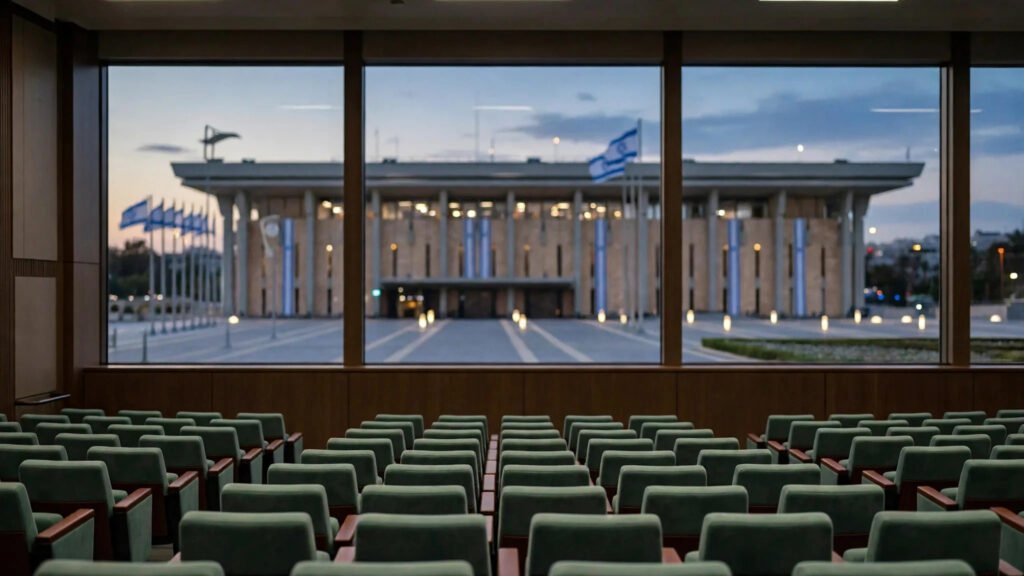
Israel’s October 27 parliamentary election has left no bloc with a governing majority, and the parties holding the balance are the two Arab-led lists that together won a record 19 seats in the 120-seat Knesset. With Prime Minister Benjamin Netanyahu’s bloc on 53 seats and the opposition bloc led by Gadi Eisenkot on 48, neither side can reach the 61 seats needed to govern without the Arab parties, or without a far broader and more difficult arrangement.
The result turns what was once treated as a side story in Israeli elections into the central question of the coalition talks now under way. The Joint List won 11 seats and Ra’am won eight, according to the completed count reported on October 31. Their combined 19 seats are described in reporting on the results as their highest-ever tally, and nearly double their previous representation.
Key Takeaways
- Netanyahu’s bloc won 53 seats and Eisenkot’s opposition bloc won 48, leaving both short of the 61-seat majority in the 120-seat Knesset.
- The Joint List (11 seats) and Ra’am (8 seats) together hold 19 seats, giving them a potentially decisive role in coalition talks.
- Official certification is expected on November 4, after which the president will consult party representatives before tasking a lawmaker with forming a government.
The numbers that created the deadlock
Israel’s parliament has 120 seats, so 61 is the line for a majority. The reported completed count puts Netanyahu’s bloc eight seats short of that line, while Eisenkot’s bloc is 13 seats short. Likud remains the largest single party with 27 seats, followed by Eisenkot’s Yashar with 21 and Naftali Bennett’s B’Yachad with 12, according to results reporting.
The arithmetic is stark. Together, the opposition bloc and the Arab parties would command 67 seats, enough on paper to replace Netanyahu, if they could agree on a governing arrangement. That “if” is doing a great deal of work, because the parties involved have very different positions and several leading figures have previously ruled out relying on Arab parties for a government.
Final voter turnout was reported at 77.7 percent, up from the previous election in 2022. Reporting on the results links the Arab parties’ performance to a record turnout among Palestinian citizens of Israel, who voted in large numbers in Tuesday’s election.
Their combined 19 seats are described in reporting on the results as their highest-ever tally, and nearly double their previous representation.
Why 19 seats matter now
A bloc that falls short by eight seats, or by 13 seats, cannot close the gap with one small party alone. That is why the 19 seats held by the Joint List and Ra’am matter more than their share of the vote might suggest. They are the only grouping large enough, on its own, to take either major bloc over the majority line.
That position does not mean the two lists act as one bloc. Reporting on the results stresses that the Joint List and Ra’am are two separate parties, not a single alliance, and that they could take different positions in coalition talks. Any government that needs their support would therefore need to satisfy two distinct party leaderships, not one.
Early coalition reporting on October 31 said Ra’am chairman Mansour Abbas had reached out to Joint List leaders, while bloc leaders on both sides were holding talks. Avigdor Liberman, whose party is counted in the opposition camp, was reported as rejecting the possibility of sitting with Arab parties, a reminder of how difficult a broad agreement could be.
What the two big blocs face
For Netanyahu, the result is a clear step back from the position his bloc held in the outgoing parliament. Reports put his bloc’s previous strength at 68 seats at its peak, against 53 now. His Likud party is still the largest party, but the largest party does not automatically form a government in Israel’s proportional system; a majority coalition does.
For Eisenkot, the path is no easier. His bloc’s 48 seats leave it further from a majority than Netanyahu’s bloc, and it would need both Arab lists, or a breakaway from the other side, to govern. Democrats leader Yair Golan has urged cooperation to remove Netanyahu, according to results reporting, but that view is not shared across the opposition camp.
Both sides are therefore talking, and both are constrained by promises made before the election. That tension is why Israeli politics can spend weeks in coalition negotiations even after the votes have been counted.
Fraud claims and the official response
The post-election period has also been marked by a dispute over the result itself. Israel voted on October 27 in an election that followed warnings about possible interference, and Netanyahu and Likud have since alleged that the election was stolen and linked the Arab parties’ performance to foreign money and fraud. Election officials and the Arab parties have said there is no evidence for those claims, according to reporting on October 31.
A separate foreign-funding inquiry is under way, with the Shin Bet security agency examining allegations about possible foreign funding. Officials have said the inquiry will not change the election results submitted to the president, and the Central Elections Committee’s acting director-general was reported on October 30 as saying that reports about attempts to influence the election were unfounded. The allegations themselves remain under investigation, and that distinction matters: an inquiry continuing is not the same as a finding of fraud.
Netanyahu had warned before the vote that Iran might try to disrupt the election, a claim that formed part of the tense run-up to polling day. The post-election dispute is different in kind: it concerns the count and the legitimacy of the result, and election officials have pushed back on the fraud allegations.
What happens next
Although the counting of ballots has been completed, the results are still subject to formal certification before they are submitted to President Isaac Herzog. Official certification is expected on November 4, according to results reporting.
Once the official results are published, Herzog will consult with representatives of the elected parties before tasking a lawmaker with forming the next government. The designated candidate will initially have 28 days, with a possible 14-day extension, to build a coalition that can command 61 seats.
That timetable gives the Arab parties time, and leverage. Every day of negotiation in which neither major bloc can reach 61 without them increases the attention on what the Joint List and Ra’am will ask for, and on whether either bloc is willing to pay that price.
- 53 seats: Netanyahu’s bloc, eight short of a majority
- 48 seats: Eisenkot’s opposition bloc, 13 short of a majority
- 19 seats: Joint List (11) plus Ra’am (8), the decisive grouping
- 77.7 percent: final voter turnout reported for the election
- November 4: expected date for official certification of the results
What to Watch Next
Watch for the official certification on November 4, for Herzog’s consultations with party representatives, and for whether either major bloc moves closer to the Joint List or Ra’am in the talks that follow. Watch, too, for whether the two Arab lists take a common position or negotiate separately, since that choice will shape how much leverage their 19 seats actually carry. The numbers already show the deadlock; the next phase will show whether anyone can break it.