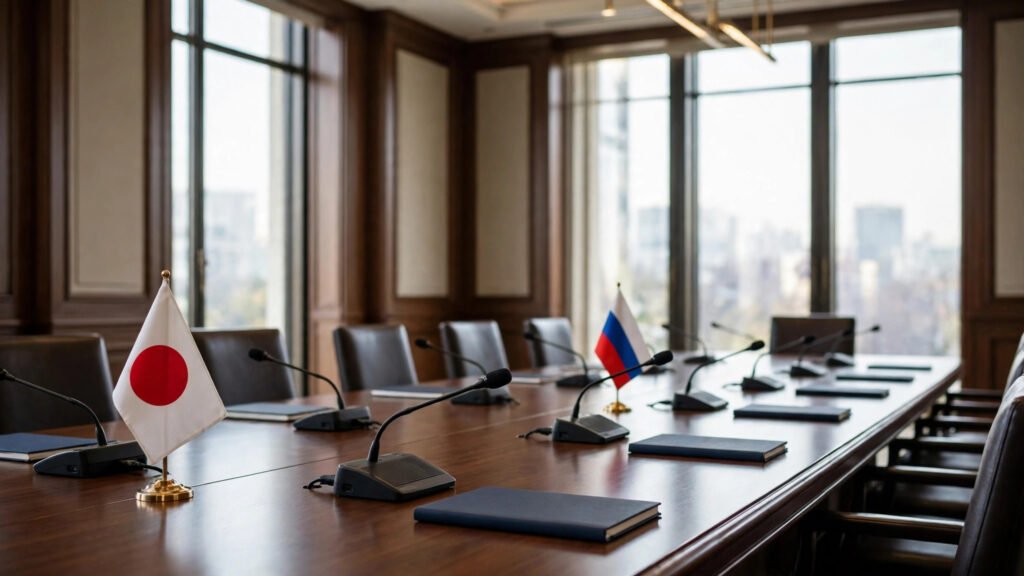
Japan’s foreign minister used a rare face-to-face meeting with his Russian counterpart to demand the immediate release of detained journalist Yuki Imai, pressing Moscow directly over a case that has become a new flashpoint in the strained relationship between the two countries. The Japan Russia detained journalist Yuki Imai case was raised by Foreign Minister Toshimitsu Motegi during talks with Russian Foreign Minister Sergey Lavrov on the sidelines of the G20 foreign ministers’ meeting in Atlanta, Japan’s Foreign Ministry said on Saturday, October 31, 2026.
According to Tokyo, Motegi “strongly demanded the immediate release” of Imai, a reporter for the Sapporo-based Hokkaido Shimbun newspaper who is being held in Moscow. The meeting on Friday was the first formal in-person meeting between the two countries’ foreign ministers in about five years, a gap that underlines how little direct high-level contact remains between Tokyo and Moscow.
Key Takeaways
- Japan’s Foreign Minister Toshimitsu Motegi demanded the immediate release of detained journalist Yuki Imai in talks with Russia’s Sergey Lavrov in Atlanta.
- Imai, a Hokkaido Shimbun reporter, was detained on Sakhalin on October 13 on espionage accusations that Tokyo rejects.
- The meeting was the first formal face-to-face between the two foreign ministers in about five years, held on the sidelines of the G20 gathering.
The Atlanta Meeting
Motegi and Lavrov met in Atlanta, in the United States, where foreign ministers from the Group of 20 economies gathered for a two-day meeting hosted by US Secretary of State Marco Rubio. Japan’s Foreign Ministry said the talks lasted about 30 minutes and were held at Japan’s request.
Tokyo said the two ministers agreed they would maintain communication, even amid what the ministry described as the severe situation in Japan-Russia relations. For Tokyo, the case is now inseparable from the wider state of Japan-Russia relations.
Moscow’s account of the meeting differed in emphasis. Russia’s Foreign Ministry confirmed that Lavrov met his Japanese counterpart, but its announcement did not mention the detained journalist. Russian officials said Lavrov stressed during the meeting that Japan must abandon what Moscow calls its “unfriendly policy” toward Russia if it wants to restore full-fledged dialogue.
Who Is Yuki Imai, and What Is Moscow Alleging?
Imai was detained by Russia’s Federal Security Service (FSB) on October 13 in Sakhalin, an island in Russia’s Far East, shortly before his scheduled departure from Russia, according to reports citing Japanese officials. Moscow accuses him of collecting information about Russia’s defence capabilities in the interests of one of Japan’s intelligence services. Those are Moscow’s accusations; they have not been independently established, and Tokyo rejects them.
A Moscow court has ordered Imai held in custody for two months, until December 12, according to Ukrinform. Japan’s Foreign Ministry said officials had met Imai for the first time since his arrest earlier this week, after a consular visit was finally granted. Tokyo had earlier summoned the Russian ambassador and lodged a protest over the detention, and Japanese Prime Minister Sanae Takaichi has rejected Russia’s espionage allegations against the journalist.
For Tokyo, the case is now inseparable from the wider state of Japan-Russia relations.
Why This Meeting Matters
The encounter matters because direct contact between Tokyo and Moscow has become so rare. The last formal meeting of this kind dated back to September 2021 in New York, before Russia’s full-scale invasion of Ukraine transformed the relationship. Since then, Japan has joined its Group of Seven partners in imposing sanctions on Russia over the war, and bilateral ties have steadily deteriorated.
The detention has added a personal, human dimension to a dispute that is usually conducted in the language of sanctions and communiques. Press-freedom advocates generally argue that detaining journalists on espionage accusations chills reporting from inside Russia, and Tokyo has framed Imai’s case as a matter concerning a Japanese citizen detained abroad rather than as a routine consular matter.
The broader backdrop also includes a territorial dispute that has never been resolved. Japan and Russia have yet to sign a formal peace treaty to end World War II, owing to the dispute over the Kuril Islands, known in Japan as the Northern Territories. That unresolved history continues to shape every bilateral encounter, including this one.
Motegi also used the Atlanta meeting to press a wider point, strongly calling on Russia to take positive actions toward achieving a just and lasting peace in Ukraine, according to Japan’s statement. The war in Ukraine remains the central reason for the sanctions and the diplomatic freeze, and it framed the G20 discussions in Atlanta, where ministers debated geopolitical tensions, energy security and supply chains against the backdrop of high oil prices and the wars in Iran and Ukraine.
- First formal Motegi-Lavrov meeting in about five years, lasting around 30 minutes in Atlanta.
- Japan says Motegi “strongly demanded the immediate release” of Hokkaido Shimbun journalist Yuki Imai.
- Imai was detained on Sakhalin on October 13 and is held in Moscow on espionage accusations Tokyo rejects.
- Russia’s account of the meeting did not mention the journalist and called on Japan to drop its “unfriendly policy.”
- Tokyo and Moscow agreed to keep communication open despite the severe state of relations.
What to Watch Next
What happens next will be measured first by whether Moscow acts on Tokyo’s demand and releases Imai, or whether his detention until December 12 runs its course. A second signal will be whether the agreement to maintain communication produces another meeting, or whether contact lapses again as it did for five years. A third will be whether the case affects the wider relationship, including Japan’s sanctions policy and the unresolved territorial dispute, or remains a separate consular dispute inside a frozen relationship. For now, the Atlanta meeting has put the case at the top of the bilateral agenda, but it has not resolved it.
Japan’s recent trilateral diplomacy with the United States and South Korea, including the reaffirmed commitment to North Korea’s denuclearization, shows Tokyo still actively shaping regional diplomacy even as its direct channel with Moscow stays narrow. And as long as the war in Ukraine continues to escalate, that channel is likely to stay narrow, with cases like Imai’s testing whether even limited communication can deliver results.