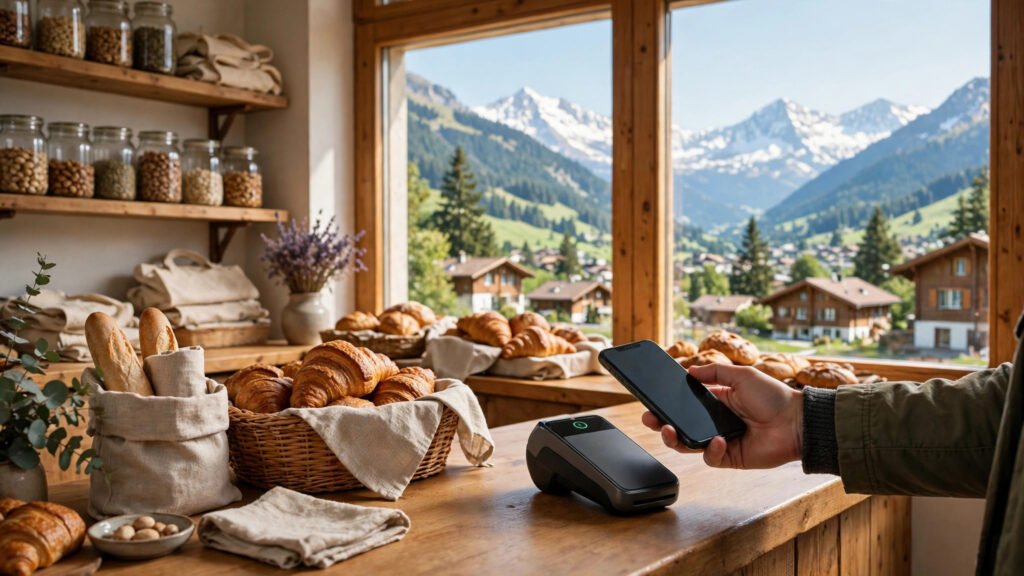
Walk into a bakery, a market stall, or a small café in Switzerland and you may notice something ordinary happening at the till: instead of pulling out a card or counting coins, the customer holds up a phone, scans a code or confirms a payment, and walks away. The app behind many of those moments is TWINT, a Swiss mobile payment system that has become part of everyday life for a large number of people in the country.
That raises a natural question for visitors and newcomers: why do Swiss people pay with TWINT instead of cards or cash? The answer is not that cards and cash have disappeared. Both are still used in Switzerland. TWINT has simply found a comfortable place between them — quick for small everyday payments, easy for sending money to friends, and closely tied to the Swiss bank accounts many people already use.
Key Takeaways
- TWINT is a Swiss mobile payment app that lets people pay in shops and online, and send money to other people, from their phone.
- Its appeal is practical: one familiar app for many everyday payments, linked to a Swiss bank account, without needing to carry cash or a separate card.
- Cards and cash still have a place in Switzerland, so TWINT works best as an everyday option rather than a complete replacement for every payment.
What Is TWINT, in Simple Terms?
TWINT is a mobile payment app made for Switzerland. In simple terms, it turns a phone into a way to pay. A user links the app to a Swiss bank account or, depending on the version they use, to a supported account or prepaid option, and then confirms payments on the phone itself. In a shop, that often means scanning a QR code shown at the till or on a payment terminal. Online, it can appear as a payment choice at checkout, where the buyer confirms the amount in the app. Between friends, it can mean sending money to another person’s phone number rather than handing over cash.
The important point is that TWINT was built around Swiss banking and Swiss everyday habits. It did not arrive as a foreign card network or a generic wallet trying to fit every country at once. It was designed for the way people in Switzerland already bank, shop, and split small costs with each other, and that local fit helps explain why it feels natural there in a way that a copied system might not.
Why So Many People in Switzerland Reach for It First
The first reason is convenience. A phone is usually already in a person’s hand or pocket, so paying with it saves a step. There is no need to search for the right card, wait for change, or worry about having small coins for a coffee, a bus ticket machine, or a market purchase. For small, repeated payments, that saved step adds up across a day.
The second reason is familiarity. Because TWINT is linked to a bank account, it feels like an extension of money people already trust, rather than a separate pot of money that needs constant topping up or careful tracking. The payment comes from a familiar account, and the confirmation happens on a familiar device. For people who are cautious about new payment tools, that closeness to their own bank makes the step from cash or card to phone feel smaller.
The third reason is that it covers more than one job. The same app can be used to pay a shop, settle a bill with a friend, or pay for something online. When one tool handles several everyday tasks, people are more likely to keep using it. They do not need to remember which app is for friends, which is for shops, and which is for online orders. That simplicity matters, especially for people who do not want their phone full of payment apps they rarely open.
There is also a social side to it. Splitting a restaurant bill, collecting money for a shared gift, or paying a friend back for a train ticket is a common part of daily life. Sending that money by phone, with the amount and the recipient visible on screen, is often easier than finding an ATM, carrying cash, or doing a bank transfer that feels formal for a small sum. TWINT fits that in-between space: more casual than a bank transfer, more traceable than cash.
Where TWINT Fits Into Daily Life
In everyday Swiss life, TWINT shows up in the places where small payments happen again and again. That includes cafés and bakeries, local shops, markets, and restaurants, as well as online shopping and services that accept it at checkout. It is also used for payments between people, which makes it handy for the shared costs that come up in families, flat-shares, clubs, and groups of friends.
This pattern is not unique to Switzerland. In the Netherlands, many people pay with iDEAL, a local bank-based payment method, rather than reaching for a card. In Denmark, MobilePay plays a similar everyday role, and in Norway, Vipps is the familiar local choice. Each country has its own answer to the same everyday problem: how to pay quickly, safely, and without friction, using the banks and phones people already have. TWINT is Switzerland’s version of that answer.
TWINT has simply found a comfortable place between cards and cash — quick for small everyday payments, easy for sending money to friends, and closely tied to the Swiss bank accounts many people already use.
When Cards or Cash Still Make Sense
None of this means that cards and cash are gone from Switzerland. Cash is still accepted in many places and is still preferred by some people, especially for privacy, for small purchases, or simply out of habit. Cards remain useful too, particularly for larger purchases, for travel, and for payments in places that do not accept TWINT. A visitor who does not have a Swiss bank account, for example, will usually rely on a card or cash rather than TWINT.
It is also worth remembering that any payment app has limits. A phone can run out of battery, lose signal, or be left at home. A shop may not accept every payment method. A person may simply prefer the feeling of paying with cash or the record-keeping of a card statement. The sensible approach, for residents and visitors alike, is to treat TWINT as one strong option among several, not as the only way to pay in Switzerland.
- TWINT links a phone to a Swiss bank account for shop, online, and person-to-person payments.
- Scanning a QR code or confirming in the app replaces cash or a card for many everyday purchases.
- Its strength is local fit: Swiss banks, Swiss shops, and Swiss everyday habits.
- Cards and cash still matter — especially for visitors, larger purchases, and places that do not accept TWINT.
- Anyone unsure about fees, limits, or supported accounts should check their own bank or the app’s terms before relying on it.
What to Watch Next
What to watch next is not a dramatic change, but a quiet one. TWINT is likely to keep spreading into more of the small, repeated payments that make up daily life, while cards and cash keep their own places for larger purchases, travel, and personal preference. The interesting question is how far that everyday habit goes: whether more shops, services, and shared costs move to the phone, or whether people settle into a stable mix where TWINT, cards, and cash each handle the jobs they do best.
For anyone visiting Switzerland, the practical takeaway is simple. Do not assume every place takes TWINT, and do not assume it has replaced everything else. Carry a card or some cash as well, and if you live in Switzerland, TWINT is worth understanding simply because so many everyday payments around you may already run through it.