France was one of the first countries in Europe to tell school pupils to put their phones away by law, and it has been tightening that rule ever since. What began in 2018 as a ban on using phones during the school day has grown into a full-day handover in middle schools, with plans to extend the same approach further. So why does France keep going further than most countries, and what does the ban actually mean for a pupil walking through the school gate?
The short answer is that France treats the school day as protected time. The argument behind the ban is not that phones are bad in themselves, but that constant notifications, social media and messaging make it harder for children to concentrate, talk to each other and simply be present at school. Supporters say a school cannot compete with a device designed to hold attention, so the device has to wait outside the classroom door.
Key Takeaways
- France banned phone use in primary and middle schools in 2018, covering pupils under 15.
- From September 2025, middle school pupils in the stricter scheme hand their phones in for the whole school day, not just during lessons.
- The ban keeps getting stricter because the original rule still left phones in pupils’ pockets during breaks, which is when much of the distraction and online friction happened.
What the Original 2018 Law Actually Said
The 2018 law applied to primary schools and collèges, the French middle schools attended by pupils aged about 11 to 15. It prohibited pupils from using mobile phones anywhere on school grounds, including during breaks and at lunchtime, not only during lessons. High schools, known as lycées, were left to set their own rules, which is why older teenagers faced a patchwork of policies depending on their school.
In practice, the 2018 rule meant phones had to stay switched off and out of sight, but schools differed in how strictly they enforced it. Some collected phones at the start of the day, others relied on pupils keeping them in bags, and enforcement often depended on individual teachers. The law set the principle, but the daily reality varied from school to school.
The argument behind the ban is not that phones are bad in themselves, but that constant notifications, social media and messaging make it harder for children to concentrate, talk to each other and simply be present at school.
Why the Ban Got Stricter in 2025
The tightening came after a trial in a group of middle schools tested a much firmer version of the rule: pupils hand their phones in when they arrive and get them back only when the school day ends. The trial was presented as a digital pause, a full break from screens rather than a ban limited to lesson time. Reports from the trial pointed to calmer break times, more face-to-face conversation and fewer online disputes spilling into the school day.
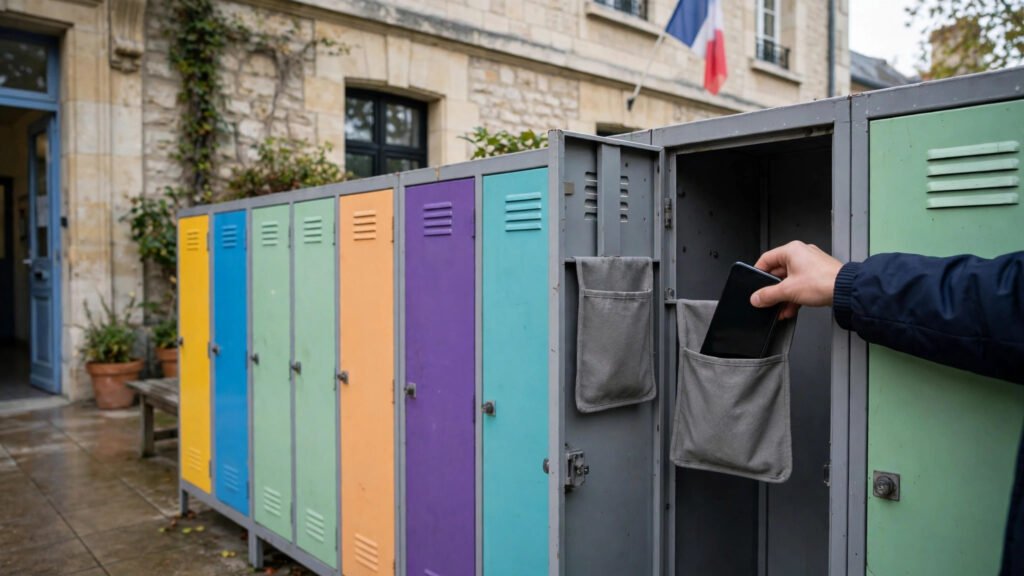
From September 2025, that full-day handover became the model for middle schools, with pupils placing phones in lockers or pouches at the start of the day. The change closed the gap in the 2018 law: under the old rule, a phone could still buzz in a pocket at break time, and much of the distraction, filming and social media pressure happened exactly then, between lessons rather than during them.
- 2018: phones banned from use in primary and middle schools, but enforcement varied by school.
- 2025: middle school pupils hand phones in for the entire school day under the stricter scheme.
- Storage: schools choose lockers, pouches or another collection method that fits their building.
- Exceptions: health needs and other genuine requirements are handled by schools on a case-by-case basis.
What Happens to a Phone During the School Day
Under the stricter scheme, the routine is simple. A pupil arrives, hands the phone in or places it in a locker or pouch, and collects it at the end of the day. Parents who need to reach a child during school hours contact the school office, as they did before mobile phones became common. Schools choose the storage method themselves, which is why some use lockable pouches, some use lockers and some use a simple collection box system.
The rule also fits a wider French pattern of setting clear technology boundaries. France has been steadily moving old technology systems over to new ones, as seen in the switch-off of the old copper landline network in favour of fibre, and other European countries are making similar calls about ageing phone technology, including the UK’s 3G switch-off and what it means for older phones. In each case the question is the same: when does an old habit stop serving people well?
The Arguments For and Against
Supporters argue that a phone-free school day protects concentration and gives children a break from social pressure. Without a phone in hand, they say, pupils talk more at break, argue less online during the day and find it easier to focus when lessons start. Teachers also gain back time that used to go to policing phone use lesson by lesson.
Critics raise practical worries instead. Parents ask how they can reach a child in an emergency, and schools must answer that question with a working office contact route. Others ask whether a ban teaches self-control or simply postpones it, since pupils get their phones back at the school gate and face the same apps and feeds at home. Some also point out that a ban on its own cannot fix wider problems such as harmful online content or late-night screen use.
France’s answer, so far, has been to keep tightening the school rule while debating the wider questions separately. The school ban is treated as one piece of a larger conversation about children and screens, not as a complete solution on its own.
What to Watch Next
The next step to watch is whether the stricter full-day handover spreads further, with reported plans to extend phone restrictions to high schools and to tighten the rules on social media accounts for under-15s. The school ban itself is already settled for primary and middle schools, and the open question is how far the same approach travels: to older pupils, to more of the school day, and into the wider rules on children’s online lives. France started this debate earlier than most countries, and its next moves will show whether a stricter school phone ban becomes the European norm or stays a French exception.