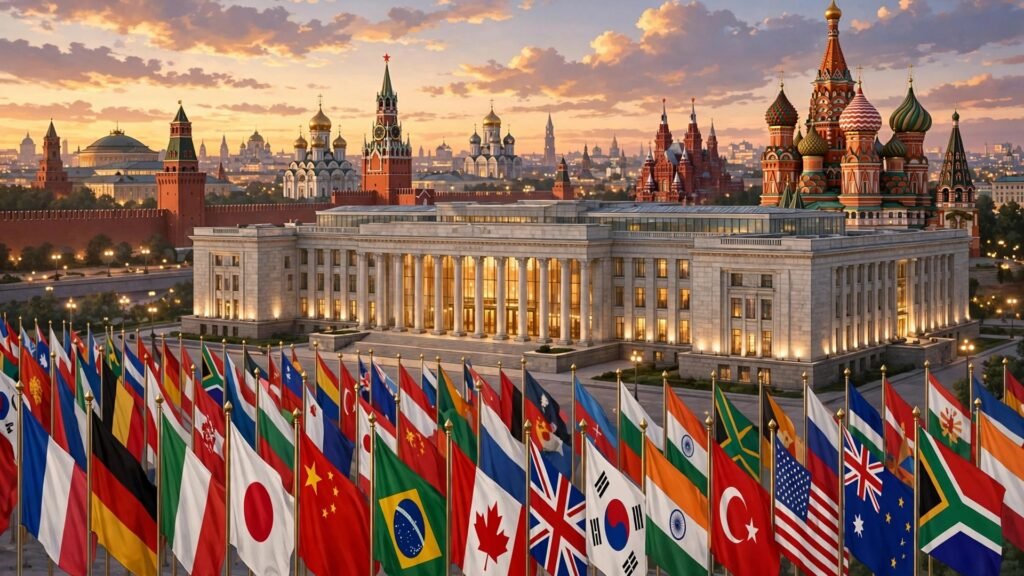
African leaders have gathered in Moscow for the third Russia-Africa Summit, a two-day meeting opening on Wednesday, October 28, 2026, that is set to shape cooperation between Russia and African countries for the next three years. Representatives of 48 African countries have confirmed their participation, according to the Kremlin, making this one of the largest gatherings of its kind since the summit format began.
The summit runs on October 28 and 29 and is co-chaired by Russian President Vladimir Putin and Burundi President Évariste Ndayishimiye, who currently chairs the African Union. A leaders’ plenary session is scheduled for the second day, alongside an Economic and Humanitarian Forum bringing together officials, businesses and experts.
The meeting follows the first Russia-Africa Summit in Sochi in 2019 and the second in St. Petersburg in 2023. Organisers say this year’s gathering will set cooperation priorities for the coming years, with a joint declaration and a Russia-Africa Partnership Action Plan for 2027–2029 expected to be adopted.
Key Takeaways
- The third Russia-Africa Summit opens in Moscow on October 28–29, 2026, with 48 African countries confirmed as participants.
- Russian President Vladimir Putin and African Union chair Évariste Ndayishimiye are co-chairing the meeting, with 22 countries represented by their heads of state.
- Trade, investment, energy, food security, science, technology and artificial intelligence are all on the agenda, alongside a planned action plan for 2027–2029.
Who Is Attending the Moscow Summit
Of the 48 African countries taking part, 22 are represented by their heads of state, according to Kremlin foreign policy aide Yury Ushakov. That is more than the 17 heads of state who attended the previous summit in St. Petersburg in 2023. The remaining delegations are led by prime ministers, ministers or other senior officials.
Several leaders had already arrived in Moscow before the opening day. Zimbabwean President Emmerson Mnangagwa arrived on Sunday and said his country’s participation would focus on economic diversification, industrial trade and jobs for young people, alongside cooperation in energy, food security and technology. The presidents of Mali and Mozambique and the prime minister of Senegal had also arrived, and delegations from Ghana and Uganda were reported in Moscow.
Tanzania is represented by Prime Minister Mwigulu Nchemba, who travelled to Moscow on behalf of President Samia Suluhu Hassan. Sierra Leone’s delegation is led by Presidential Adviser Timothy Kabbah and includes ministers covering mines, education, transport and finance. Republic of Congo President Denis Sassou Nguesso also left Brazzaville for Moscow on Sunday, according to his office.
The summit runs on October 28 and 29 and is co-chaired by Russian President Vladimir Putin and Burundi President Évariste Ndayishimiye, who currently chairs the African Union.
What Is on the Agenda
The agenda covers political relations, economic cooperation and security, as well as Africa’s growing role in global affairs. Practical cooperation is expected to span trade, investment, energy, infrastructure, agriculture, food security, science, technology, education and humanitarian work.
Digital transformation and artificial intelligence are prominent themes this year. Participants are expected to issue a declaration on cooperation in the civilian use of artificial intelligence, alongside the signing of intergovernmental documents and commercial agreements. For many delegations, the test of the summit will be whether the talks produce investment and technology transfer, not only declarations.
That point was underlined before the summit by Ghanaian President John Dramani Mahama, who was expected to attend and who has argued that partnerships should be judged by the investment and fair returns they deliver, rather than by competition among outside powers. Russian Foreign Ministry spokesperson Maria Zakharova has said African governments faced Western pressure to stay away from the gathering.
Why This Summit Matters Now
The summit takes place at a moment of sharp competition for partnerships in Africa. Moscow has been working to deepen political and economic ties across the continent, while European governments have taken a different approach, including moves by France and the European Union against alleged Russian interference in Africa. The Moscow meeting is therefore being watched as a measure of how many African governments are willing to engage with Russia in public, and on what terms.
Energy is also part of the backdrop. Moscow also hosted the eighth summit of the Gas Exporting Countries Forum on Tuesday, October 27, bringing together major gas-producing nations just before the Africa summit opened. Energy, food security and infrastructure remain central concerns for many African economies, and those themes run through the summit’s published agenda.
Diplomacy around Russia has been active on other fronts as well. Earlier this week, the leaders of Finland and Norway spoke directly with President Putin about ending the war in Ukraine, in the first direct contact of its kind between Putin and Europe’s pro-Ukraine leaders in more than a year. The Africa summit adds another major diplomatic gathering in Moscow in the same week.
- 48 African countries confirmed; 22 represented by heads of state, up from 17 in 2023.
- Co-chairs: Vladimir Putin and African Union chair Évariste Ndayishimiye.
- Expected outcomes: a joint declaration, a 2027–2029 action plan and an AI cooperation declaration.
- Running alongside: the Russia-Africa Economic and Humanitarian Forum.
A Forum Alongside the Summit
A central component of this year’s gathering is the Russia-Africa Economic and Humanitarian Forum, which runs alongside the leaders’ meeting. It is designed to bring together government officials, business leaders, financial institutions and experts to identify practical opportunities in trade, investment, industrial development, digitalisation, healthcare, education and technological innovation.
For delegations such as Tanzania’s and Sierra Leone’s, the forum is an opportunity to pursue bilateral meetings and commercial agreements beyond the main plenary sessions. For Russia, it is a platform to present itself as a partner in infrastructure, energy and technology at a time when African governments are seeking to diversify their international partnerships.
What to Watch Next
Attention now turns to the leaders’ plenary session on the second day and to the documents the summit is expected to adopt, including the joint declaration and the Russia-Africa Partnership Action Plan for 2027–2029. Observers will also watch for the declaration on civilian artificial intelligence cooperation and for any intergovernmental documents and commercial agreements signed on the sidelines.
The final attendance picture, and the language of the closing documents on trade, energy, food security and technology, will show how far this third summit goes beyond the gatherings in Sochi in 2019 and St. Petersburg in 2023. For the African delegations in Moscow, the measure of success will be what follows the summit: investment, jobs and cooperation that reaches beyond the meeting rooms.