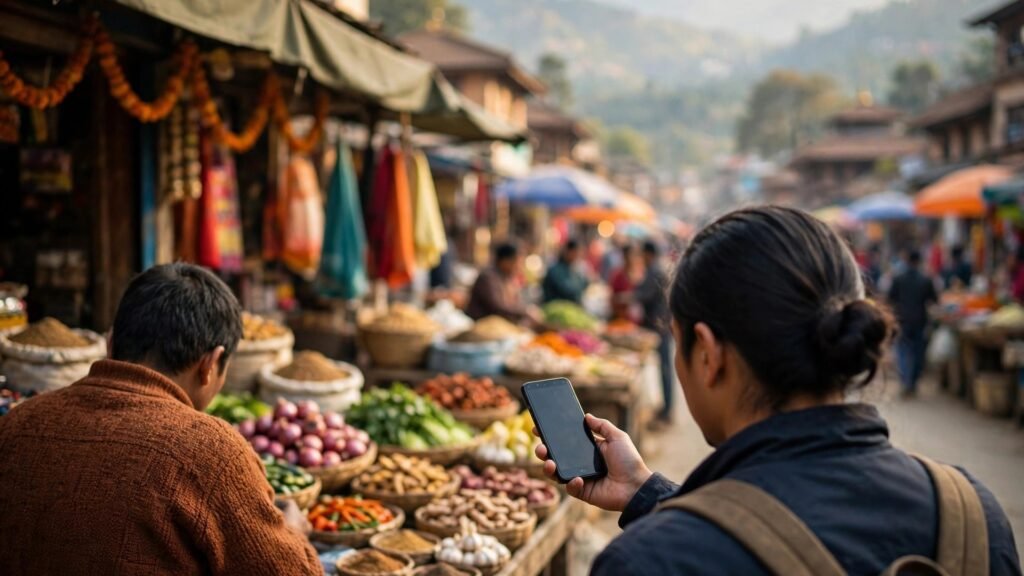
In Nepal, a growing number of everyday payments now happen on a phone screen rather than with banknotes. Electricity bills, water bills, mobile top-ups, internet payments and small transfers between friends are increasingly handled through mobile wallets, and two names come up again and again: eSewa and Khalti. For visitors, the change can be surprising in a country where cash has long been the default. For many Nepalese, though, the switch feels practical rather than dramatic.
The short answer is convenience. A wallet on a phone can do in a minute what once took a journey, a queue and a pocket full of change. But convenience alone does not explain why these two apps, in particular, have become part of daily life. The fuller answer involves Nepal’s geography, its banking habits, its young phone-using population and the kinds of payments people actually make most often.
Key Takeaways
- eSewa and Khalti let people pay bills, top up phones and send money without travelling to a counter or carrying cash.
- Their appeal is strongest for small, repeated payments — the ones people make every week or every month.
- Cash has not disappeared in Nepal, and wallets work best where phones, mobile data and merchants already support them.
What eSewa and Khalti Actually Do
At their simplest, eSewa and Khalti are digital wallets: apps where a user keeps money in an account on their phone and uses it to pay for things. A user adds money to the wallet, often from a bank account, and then spends from that balance. Typical uses include paying utility bills, recharging a mobile phone, paying for internet or television services, buying bus or flight tickets where those options are offered, and sending money to another wallet user.
That range matters. A single app that covers many small chores is more useful than an app that does only one thing. When the same wallet pays the electricity bill on Monday, tops up a phone on Wednesday and sends money to a family member on Friday, it stops being a novelty and becomes a habit. People open it because it is already the place where several of their regular payments live.
Why Cash Was Inconvenient for Everyday Bills
Paying in cash sounds simple, but in practice it often meant planning around counters and opening hours. A bill had to be paid at a particular office or collection point, during working hours, sometimes after travelling some distance. In Kathmandu Valley that might mean traffic and a queue. Outside the main cities, the journey could be much longer, especially in hill areas where the nearest town is not next door.
Cash also brings small frictions that add up: finding exact change, keeping receipts safe, and remembering due dates. A missed bill can mean a late fee or a disconnected service, and sorting that out takes more time. Paying from a phone removes the journey and the queue, and the app usually keeps a record of the payment, which is easier to check later than a paper receipt tucked into a drawer.
When the same wallet pays the electricity bill on Monday, tops up a phone on Wednesday and sends money to a family member on Friday, it stops being a novelty and becomes a habit.
Phones Came First, Wallets Followed
Nepal’s mobile phone use grew faster than traditional banking in many places. Plenty of people who did not have a nearby bank branch, or who rarely visited one, still had a phone in their pocket. That pattern is familiar across South Asia: where phones spread widely, services built for phones tend to spread with them. Readers who follow mobile payments in the region will recognise the same logic in why Indians pay with UPI instead of cards, where a phone-based system fitted how people already lived and shopped.
Mobile wallets also fit Nepal’s remittance economy in a general sense. Many families receive money from relatives working elsewhere, and moving money between people matters a great deal in daily life. A wallet does not replace every kind of transfer, but for small, person-to-person amounts it can be quicker and easier to arrange than meeting in person or travelling to an agent.
Why Two Wallets, Not Just One
Having two well-known wallets, rather than a single dominant one, has shaped how people use them. Some merchants and services accept one wallet more readily than the other, and some users keep both so they are covered either way. Friends and family may also prefer different apps, so keeping both avoids the awkward moment when a transfer cannot go through because the other person uses the other wallet.
Competition has also pushed both apps to keep adding everyday services. Bill payment, top-ups, ticket booking and merchant payments are the battleground, not exotic features. The winner, from a user’s point of view, is not necessarily one app or the other — it is the fact that routine payments keep getting easier to make from a phone.
- Bill payments and mobile top-ups are the most repeated wallet uses in daily life.
- One wallet that covers many chores is more useful than an app that does only one thing.
- Keeping both eSewa and Khalti helps when a merchant, service or contact prefers one over the other.
- Payment records inside the app are easier to check later than scattered paper receipts.
Where Cash Still Wins
None of this means cash has gone away in Nepal. It has not. Small street vendors, local markets, rural shops and many everyday transactions still run on cash, and that is unlikely to change quickly. A wallet needs a charged phone, mobile signal or data, and a merchant or service that accepts it. Where any of those are missing, cash remains the reliable option.
There is also a trust question. Some people, especially older users, prefer to see and hold their money, or they worry about making a mistake on a screen — sending money to the wrong number, for example. Those concerns are reasonable, and they explain why adoption has been gradual rather than overnight. Wallets have grown by proving themselves on small, low-risk payments first: a top-up here, a bill there, a small transfer to a known contact.
A similar pattern appears in neighbouring countries. In Bangladesh, for instance, mobile money grew by fitting basic phones and everyday needs, as explained in how bKash works on a basic phone. The technology differs, but the lesson is the same: people adopt a payment tool when it solves a chore they already have, not because the technology itself is impressive.
What This Means for Visitors and New Users
For someone new to Nepal, the practical point is simple: in cities, expect wallets to be accepted for many bills and services, but always carry cash as well, especially for markets, small shops and travel outside urban areas. For a new wallet user, the sensible way to start is small — one bill or one top-up — and to check the payment confirmation before moving on. Learning the app on a routine payment is far less stressful than learning it during an urgent one.
It also helps to remember that a wallet is only as useful as the services around it. A wallet with no accepted merchants nearby is just an app on a phone. In Nepal’s cities, that network of bills, top-ups and merchants is now wide enough that the wallet earns its place on the home screen. In more remote areas, that network is thinner, and cash rightly keeps its role.
The same everyday logic drives wallet use far beyond Nepal. In the Philippines, for example, why Filipinos pay with GCash instead of cards comes down to a similar mix of convenience, phone-first habits and small daily payments. The apps and the country change; the reason people switch usually does not.
What to Watch Next
eSewa and Khalti became everyday tools in Nepal because they made repeated small payments easier: bills, top-ups and transfers that once needed a journey and a queue can now be done from a phone, with a record to check afterwards. Cash has not disappeared, and in markets, small shops and remote areas it remains essential. The wallets work best where phones, connectivity and accepting merchants are already in place, and they grew by proving themselves on small payments first. What happens next will depend on how far that network of accepted payments spreads beyond the cities, and on whether new users keep finding the apps easy and trustworthy for the chores they already do every week.