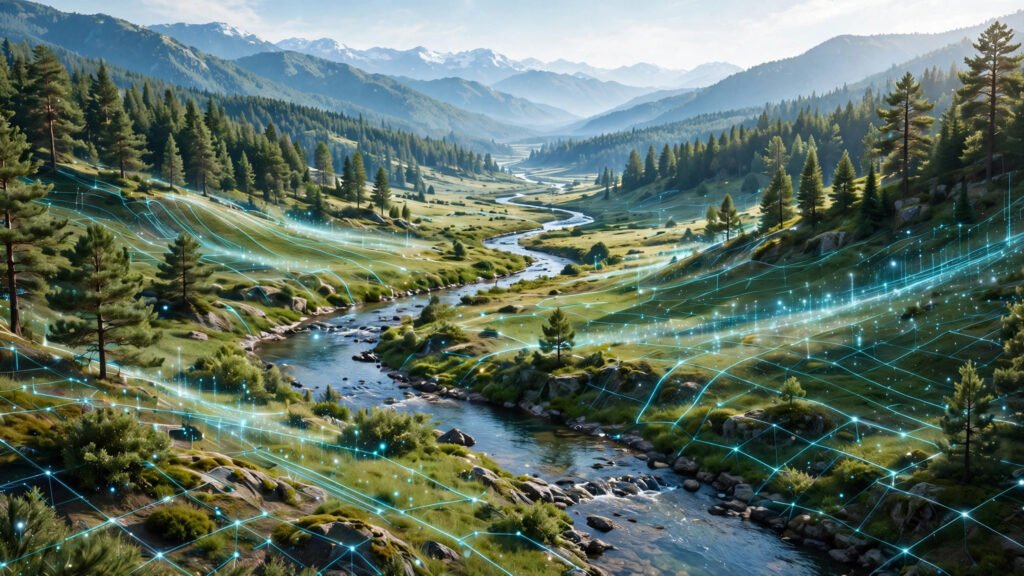
Google DeepMind has unveiled Genie 4, its newest world model, an artificial intelligence system that builds realistic virtual worlds users can walk through, explore and change in real time. Unlike a video generator, which produces a clip to watch, Genie 4 runs a living scene: type a prompt and the weather changes, the camera moves, or a new character appears, while matching sound is generated on the fly.
Genie 4 is the successor to Genie 3, and it arrives as a research preview rather than a finished consumer product. Google describes it as its most photorealistic and interactive simulated world yet, with improved physics, more humanlike characters, and scenes that stay consistent for up to two minutes, twice as long as its predecessor could manage.
Key Takeaways
- Google DeepMind’s Genie 4 is a world model that creates interactive virtual worlds from text or image prompts, with scenes that stay consistent for up to two minutes.
- Users can steer a running world with typed prompts, changing the weather, camera angles, or characters, while the model generates ambient sound, music and dialogue in real time.
- Genie 4 is in research preview for trusted testers, with wider access planned for Google AI Ultra subscribers through Project Genie and for early-access partners via the Gemini API and Google AI Studio.
What Genie 4 Actually Does
A world model is different from the video tools most people know. A video model produces a finished clip; a world model simulates a place that responds as you act. With Genie 4, you can set an event in motion and steer scenes in real time using natural language, like moving the camera, changing the weather, or introducing new characters, and every world also generates native audio on the fly, including ambient sounds, music, and interactive dialogue. That sentence comes from Google’s own announcement, and it captures the core idea: the world keeps running while you redirect it.
The practical effect is a scene that feels closer to a game than a film. A user can start from a text description or an image, enter the world, and keep reshaping it without stopping and regenerating. Characters move more naturally than in the previous version, objects behave under improved physics, and the environment holds together for up to two minutes of continuous simulation, a limit Google itself reports.
With Genie 4, you can set an event in motion and steer scenes in real time using natural language, like moving the camera, changing the weather, or introducing new characters.
Why It Matters Beyond Gaming
Gaming is the most obvious use, but Google and its engineers point further. The same technology could power interactive education, letting a student step into a historical scene and talk with its subjects, or filmmaking, where directors could prototype and storyboard ideas in minutes instead of waiting for lengthy video renders. The robotics angle may matter most in the long run: in a research experiment, a Gemini 4 Argon model broke tasks into steps that Genie 4 then simulated in real time, a setup that could let robots be trained and tested inside virtual environments before they are deployed in the real world.
That link to robotics connects Genie 4 to the wider physical AI push already visible this week, including the return of physical AI investment from warehouse automation firms. Gemini itself is more tightly integrated with Genie 4 than before, acting as a director that plans steps and checks frames while Genie creates the visuals, according to reports of the announcement. Google DeepMind’s research director has described future world models as hybrids, with Gemini writing code and text while Genie simulates reality in real time.
- What it is: Google DeepMind’s newest world model, released in research preview, building interactive virtual worlds from text or image prompts.
- Real-time steering: users change weather, camera angles, characters and objects mid-simulation by typing prompts.
- Native audio: ambient sounds, music and interactive dialogue are generated on the fly to match what happens in the world.
- Consistency: scenes hold together for up to two minutes, double the limit of Genie 3.
- Access: trusted testers now, then Google AI Ultra subscribers through Project Genie and early-access partners via the Gemini API and Google AI Studio.
- Competition: Runway’s GWM Worlds 2 and Alibaba’s Happy Oyster are rival world models, as the field draws major acquisitions.
The Limits Google Acknowledges
For all the ambition, Genie 4 is early technology, and Google’s own team says so. In longer sessions, generated worlds can drift, with objects losing detail or disappearing, and the team is still improving audio synchronisation and the rendering of readable text inside virtual environments. Two minutes of consistency is a step forward, but it is also short for a game, a long training run, or a full film scene.
The competitive race is nevertheless accelerating. The launch comes months after AI video startup Runway released GWM Worlds 2, its second world model with interactive video and audio generation, and Alibaba has announced its own world model. Recent acquisitions, including AMD’s purchase of World Labs and Rivian’s purchase of Third Dimension, show how valuable the underlying technology has become, because the same simulation skills apply to games, robots and self-driving cars. That investment wave is also visible elsewhere in the AI industry, from the record-breaking Anthropic IPO filing to reports that OpenAI plans to buy Google’s AI chips to meet surging demand for computing power.
What to Watch Next
What to watch next is what this article has already set out: whether Genie 4 moves from trusted testers to Google AI Ultra subscribers through Project Genie and to early-access partners via the Gemini API and Google AI Studio in the coming weeks, whether longer simulations overcome the object drift and audio synchronisation limits Google has acknowledged, and whether gaming, education, filmmaking and robotics turn this research preview into working tools rather than demonstrations.