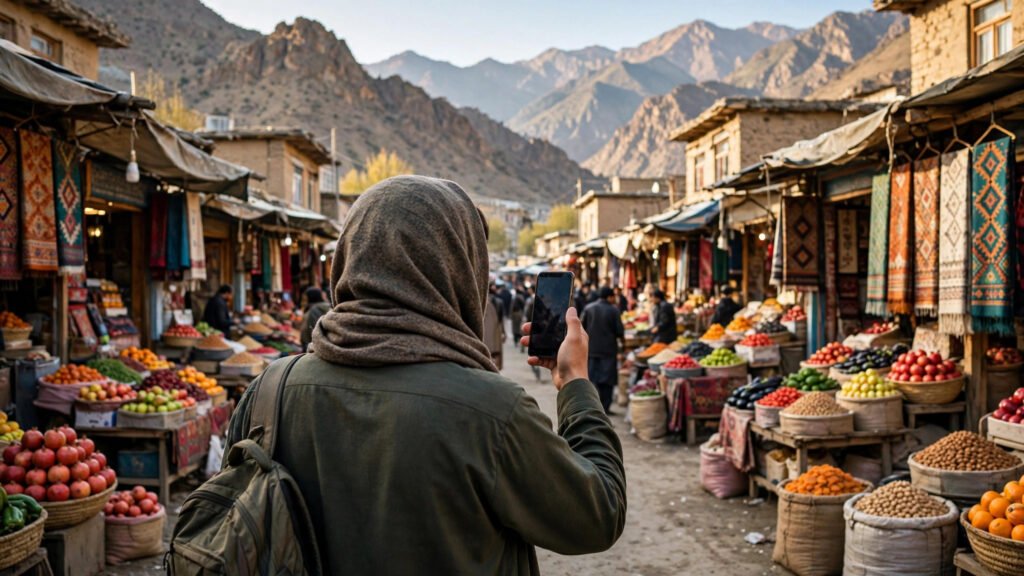
For many Afghans, the most important journey of the day is one they no longer have to make. Money from a relative working far away, news from another province, or a message from family in a different country can now arrive on a phone, instead of waiting for a trip to town. In a country of long distances, mountain roads, and scattered settlements, that change matters more than any single app or feature.
Afghanistan is a large country, and its people are spread across cities, market towns, farming valleys, and remote villages. Bank branches and government offices are concentrated in the bigger towns and cities. For someone living far from those centres, a simple task such as collecting money or checking on an official matter could mean a long journey, a wait, and a journey back. The phone has shortened that distance, not by removing the journey altogether, but by making many everyday tasks possible from home.
The question is not whether Afghans use phones. It is why the phone has become the tool for two things in particular: moving money and staying informed. The answer lies in geography, family life, and the practical limits of the older systems.
Key Takeaways
- Long distances and bank branches concentrated in towns make the phone the practical way for many Afghans to receive money and stay informed.
- Money sent by family working elsewhere can reach a phone wallet or a local agent, instead of requiring a long trip to collect cash.
- The phone also carries news, market information, and family contact, but cash, signal problems, and safety habits still shape how far it can go.
Distance Is the First Problem the Phone Solves
Roads in Afghanistan cross mountains and valleys, and travel can be slow, costly, or disrupted by weather and road conditions. A family in a rural district may be hours from the nearest town with a bank branch. When money is needed for food, medicine, school costs, or a household repair, waiting for a trip to town is not just an inconvenience. It can delay the very thing the money is for.
A phone transfer changes the timing. A relative working in a city, or in another country, can send money through a mobile money service or a transfer service that delivers to a phone. The receiver gets a notification, checks the balance, and can use the money, withdraw it through a local agent or shop, or pass part of it on to another family member. The journey to town is replaced by a message, and the money is available when it is needed rather than when a trip becomes possible.
This pattern is familiar across South Asia. In Pakistan, for example, mobile wallets became the everyday way to pay and send money because branches and card machines never reached everyone. In Nepal, families found a similar answer when money from abroad started arriving straight into a mobile wallet, removing the trip to a cash counter. Afghanistan’s version of the story is shaped by its own distances, but the logic is the same: the phone reaches where the branch does not.
Family Money Travels Further Than People Do
Many Afghan families have members working in different places. Some work in another Afghan city, while others live abroad. Supporting family back home is a normal part of household life, and those transfers often cover everyday needs rather than large one-off purchases. A regular, smaller transfer that arrives reliably matters more than a large sum that is hard to collect.
Phones fit that rhythm. A sender can transfer money when wages arrive, and the receiver can spend it in stages: food this week, a bill next week, a school expense when it falls due. Keeping the money in a wallet or with a trusted local agent, rather than carrying a large amount of cash home from town, also reduces one worry that comes with a long journey. The record on the phone, showing what arrived and when, helps a household keep track without paperwork.
Local agents and small shops play an important part in this system. Not everyone is comfortable using an app alone, and not every transaction can stay fully digital. An agent can help load money, hand over cash, or explain a step face to face. That human help matters in places where people came to digital money through a phone first, rather than through a bank account or a computer. It is the same role agents play in Bangladesh, where local shops became access points for mobile money and helped wallets spread beyond the cities.
The Phone as a Source of News
Money is only half of the story. For many Afghans, the phone is also the main way of hearing news. Radio has long been important in Afghanistan, and the phone has extended that habit: news, announcements, and updates from relatives now travel through calls, messages, voice notes, and social apps. A farmer can hear about road conditions or market prices, a trader can check what buyers are paying in another town, and a family can check on relatives in a different province without waiting for a visitor to bring word.
This matters most when events move quickly. Weather, road closures, and local developments can change plans within hours. A phone message reaches a household the same day, while a newspaper or a trip to town might take much longer. For families separated by distance, that speed is not a luxury. It is how they know whether relatives are safe, whether a journey is worth making, and whether help is on its way.
The phone reaches where the branch does not, and that single difference changed how money and news move across Afghanistan.
Why Basic Phones Still Matter
Not every Afghan owns a smartphone, and the systems that work best are often the ones that work on ordinary phones too. Simple menus, text messages, and voice calls can carry a transfer notification, a balance check, or a short news update without needing the newest device or a fast connection. That matters in areas where incomes are low and where replacing a phone is not a small expense.
Smartphones add more: photos, video calls, and apps that show prices, maps, and documents. But the core uses, receiving money, sending a message, and hearing news, do not depend on an expensive handset. A system built only for the newest phones would leave out the very people who need it most, those living far from towns and services. The strength of phone-based money and news in Afghanistan is that it starts from the phone people already own.
What the Phone Cannot Fix Yet
The phone has not removed every obstacle. A transfer still needs a mobile signal, and signal can be weak or patchy in mountain areas and remote districts. A phone also needs charging, and electricity supply is not reliable everywhere. When the network fails or a battery runs out, the old problems return: a trip to town, a wait, and cash carried home.
Safety is another limit. A lost phone, a shared PIN, or a fake message pretending to be a payment notification can all cause trouble. Receivers should check the balance inside the wallet or service itself rather than trusting a message alone, keep their PIN private, and ask a trusted person for help if something looks unfamiliar. Senders should confirm the receiver’s details before sending, since a mistyped number can send money to the wrong account.
Cash has not disappeared either. Many markets, small shops, and everyday transactions still run on cash, and a phone wallet is most useful when the people around you can also use it. For now, most households keep both: cash for the market stall, and the phone for transfers, bills, and contact with family far away.
- Distance and concentrated bank branches make phone transfers the practical option for many rural households.
- Family money from cities and abroad arrives by phone, and can be spent in stages rather than collected in one trip.
- Local agents and small shops help people use mobile money face to face, not only through an app.
- Phones carry news, market prices, and family contact as well as money, which matters when events move quickly.
- Signal, charging, and safety habits still limit the phone, so cash remains part of daily life.
What to Watch Next
The phone’s role in Afghanistan will likely keep growing along the same lines that built it: reach, simplicity, and everyday usefulness. If mobile money keeps working on ordinary phones, through local agents, and for the small, regular transfers that families depend on, it will remain the practical choice for many households. If signal and charging improve in remote areas, the phone will reach further still, carrying more news and more services to places where a trip to town is still a long undertaking. What is unlikely to change quickly is the basic pattern itself: distance made the phone essential in Afghanistan, and the phone, for money and for news, is now the tool that bridges that distance.