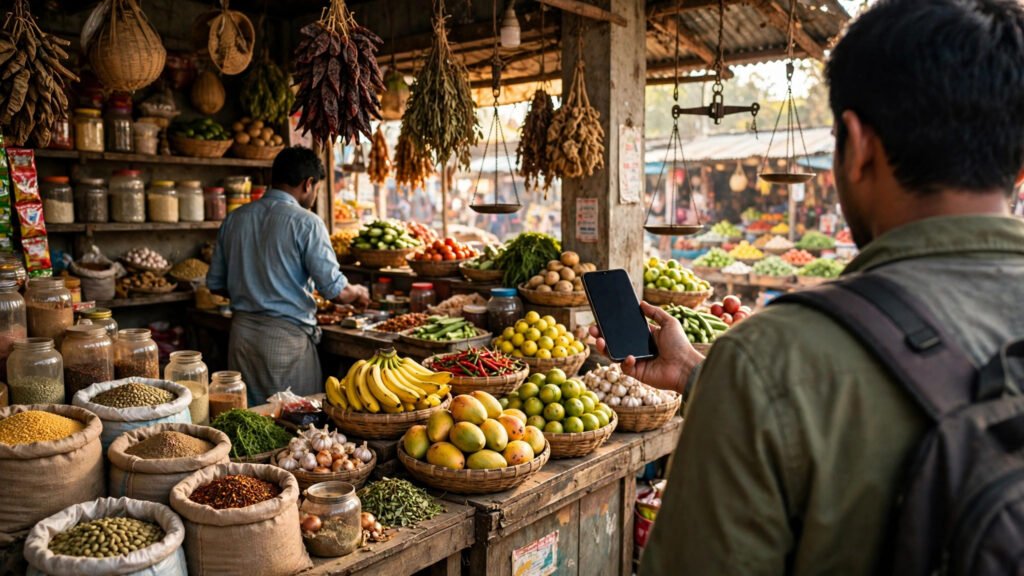
Walk through a busy market in Dhaka, or a small town bazaar anywhere in Bangladesh, and you will notice something quickly: many payments happen on a phone, not with a bank card. A shopkeeper shows a code or a number, a customer taps a few buttons, and the payment is done. For a large share of everyday life in Bangladesh, that phone-based payment has become the normal way to pay.
The two names you hear most often are bKash and Nagad. Both are mobile financial services, which means they let people store money in a mobile wallet, send money to others, pay shops, and handle everyday bills without needing a traditional bank card. The question is why this system took hold so strongly in Bangladesh, when bank cards are the default in many other countries.
The answer is not about one single feature. It is about access, habit, and the way daily life actually works in Bangladesh, from big cities to villages far from a bank branch.
Key Takeaways
- Mobile wallets such as bKash and Nagad fit daily life in Bangladesh because they work on ordinary phones and through local agents, not only through bank branches and cards.
- Bank cards never became the default for most people, because bank branches and card acceptance stayed limited outside major cities.
- Mobile money grew through everyday uses — sending money to family, paying shops, and settling bills — rather than through one single feature.
Bank Cards Were Never the Easy Option for Most People
In many countries, a bank account comes first and a card follows naturally. In Bangladesh, that path was much slower for a large part of the population. Opening and using a bank account often meant travelling to a branch, completing paperwork, and maintaining an account in a system built around offices and opening hours. For people living far from a branch, or working hours that do not match bank hours, that was a real barrier.
Card acceptance added another barrier. A card is only useful if shops accept it. Small shops, market stalls, rickshaw services, and neighbourhood stores across Bangladesh mostly did not have card machines, and many still do not. A payment method that only works in larger stores and shopping malls does not help with the small, frequent payments that fill a normal day.
Mobile wallets solved the acceptance problem from the other side. A shop does not need a machine to receive a mobile payment. A phone number, an agent, or a printed code can be enough. That made it possible for very small businesses to accept digital payments without new equipment.
Agents Brought the Service to the Neighbourhood
One of the most important parts of the Bangladeshi mobile money story is the agent network. Agents are local shops and small businesses that act as human access points for the service. A customer can hand cash to an agent and load it into a wallet, or withdraw cash from a wallet through an agent, without visiting a bank.
This matters because it turns a familiar place — the corner shop — into a place where money can move. People already trust their local shopkeeper, and they already visit that shop for other reasons. Adding money services to that visit is far easier than asking someone to make a separate trip to a bank.
Agents also help people who are less comfortable with technology. A new user can ask questions in person, get help with a transaction, and learn the steps face to face. That human help has mattered a great deal in a country where many people came to digital payments for the first time through a phone rather than through a computer or a bank.
A shop does not need a machine to receive a mobile payment, and that single difference changed who could accept digital money in Bangladesh.
It Works on the Phones People Already Own
Another reason mobile wallets spread so fast is that they did not demand an expensive new phone. Mobile financial services in Bangladesh were designed to work through simple menus on basic phones as well as through apps on smartphones. That meant a person did not need the newest device, a card reader, or a bank account to start.
This is a pattern seen in other countries too, where mobile money filled gaps left by traditional banking. In Myanmar, for example, services such as Wave Money and KBZPay became popular for similar reasons, letting people move money by phone instead of relying on bank cards, as explained in why people in Myanmar pay with Wave Money and KBZPay. In India, the UPI system likewise made phone-based payments normal for everyday spending, as covered in why Indians pay with UPI instead of cards.
In Bangladesh, the phone-first design also fits how people communicate. Mobile phones are already central to work, family contact, and business. Adding payments to the same device felt natural, especially when the alternative was carrying cash or travelling to a branch.
Family Money Moves Faster by Phone
Sending money to family is one of the most important everyday uses of mobile money in Bangladesh. Many people work in a city while their family lives elsewhere, and regular support from one place to another is a normal part of household life. Before mobile wallets, sending that money could mean a trip, a wait, or help from an intermediary.
A mobile wallet makes that transfer immediate in practical terms: the sender loads or holds money in the wallet, sends it to a family member’s number, and the recipient can use it or cash it out through a nearby agent. That speed and simplicity is hard for a card-based system to match, especially where the recipient may not have a bank account at all.
The same logic applies to small business payments. A customer paying a tailor, a food seller, or a repair worker can send money directly, without either side needing a card machine. Over time, those small transfers add up into a habit, and the habit becomes the standard.
Everyday Bills and Small Payments Sealed the Habit
Mobile wallets in Bangladesh are not only for sending money to other people. They are also used for the routine payments of daily life: mobile top-ups, utility bills, school-related payments, and purchases from shops that accept wallet payments. Each of these uses gives people one more reason to keep money in the wallet rather than in cash alone.
That range of uses is important. A payment method that only works for one thing is easy to abandon. A method that handles family transfers, shopping, and bills becomes part of a routine, and routines are what keep a system alive long after the novelty wears off.
- Mobile wallets work through local agents, so cash can go in and out without a bank branch visit.
- They run on basic phones as well as smartphones, so expensive devices are not required.
- Shops can accept payments without card machines, which opened digital payments to small businesses.
- Family transfers, shop payments, and bill payments together turned a new tool into a daily habit.
- Bank cards remain useful for some people, but they never matched mobile wallets for everyday reach in Bangladesh.
Why Cash and Cards Still Have a Place
None of this means cash has disappeared in Bangladesh, or that bank cards are useless. Cash is still widely used, especially in markets and for very small amounts. Cards are still used by people who have them, particularly for larger purchases and in places that accept them. Mobile wallets did not replace everything at once.
What changed is the default. For a large part of the population, the first question is no longer whether a shop takes cards, but whether it accepts a mobile wallet payment. That shift happened because wallets fitted the existing economy — small shops, agent networks, family transfers, and phones people already owned — better than a card system built around branches and machines.
The experience in other countries shows the same lesson in different forms. In Indonesia, for example, phones themselves are often bought in instalments because the device is the gateway to work and services, as described in why Indonesians buy phones in instalments. Wherever the phone becomes the main tool for daily life, payment tends to follow the phone.
What to Watch Next
The future of payments in Bangladesh will likely be shaped by the same forces that built the current system: reach, simplicity, and everyday usefulness. If wallets keep working on ordinary phones, through local agents, and for the small payments that fill daily life, they will remain the default for many people. Cash will still matter in markets and small transactions, and cards will still matter for those who have them and for places that accept them. What is unlikely to change quickly is the basic pattern itself: in Bangladesh, the phone became the wallet because it was the tool that reached furthest, and that reach is what turned bKash and Nagad into everyday names.