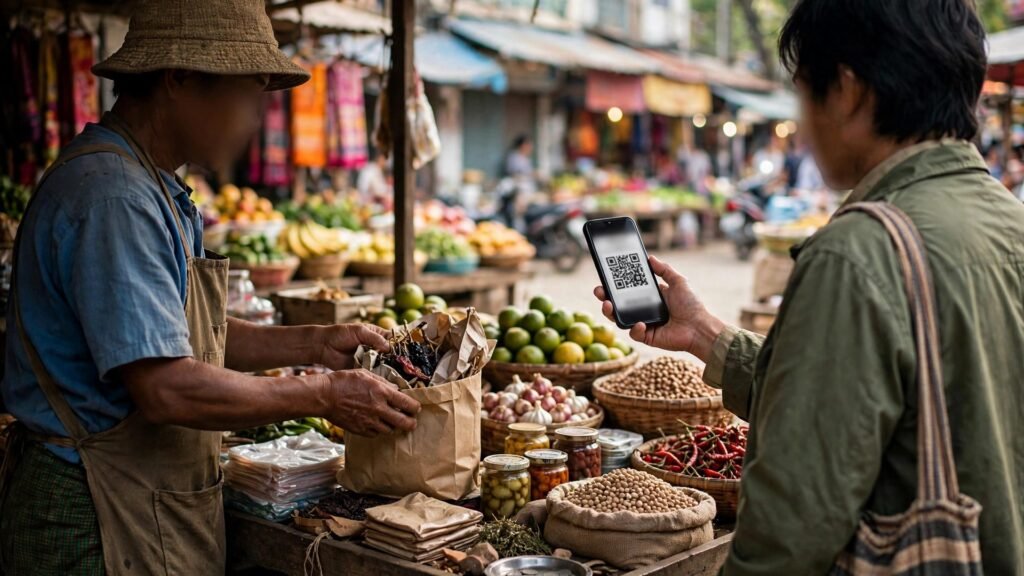
In a busy market in Myanmar, the payment often happens before the change is even counted. A shopper holds up a phone, scans a printed QR code on the counter, and the shopkeeper nods. No card machine beeps, no bank card changes hands, and no one waits for a receipt to print. For many people in Myanmar, this is simply how paying works now — through mobile wallets such as Wave Money and KBZPay, rather than through a bank card.
Visitors sometimes find this surprising. Myanmar has banks, ATMs and cards, so why would a phone wallet come first? The answer is practical, not technical. A wallet fits the way most people already live and trade: phones are widespread, bank branches are not always nearby, and small daily payments — for food, transport, phone credit and market goods — need something fast, simple and accepted by the person on the other side of the counter. Wave Money and KBZPay were built for exactly that kind of everyday payment.
Key Takeaways
- In Myanmar, Wave Money and KBZPay let people pay, send money and top up phones without needing a bank card.
- Agent shops and QR codes bring wallet payments into markets, villages and small towns where card machines are rare.
- Bank cards still exist, but for many daily purchases the wallet is simply faster, easier and more widely accepted.
Why the Wallet Came Before the Card
In many countries, cards arrived first and wallets followed. In Myanmar, the order was different for a large part of the population. Mobile phones spread quickly, while formal banking reached people more slowly — especially outside the big cities. Opening and maintaining a bank account, keeping a card, and finding an ATM or a shop with a card terminal all take effort, and for someone who earns and spends in small amounts each day, that effort does not always pay off.
A mobile wallet lowers that barrier. A person with a phone and a mobile number can usually register, add money through an agent or a linked account, and start paying. There is no plastic card to carry, no terminal to install, and no need to visit a branch for an ordinary purchase. For a market trader, the wallet is also easier to accept: a printed QR code on the stall costs far less than a card machine and works with the phone the trader already owns.
This pattern is not unique to Myanmar. In Tanzania, people also pay with mobile money instead of bank cards for similar reasons — the phone reaches further than the branch network. Myanmar’s version of that story has its own names and habits, but the underlying logic is the same: the payment method that reaches the most people wins the daily purchase.
What Wave Money and KBZPay Actually Do
Wave Money and KBZPay are best understood as everyday money tools, not as banks in an app. At their core, they let a user store money on the phone, send it to another person, pay a shop, buy mobile top-up and settle small bills. The phone number often acts as the address: to send money, you send it to someone’s number, and they receive it in their wallet.
For shoppers, the most visible feature is the QR payment. A shop displays a code, the customer scans it, types the amount, and confirms. The shopkeeper sees the payment arrive and hands over the goods. For people sending money to family in another town, the wallet removes a journey: money that once had to be carried or collected in person can now move between phones, with the receiver cashing out at a nearby agent if cash is needed.
Agents are a big part of why this works. These are ordinary shops — phone shops, grocery stores, small kiosks — that act as human cash points for the wallet network. A customer can hand cash to an agent and see it appear in the wallet, or withdraw wallet money as cash. In places where bank branches are few and far between, the agent network is the branch network, spread across neighbourhoods and towns in a way no single bank could match quickly.
Why Cards Struggle With the Daily Purchase
Bank cards are not absent from Myanmar, and they work well for certain kinds of spending — larger purchases, formal salaries, and transactions at bigger stores that have terminals. The difficulty is with the small, frequent purchase that makes up most of daily life: a bowl of noodles, a bus fare, vegetables from a market stall, or a top-up for the phone itself.
For those purchases, a card has friction at both ends. The buyer must have the card and remember its PIN, and the seller must have a working terminal, a connection and the willingness to pay terminal costs. A wallet payment avoids most of that. The buyer already carries a phone, the seller already displays a code, and the payment clears between two phones in moments. When a payment method is that much simpler for a five-minute errand, people use it without thinking about it.
Trust plays a role too. People tend to use the payment method their neighbours, family and regular shopkeepers already use. Once a market full of stalls accepts wallet QR codes, a new shopper learns the habit from the stall next door, not from an advertisement. In Thailand, a similar network effect helped phone payments through PromptPay, as people pay with their phones through PromptPay because the people around them do. Myanmar’s wallets grew the same way — stall by stall, town by town.
Cash Is Still Part of the Picture
None of this means cash has disappeared in Myanmar. Cash remains common, especially in rural areas, for older shoppers, and for transactions where either side prefers notes and coins. The wallet has not replaced cash so much as joined it: many people move between cash and wallet during the same day, paying by phone at a shop with a QR code and by cash at a stall without one, and keeping some money in the wallet for sending to family.
That flexibility is part of the appeal. A wallet does not demand that a person give up cash entirely. It simply offers a second way to pay that works when cash is inconvenient — when change is short, when the amount is small, when the receiver is far away, or when a bill needs paying without a trip. For people who split their money between household spending, small business and family support, having both options matters more than having one perfect one.
There are limits to be honest about. A wallet payment needs a charged phone and a mobile signal, and not every corner of the country has reliable coverage at all times. Some people are still more comfortable with cash, and learning a new app takes confidence, especially for first-time users. The wallet’s success comes not from removing every limit, but from being useful enough, often enough, that people keep choosing it.
- Wave Money and KBZPay turn a phone number into a payment address — no card or terminal needed.
- Agent shops let people add and withdraw cash close to home, filling the gap left by few bank branches.
- QR codes make wallet payments cheap for small traders to accept, from market stalls to corner shops.
- Cash still matters in Myanmar — the wallet succeeds alongside cash, not by replacing it overnight.
Why This Matters Beyond Myanmar
Myanmar’s wallet story is a reminder that payment habits follow everyday life, not the other way around. The winning payment method is rarely the most advanced one on paper. It is the one that works at the market stall, on a slow connection, with the phone a person already owns, and among the shopkeepers a person already trusts. In Kenya, that same practicality explains why so many Kenyans pay with phones — the phone was simply the tool that reached everyone first.
The winning payment method is rarely the most advanced one on paper. It is the one that works at the market stall, with the phone a person already owns.
For visitors and businesses dealing with Myanmar, the lesson is straightforward: expect the phone at the till. A shop that accepts wallet QR payments is not offering a novelty; it is offering the normal way many customers prefer to pay. And for people in Myanmar, the wallet is less a piece of financial technology than a daily convenience — a way to pay the stallholder, support family elsewhere, and get through the day without a trip to the bank.
What to Watch Next
What happens next will depend on the same practical forces described above: whether agent networks keep reaching smaller towns, whether more shops display QR codes, and whether wallet payments stay simple as new features are added. If coverage and confidence keep growing, wallets are likely to handle an even larger share of everyday spending, while cash keeps its place for the purchases and people it still serves best. The card is unlikely to disappear, but in Myanmar’s daily markets and neighbourhood shops, the phone — not the card — is already the payment habit to watch.