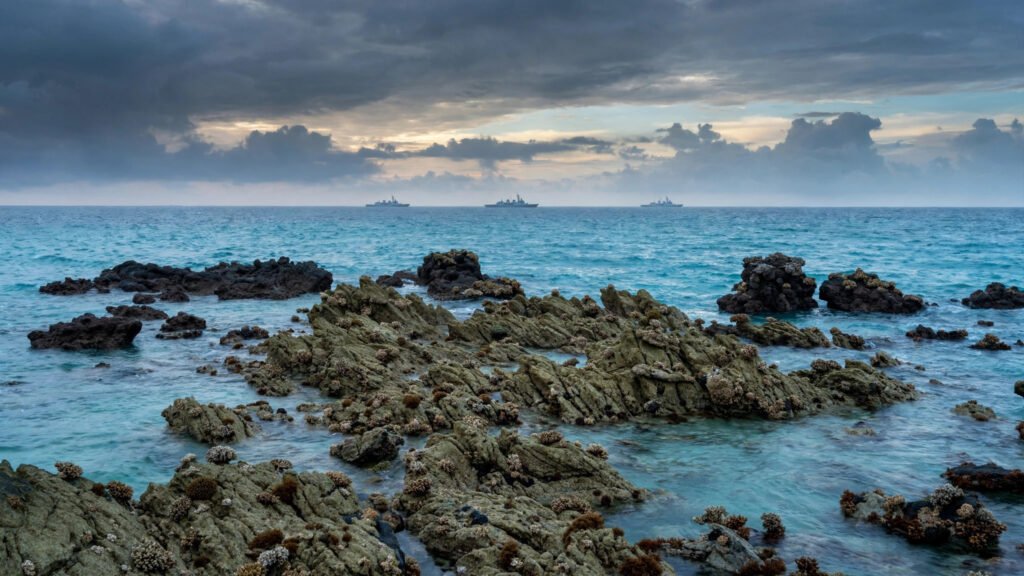
China’s military said on Friday, October 30, that its naval and air forces had conducted combat readiness patrols around Scarborough Shoal, a disputed feature in the South China Sea that has long been a flashpoint in tensions between Beijing and Manila.
The People’s Liberation Army Southern Theater Command said the patrols were a necessary countermeasure in response to what it called the Philippines’ rights-violation and provocative acts, and said it had strengthened such patrols during October. The statement did not give details of which Philippine actions it was referring to.
Key Takeaways
- China’s naval and air forces conducted combat readiness patrols around Scarborough Shoal on October 30, according to the PLA Southern Theater Command.
- Beijing described the patrols as a necessary countermeasure to what it called Philippine rights-violation and provocative acts, without giving details.
- The China Coast Guard also carried out law-enforcement patrols in the waters around the shoal on the same day, using the same description.
What China said about the patrols
According to the Southern Theater Command statement, the patrols were aimed at further enhancing control and management over the relevant waters and airspace, and at serving as an effective countermeasure to cope with what it described as rights-violation and provocative acts. The command said it had stepped up such patrols this month, signalling that the October 30 operation was part of a wider pattern rather than a one-off deployment.
Separately, the China Coast Guard said it had conducted law-enforcement patrols in the waters around the shoal on Friday, calling the activities a necessary countermeasure in response to the Philippines’ rights-violation and provocative acts. As with the military statement, the coast guard did not specify which actions it was answering.
Scarborough Shoal has long been a flashpoint in tensions between Beijing and Manila in the South China Sea. The shoal sits in waters claimed by both sides, and encounters there have repeatedly drawn in coast guard vessels, fishing boats and diplomatic protests over the years.
Scarborough Shoal has long been a flashpoint in tensions between Beijing and Manila in the South China Sea.
Why the shoal matters in the wider dispute
China claims sovereignty over almost the entire South China Sea through a nine-dash line on its maps, a claim that cuts into parts of the exclusive economic zones of Malaysia, Vietnam, the Philippines, Brunei and Indonesia. The Philippines, for its part, maintains its own claims in the area, and Scarborough Shoal has become one of the most closely watched symbols of that overlapping dispute.
That geography is why a patrol announcement matters beyond a single day’s sailing. Control and management of the waters and airspace around a disputed feature is itself contested, and both sides treat presence in the area as evidence supporting their position. When patrols are described in public statements as countermeasures, they also function as messages to the other claimant, to regional neighbours and to outside powers watching the sea lanes.
The timing added to the sensitivity. Tensions between China and the Philippines resurfaced at the close of a two-day Association of Southeast Asian Nations defence gathering on Thursday, with Beijing accusing an unnamed Philippine politician of obstructing its participation in the event. The patrol announcement followed a day later, against that already strained backdrop.
What Manila has said so far
The Philippine embassy in Beijing and the Philippine military did not immediately respond to requests for comment on the patrols, according to the reports of the announcement. That silence leaves the immediate Philippine reaction unclear, and it means the fullest public account of the operation so far comes from the Chinese statements themselves.
The lack of detail in those statements also matters. Because neither the military nor the coast guard specified which Philippine actions prompted the patrols, analysts and neighbours are left to read the move in the context of the recent ASEAN defence meeting and the longer pattern of encounters around the shoal, rather than against a single named incident.
Beijing’s broader diplomatic calendar this week underlined how much China is balancing competition with engagement. In separate talks, China and Germany discussed a new chapter in their relationship in Beijing, while at home the Communist Party has been reshaping its top ranks, as covered in our report on the party plenum and its leadership changes.
- Naval and air forces conducted combat readiness patrols around Scarborough Shoal on October 30
- PLA Southern Theater Command said patrols had been strengthened during October
- China Coast Guard carried out separate law-enforcement patrols in the same waters on Friday
- China’s nine-dash line claim overlaps the exclusive economic zones of five Southeast Asian states
- Philippine embassy in Beijing and Philippine military did not immediately respond to requests for comment
The regional stakes
For Southeast Asia’s other claimants, the episode is a reminder of how quickly a bilateral dispute can become a regional one. Malaysia, Vietnam, Brunei and Indonesia all have stakes in how the South China Sea’s rules are interpreted, even when a particular incident involves only China and the Philippines. Shipping through the sea is also a shared interest: the waterway carries a large share of global trade, and any rise in military activity there is watched closely by trading nations far beyond the region.
Maritime incidents elsewhere have shown how fast such tensions can affect shipping and energy routes, as seen in the recent tanker incident reported in the Strait of Hormuz. The South China Sea carries its own version of that risk, where a patrol, a coast guard encounter or a fishing dispute can escalate into a diplomatic standoff.
For now, the October 30 patrols stand as a public assertion of China’s position around Scarborough Shoal, framed by Beijing as a response to Philippine actions and presented as part of an intensified patrol effort through October. How Manila responds, and whether further patrols follow, will determine whether this remains a single announcement or becomes a longer phase of heightened activity around the shoal.
What to Watch Next
Watch for any Philippine response to the patrols, for further Chinese patrol announcements around the shoal, and for whether the dispute surfaces again at upcoming ASEAN meetings. The key questions are whether patrol activity stays at its stepped-up October level, whether either side names a specific incident behind the latest operation, and whether other South China Sea claimants weigh in on the rules governing the waters around Scarborough Shoal.