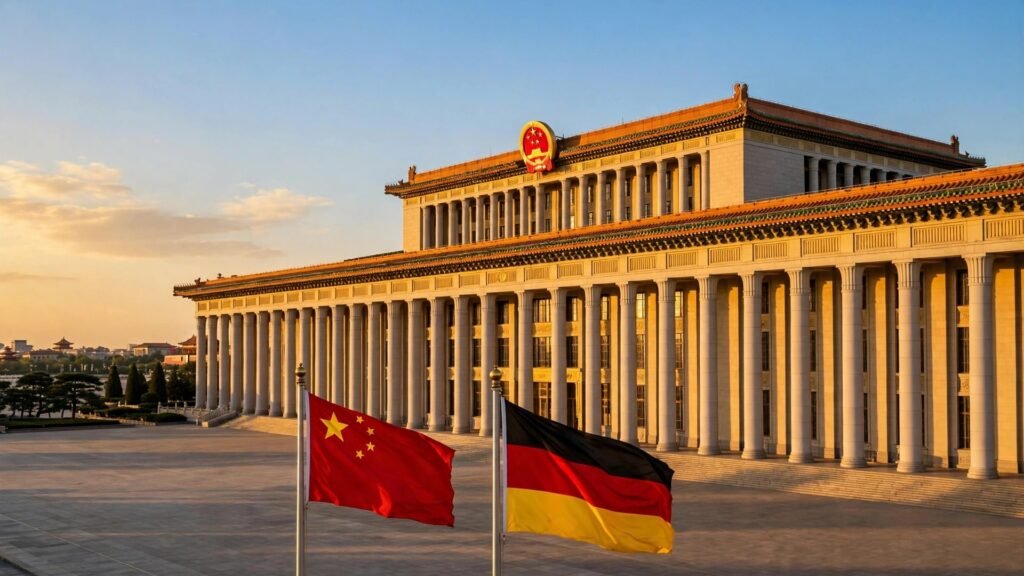
Chinese President Xi Jinping held talks with German President Frank-Walter Steinmeier in Beijing on Friday, October 30, 2026, hailing relations between the two countries as opening a new chapter. The meeting came during Steinmeier’s five-day state visit to China, which runs until October 31 and is the first by a German president in nearly eight years.
Xi told Steinmeier that it was incumbent upon China and Germany to take the lead and forge a new model of cooperation based on equality, mutual benefit and strategic stability. He also said China hopes Germany will adhere to a rational, pragmatic and friendly China policy, and that the European Union can work with China in the same direction. According to reports of the talks, Xi said China has always viewed the EU as a partner and has developed ties with the bloc in a spirit of sincerity and goodwill, adding that cooperation outweighs competition and consensus outweighs differences in China-EU relations.
Key Takeaways
- Xi Jinping and Frank-Walter Steinmeier met in Beijing on October 30, 2026, during Steinmeier’s five-day state visit to China.
- Xi described China-Germany relations as opening a new chapter and called for cooperation based on equality, mutual benefit and strategic stability.
- Steinmeier stressed that the world needs China to help preserve the international order, a day after warning against one-sided trade dependence in a Beijing speech.
A meeting framed around stability
Steinmeier, in his opening remarks at the meeting, told Xi that the world needed China to play its part in preserving the international order, referring to the rules-based global governance system based on the UN Charter. Xi, in turn, called on both countries to help forge a more equitable and stable system of global governance. Xi also held a welcome ceremony for Steinmeier at the Great Hall of the People in Beijing on Friday afternoon, after Steinmeier arrived in China on Tuesday at Xi’s invitation.
The talks took place against a backdrop of trade friction between Europe and China. A day earlier, on October 29, Steinmeier used a speech at Peking University to argue that China’s pursuit of economic self-sufficiency should not leave other countries dependent on Chinese suppliers or exposed to unequal market access. He said Europe was determined to keep its industrial base, and that he was confident Brussels and Beijing would be able to find solutions through dialogue.
We do not want a new bloc confrontation. That would not only be dangerous for international security, but would also be an economic loss for everyone.
That warning was a diplomatic message, not a new tariff decision, and no new trade agreement was reported from Friday’s talks. Steinmeier’s role as head of state gives him a platform for diplomatic engagement, while substantive trade negotiations remain with the German government and EU institutions. During the visit, Steinmeier was also expected to hold talks with China’s top leadership beyond Xi, including Premier Li Qiang and Zhao Leji, the country’s foremost legislator.
Why the visit matters for Europe and China
China and Germany are two of the world’s leading industrial economies, and their relationship shapes much of Europe’s economic debate. Analysis published ahead of the visit noted that German imports from China expanded 8.8 per cent in 2025 to 170.6 billion euros, a figure that underlines how deeply the two economies are intertwined even as competition and trade tensions intensify. Talks during the trip were expected to centre on joint efforts to resolve challenges around competition, market access and supply chains.
The Beijing meeting also fits a wider week of diplomacy. Leaders elsewhere have been using direct talks to manage conflicts and alliances, from Erdogan telling Trump that Turkiye is ready to revive Ukraine-Russia talks to Singapore’s foreign minister visiting Islamabad for anniversary talks and a disaster pact. In that context, the Xi-Steinmeier meeting stands out as an attempt to steady one of the world’s most consequential bilateral relationships through dialogue rather than confrontation.
- Five-day state visit: Steinmeier is in China from October 27 to October 31, his first state visit to the country in nearly eight years.
- Xi’s message: a new chapter for Beijing-Berlin ties, built on equality, mutual benefit and strategic stability.
- Steinmeier’s message: China should help preserve the international order, without creating one-sided dependence.
- No deal announced: Friday’s talks produced no reported new trade agreement.
What to Watch Next
What happens next will depend on whether Friday’s language turns into practical steps. Observers will watch for any follow-up from Steinmeier’s remaining meetings in China, for signals from Berlin and Brussels on trade and market access, and for whether Beijing and Berlin can find solutions through dialogue on the competition and supply-chain questions raised during the visit. For now, both presidents have publicly committed to the same broad idea: that China and Germany should work together to keep the international order stable, rather than drift toward a new bloc confrontation.