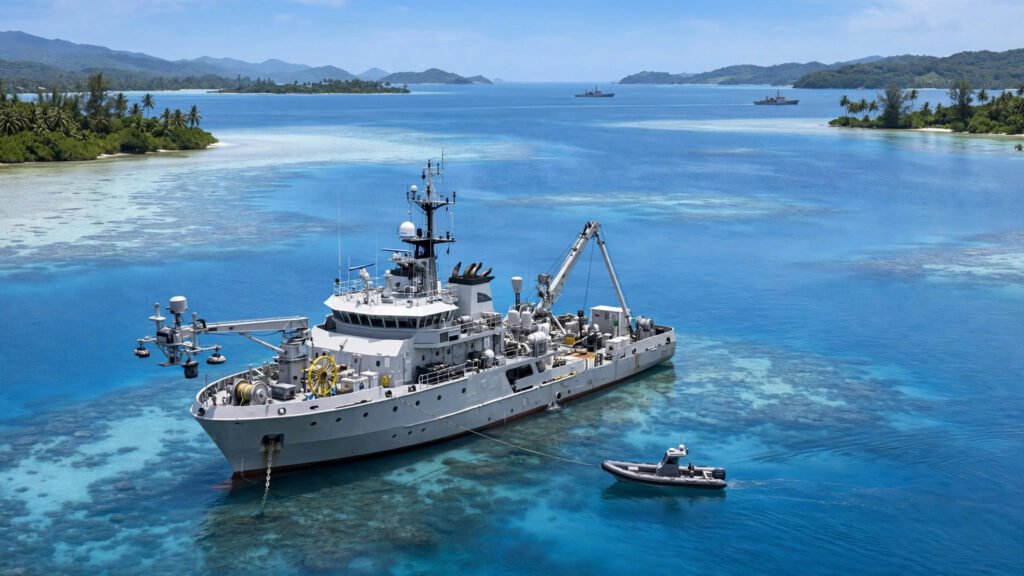
A Chinese research support vessel spotted inside the lagoon of Bajo de Masinloc, known internationally as Scarborough Shoal, has stirred fresh security concerns in the Philippines, after the Philippine Coast Guard said it was investigating unidentified equipment seen aboard the ship. The warning, reported on November 1, 2026, centres on a simple but unresolved question: what the equipment is for, and whether scientific research is being used to conceal activity with a military purpose.
According to the Philippine Coast Guard, the blue-and-white vessel was first monitored on October 3 and had changed its configuration several times since then. During a maritime domain awareness flight on Thursday, October 29, Philippine personnel observed the vessel towing a smaller boat and carrying an orange, boat-shaped object fitted with sensors and antennas on its rear deck. The Coast Guard said it was trying to establish the capability and purpose of the equipment, including whether it could be used for underwater operations.
Key Takeaways
- The Philippine Coast Guard is investigating unidentified sensor-fitted equipment aboard a Chinese vessel inside the Scarborough Shoal lagoon.
- The vessel was first monitored on October 3 and was seen towing a smaller boat on October 29.
- China has meanwhile announced stepped-up naval and air patrols around the shoal, while Manila insists the research activity was unsanctioned.
What the Coast Guard found
Rear Admiral Jay Tarriela, the Coast Guard spokesperson for the West Philippine Sea, said the service was tracking what the watercraft could do. The Philippine Coast Guard has said any Chinese research vessel operation in the West Philippine Sea is illegal, citing confirmation from the Department of Foreign Affairs that the activities were unsanctioned by the Philippine government. A Bureau of Fisheries and Aquatic Resources aircraft accompanied the Philippine contingent during the October 29 flight, which issued radio challenges to Chinese vessels in the vicinity of the shoal.
Philippine personnel also reported other Chinese vessels in the area during recent patrols. In a separate account of an October 27 fuel mission to Filipino fishermen at the shoal, the Coast Guard said three China Coast Guard ships, five maritime militia vessels and a People’s Liberation Army Navy warship were spotted nearby, with the warship about 15 nautical miles from Zambales. That mission, the Coast Guard said, was completed without any untoward incident.
The warning centres on a simple but unresolved question: what the equipment is for, and whether scientific research is being used to conceal activity with a military purpose.
Why the warning matters
Jose Antonio Goitia, chairman emeritus of the Filipinos Do Not Yield Movement, warned that Beijing should not be allowed to use claims of scientific research to conceal potentially military activities. He stressed the Philippines’ right to protect its maritime interests and to demand transparency from foreign vessels operating in its maritime domain.
Goitia also raised concern about reports that Chinese maritime platforms described as ghost research ships could be used to deploy underwater drones to map submarine transit routes and collect information with potential military applications, including anti-submarine warfare. Available information, however, does not establish that the vessel spotted inside the shoal’s lagoon carried out such activities, and the Coast Guard has not determined what the orange object does or whether the ship deployed autonomous underwater vehicles.
The distinction matters. A research vessel, a support vessel and a survey platform can look similar from the air, but their legal standing and their risk depend on what they actually do, where they do it, and whether the coastal state consented. Goitia cited Article 246 of the United Nations Convention on the Law of the Sea, which generally requires a coastal state’s consent for marine scientific research in its exclusive economic zone and continental shelf.
- First monitored: October 3, with several configuration changes since then
- Key sighting: October 29 flight spotted the vessel towing a smaller boat
- Equipment in question: an orange, sensor-fitted, boat-shaped object on the rear deck
- Manila’s position: the research activity was unsanctioned
- What is not yet known: the equipment’s exact purpose or capability
China’s patrols around the shoal
The sighting coincided with an announcement by the People’s Liberation Army Southern Theater Command on Friday that Chinese naval and air forces had conducted combat-readiness patrols in the waters and airspace around Huangyan Dao, Beijing’s name for Bajo de Masinloc. The command said it had strengthened patrols around the shoal since early October to tighten control over surrounding waters and airspace, describing the operations as a response to what it called Philippine rights violations and provocative acts.
The China Coast Guard separately said it conducted law enforcement patrols around the shoal on Friday, also citing alleged Philippine provocations. Footage aired by Chinese state broadcaster CCTV-7’s military programme on October 30 showed military aircraft and a naval vessel operating around the shoal, including scenes depicting Chinese forces monitoring a Philippine aircraft and issuing radio warnings. The broadcast did not independently establish when the encounters occurred or verify Beijing’s claim that the Philippine aircraft had entered Chinese territorial airspace.
Neither side’s account closes the loop. The Philippines has not published what the orange object aboard the Chinese vessel does, and Beijing has not said which Philippine actions its patrols were answering. The Coast Guard has said it is still examining the equipment.
A long-disputed shoal
Bajo de Masinloc, also known as Scarborough Shoal, lies about 124 nautical miles off Masinloc in Zambales, inside the Philippines’ 200-nautical-mile exclusive economic zone. The Philippines rejects Beijing’s claim that the shoal is China’s inherent territory, and the 2016 arbitral ruling found that China had unlawfully prevented Filipino fishermen from working the shoal. Control of the shoal, access for fishermen, and the presence of coast guard and naval vessels there have remained a recurring source of friction, even in periods when encounters end without incident.
The latest episode fits a wider pattern of maritime security incidents in contested waters, where an ambiguous vessel or an unexplained object can raise tensions faster than either side’s stated intentions. It also comes amid broader friction between Beijing and Western governments, including China’s rejection of US criticism over its overseas institutions and activities.
What to Watch Next
What to watch next is what the Philippine Coast Guard’s examination concludes about the equipment aboard the Chinese vessel, whether Manila publishes further details about its capability or purpose, and whether patrols around the shoal by either side intensify or ease in the days ahead. The central question remains unresolved: the equipment has been photographed and described, but its function has not yet been established, and the competing claims over the shoal itself remain unchanged.