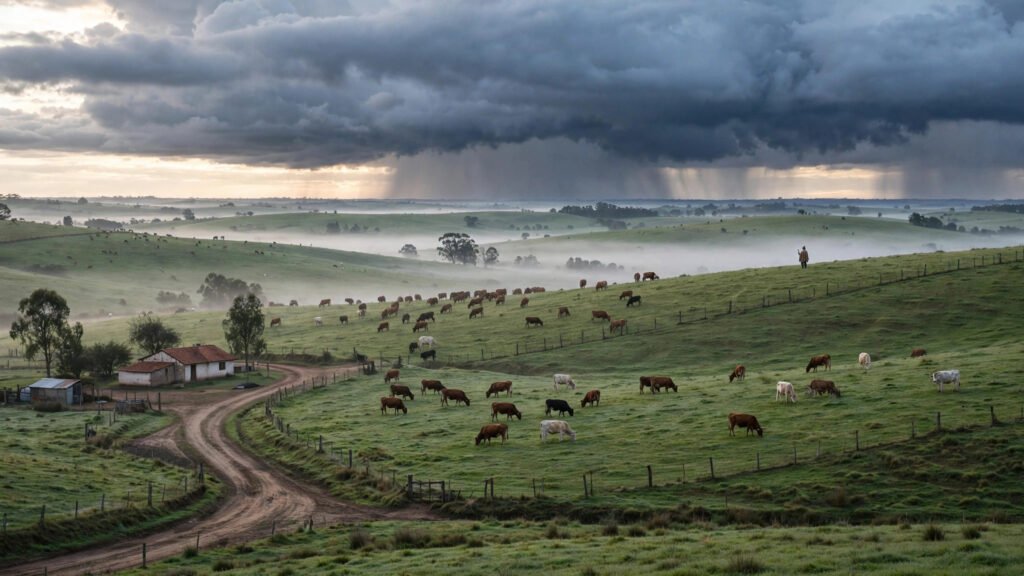
In Uruguay, farming is not a job that waits for the weather to arrive. It is a job that tries to read the weather before it arrives. That is why, for many farmers and rural workers, the first tool of the day is not a tractor key or a pair of boots. It is a phone, opened to check the rain forecast before any work begins.
A rain forecast can change almost every decision on a farm. It can decide whether cattle are moved, whether a field is worked, whether hay is cut, and whether a trip down a rural dirt road is worth making at all. When rain is coming, timing matters. When rain is not coming, planning matters just as much. A phone puts that information in a farmer’s pocket, field by field, hour by hour.
Key Takeaways
- Rain forecasts help Uruguayan farmers decide when to move cattle, work fields, and travel rural roads.
- Phones are useful because they show local, hour-by-hour forecasts rather than one general outlook for the whole country.
- A wrong guess about rain can waste a day of work, so checking first has become a daily habit, not a luxury.
Why Rain Decides the Day on a Uruguayan Farm
Uruguay’s countryside is shaped by open pasture, grazing cattle, and crops grown across wide, flat land. Grass, soil, and animals all respond to rain, and they respond quickly. Wet ground can turn soft and difficult to work. A dry stretch can slow pasture growth and leave less feed for animals. Heavy rain can make rural roads muddy and slow, especially roads that are not paved.
That is why a forecast is not just background information for a farmer. It is a working tool. If rain is expected in the afternoon, morning work may be moved earlier. If a dry window is coming, it may be the right moment to cut, move, or repair. If storms are expected, animals may be brought closer to shelter and outdoor work may be paused. Each choice saves time, effort, and sometimes a wasted journey.
What Farmers Actually Check on Their Phones
Most farmers are not looking for a single word like “rain” or “sun.” They are looking for detail. When will the rain start? How long will it last? Will it be light rain or a heavy downpour? Will wind come with it? A forecast that answers those questions is far more useful than a forecast that only gives a daily symbol.
Phones also allow farmers to check the forecast for their own area, not just for Montevideo or for Uruguay as a whole. Weather can be very different from one department to another, and even from one valley to the next. A local forecast helps a farmer judge what is likely on their own fields, rather than guessing from conditions many kilometres away.
Alerts matter too. In other parts of the world, people check their phones for weather and road alerts before mountain travel, for cyclone warnings, and for typhoon alerts before storms. The idea is the same in Uruguay: a phone warning can arrive faster than waiting for the next radio bulletin or television forecast.
From Forecast to Field Decision
A typical morning check leads to practical choices. If rain is forecast later in the day, a farmer may finish outdoor work early and bring equipment under cover. If the ground is already wet, heavy machinery may be kept off a field to avoid damaging the soil. If several dry days are forecast, that stretch may be used for work that cannot be done in the wet.
Animal care follows the same logic. Cattle on open pasture need water, feed, and safe ground. Moving animals in heavy rain is harder and more stressful for both animals and workers. Checking the forecast first allows that move to be planned calmly, rather than rushed when the rain has already started.
- Rain timing decides when fields can be worked safely.
- Local forecasts beat a single national outlook for farm decisions.
- Phone alerts arrive faster than waiting for scheduled broadcasts.
- Planning around rain protects soil, animals, equipment, and time.
Why the Phone Beat the Old Routine
Before smartphones, many rural households relied on radio forecasts, television weather, or simply looking at the sky. Those methods still have value, and experienced farmers still read clouds, wind, and temperature. But they have limits. A scheduled broadcast cannot be replayed at the exact moment a decision is needed, and a sky that looks clear in the morning can change by the afternoon.
A phone solves that timing problem. The forecast can be checked again after breakfast, again before leaving the house, and again from the field itself. If the forecast changes, the plan can change with it. That flexibility is especially valuable in farming, where work is spread across large areas and returning home to check again costs time.
A phone puts that information in a farmer’s pocket, field by field, hour by hour.
Connectivity in rural areas is not always perfect, and that remains a real limit. But even a brief connection in the morning is often enough to load a forecast and plan the day. For many farmers, that short check has become as routine as checking feed, water, and fences.
What to Watch Next
The habit is unlikely to disappear. As forecasts become more local and easier to read, farmers will keep using them to plan work around rain rather than reacting to it. The basic question will stay the same each morning: what is the sky likely to do today, and what should change because of it? In Uruguay, the answer now usually starts with a phone, checked before the farm work begins.