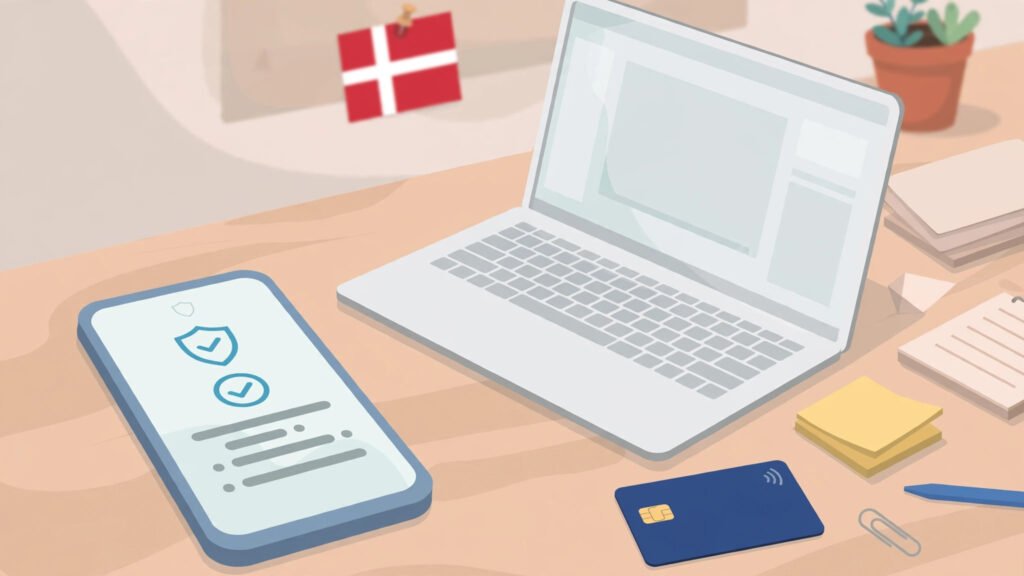
If you live in Denmark, one small moment repeats itself many times a day: your phone lights up, asks you to approve something, and with one confirmation you are in. It might be your bank, a letter from a public authority, your tax account, or a health service. Behind that single step is MitID, Denmark’s national digital ID, and it is one of the main reasons daily life in Denmark feels so connected online.
In Denmark, proving who you are online is not a separate chore for every website — it is one step that unlocks almost everything else. That is the simple idea behind MitID, and it explains why Danes reach for it so often.
Key Takeaways
- MitID is Denmark’s national digital ID, used to prove identity across banks and public services with one login.
- It replaced the older NemID system, bringing the approval step onto the phone most people already carry.
- Its wide use rests on public services designed to work digitally, and on trust in a shared system used by both the state and banks.
What Is MitID?
MitID is a digital identity that confirms who you are when you log in to a service online. Instead of creating a different username and password for every bank, authority, and health portal, a person in Denmark can use MitID as the shared key that those services accept.
The most familiar version is the MitID app on a phone. When you try to log in on a computer or in another app, MitID asks you to approve the login on your phone, often with a swipe, a code, or a fingerprint or face check, depending on how your phone and MitID are set up. The point is that the approval happens on a device you control, rather than on a password alone.
MitID is not a social media account or a payment app on its own. It is the identity layer underneath many everyday tasks: it confirms that the person logging in is the person the account belongs to, and then the bank or the authority takes over from there.
Why One ID for So Much?
The biggest reason MitID is used so widely is that so many Danish services accept it. Public services in Denmark were built to work online, and private services such as banks joined the same system. When the same ID works in both worlds, there is little reason to keep a separate login for each one.
That shared acceptance also makes life simpler. People do not have to remember a long list of passwords for sensitive accounts, and services do not have to build their own identity checks from scratch. One trusted check, used carefully, replaces many weaker ones.
Denmark’s approach is not unique in spirit. Estonia’s online-first public services follow a similar idea, and Ukraine’s Diia app puts many state services in one place too. What makes the Danish case stand out is how deeply the same ID runs through both government and everyday banking.
In Denmark, proving who you are online is not a separate chore for every website — it is one step that unlocks almost everything else.
How MitID Works Day to Day
For most people, MitID is quiet and routine. A typical day might include approving a bank login in the morning, opening an official digital letter during the day, and signing into a health or tax service later — all with the same identity.
The approval step is deliberate. Logging in is not just typing a password that anyone who finds it could reuse. The phone approval adds a second check: access to the device and the approval itself. That is why losing a password alone does not give someone the same access.
MitID also fits how Danes already pay and bank. Danes are used to handling money on their phones, and MobilePay is part of the same phone-first habit. MitID supplies the identity behind that habit, while payment and banking apps handle the money itself.
- One digital ID works across banks and many public services.
- Login approval happens on the phone, not on a password alone.
- Official letters, tax, health, and banking logins can all use the same check.
- Keeping the phone and its lock screen secure is part of keeping MitID secure.
What If You Lose Your Phone?
Losing a phone is the worry that comes up most often with a phone-based ID, and the system is built with that in mind. A person who loses a phone can get MitID set up again, typically by going through an identity check with their bank or through the official MitID help channels and proving who they are before a new device is trusted.
That recovery step matters because it is the balance at the heart of MitID: everyday logins should be easy, but setting up a new trusted device should not be. The friction is placed where it protects the account, not on every routine login.
It is also why basic phone security matters so much in Denmark. A locked phone, a careful approach to unexpected approval requests, and never approving a login you did not start are habits that protect the ID itself. If an approval request appears out of nowhere, the safe move is to ignore it and check the service directly.
Why Denmark Went This Way
Denmark’s digital public services did not appear overnight. Over many years, authorities moved letters, forms, and appointments online, and a shared digital identity made that shift practical. Without one trusted login, every new online service would have asked people to create yet another account.
Trust plays a large role too. A shared identity only works if people believe the system is run carefully and if banks and authorities both accept it. In Denmark, that acceptance grew over time, helped by the earlier NemID system, which MitID replaced as phones became the natural place for approvals. The change kept the idea — one national digital ID — and moved it onto the device people already carry.
Size and coordination help as well. Denmark is a compact country where banks, authorities, and technology providers could agree on one system rather than building many competing ones. The result is less fragmentation: fewer logins, fewer passwords, and a clearer path for new services to join.
What Visitors Should Know
Visitors to Denmark should not expect to get MitID on a short trip. MitID is tied to living in Denmark and having the official personal registration that Danish services use to identify residents. A tourist can still pay by card, use a foreign bank app, and visit public services in person where needed, but the deep digital shortcuts are designed for residents.
That distinction is worth understanding because it explains why MitID feels invisible to visitors and essential to residents. It is not a travel app. It is infrastructure for people whose daily life — banking, tax, health, and official mail — runs through Danish systems.
What to Watch Next
MitID’s future will likely follow the same pattern as its past: the same identity, used in more places, with the approval step staying on the phone. As more services move online, the value of one trusted login grows, and so does the importance of protecting it.
For anyone watching Denmark from abroad, the lesson is not that one app solves everything. It is that a shared digital identity works best when public services are designed to be digital, when banks and authorities accept the same check, and when the security burden falls on setting up a device rather than on every login. In Denmark, that combination is why MitID is used for almost everything — and why it has become part of ordinary life.