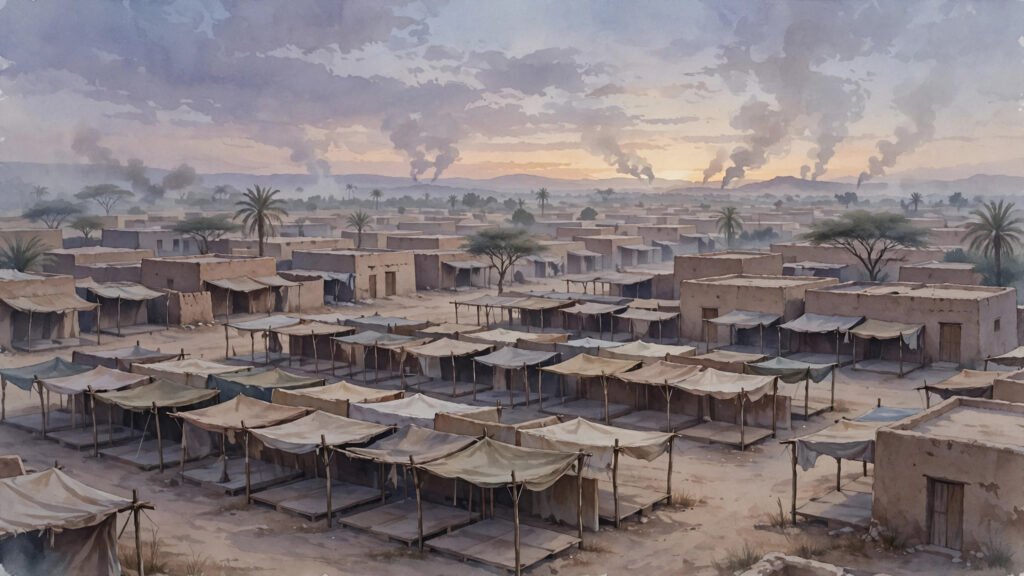
More than 100 people were killed in drone strikes on a busy market in Nyala, the capital of South Darfur, earlier this week, according to a rights group tracking violence in Sudan. The attack has again put civilians at the centre of a war in which, the United Nations says, drone strikes have become the leading cause of civilian deaths.
The market in Nyala serves as a gathering place for traders, food sellers and residents, as well as fighters from the paramilitary Rapid Support Forces (RSF), which controls the city. Witnesses told the Associated Press that the strike hit on Monday evening, when the market was crowded, and that the blast was massive. What exactly happened, and how many people died, remains disputed, because independent verification from inside the city is severely limited by the fighting.
Emergency Lawyers, a Sudanese rights group, put the toll from Monday’s attacks at more than 100 dead and 113 wounded, and reported that most of the victims were women and children. That account is the highest casualty figure reported so far, and it sits alongside very different numbers from other organisations working in the area — a reminder of how difficult it is to establish a single confirmed toll while Nyala remains cut off by active military operations.
Key Takeaways
- Emergency Lawyers reported more than 100 people killed and 113 wounded in Monday’s strikes on a market in Nyala, South Darfur.
- Doctors Without Borders said a hospital it supports in Nyala received 36 bodies and treated more than 150 wounded people after the strikes.
- Casualty figures remain unconfirmed, with different groups reporting different tolls amid limited access to the city.
What witnesses reported from the market
According to witnesses who spoke to the Associated Press on Wednesday, hundreds of RSF fighters had gathered at the market on the evening of the attack. One cigarette vendor said he moved his stall between gatherings of fighters to sell cigarettes, and that a drone struck at around 8pm, killing dozens of fighters and women selling food.
Another witness said the explosion was massive and killed many fighters, and estimated that around 14 civilians, including women and children, were also killed, most of them women selling tea and food. Both witnesses spoke on condition of anonymity for fear of retaliation.
The accounts underline a painful reality of the Nyala market: it is both a civilian marketplace and a place where armed fighters gather. That overlap does not change the protection civilians are owed under the laws of war, aid groups argue, but it does make the aftermath harder to document — and the competing claims about who was killed harder to untangle.
Markets, homes, and key civilian infrastructure are not targets.
Conflicting casualty accounts, and why they differ
Doctors Without Borders, known by its French initials MSF, said a second strike hit a civilian neighbourhood after the market attack. A hospital it supports in Nyala received 36 bodies in the hours after the strike, 21 of them wearing civilian clothing, and its teams saw more than 150 wounded people in the emergency room. MSF called the strikes “appalling” and said all parties to the conflict must protect civilians.
The Sudan Doctors Network, another group tracking violence, issued a preliminary statement on Wednesday reporting 21 dead and more than 40 wounded, and said shelling caused most of the deaths. The group said its statement was delayed because of the challenges of accessing field documentation sources within Nyala amid ongoing military operations and security constraints.
On the army side, Mohamed Didan, the official spokesperson for the Special Operations Forces fighting with the army, wrote on Facebook that more than 150 militia recruits were killed at the Dumaya camp, west of Nyala, in what he described as a precise and targeted air strike.
These figures cannot simply be added together, and none of them has been independently verified. They come from different sources, cover different locations and time windows, and were collected under very different conditions. Al Jazeera, reporting the accounts, noted that casualty figures from Monday’s attack are unconfirmed and could not be independently verified amid limited information from the city. That uncertainty is itself part of the story: in Nyala, even counting the dead is constrained by war.
- Emergency Lawyers: more than 100 dead, 113 wounded, most victims reported to be women and children.
- MSF-supported hospital in Nyala: 36 bodies received, 21 in civilian clothing, and more than 150 wounded seen in the emergency room.
- Sudan Doctors Network: a preliminary toll of 21 dead and more than 40 wounded, attributed mostly to shelling.
- Army spokesperson’s claim: more than 150 militia recruits killed at Dumaya camp, west of Nyala.
- Aid worker Mubarak Bekheit said many people remained missing and some bodies had yet to be recovered from homes in the area.
Nyala and a war now in its fourth year
Nyala is the de facto capital of the RSF in South Darfur, and the war between the RSF and the Sudanese army is now in its fourth year. The conflict has created severe poverty and food shortages and, according to the United Nations, the world’s worst displacement crisis. Civilians have borne the heaviest cost throughout, and the Nyala strikes fit a pattern aid groups have warned about repeatedly: markets, homes and neighbourhoods caught in fighting between organised armed forces.
The humanitarian picture in Nyala was already grave before this week’s strikes. In RSF-controlled Nyala, the share of children seeking treatment for severe acute malnutrition more than doubled between January and August, from 5 percent to 11 percent, according to UN estimates released earlier this month. Food shortages and the collapse of basic services have left families with fewer ways to cope, and each new attack deepens that strain.
That wider crisis is also why warnings about Sudan have grown louder internationally. The United States, the United Kingdom and 31 other countries have already warned about famine in Sudan, a warning that gives the Nyala attack a context beyond a single evening’s violence: it happened in a city where hunger was already rising and where hospitals were already under pressure. Drone attacks elsewhere in Sudan, including a drone attack on a power station in Khartoum, have shown how strikes on infrastructure ripple through civilian life long after the blast itself.
Aid worker Mubarak Bekheit, speaking from Darfur, said many people remained missing after the Nyala strikes and some bodies had yet to be recovered from homes in the area. His words captured the fear that now shapes daily life for residents: that the next strike could come without warning, and that the missing may not be found quickly, if at all.
MSF’s statement was blunt. In its words, markets, homes and key civilian infrastructure are not targets, and all parties to the conflict must protect civilians. That principle is now the central demand from aid groups following the Nyala attack — not only an accounting of Monday’s dead, but a halt to strikes that put markets and neighbourhoods in the line of fire. The international warning over famine in Sudan makes that demand harder to ignore, even if it does not, on its own, stop the fighting.
What to Watch Next
What to watch next is whether a clearer, verified casualty count emerges from Nyala, and whether the many people reported missing are found. Aid groups will also be watching whether hospitals in the city can cope with the wounded already received, and whether further strikes hit civilian neighbourhoods in the days ahead. Above all, the question remains whether the parties to the conflict will heed the call to protect civilians — and whether the international warnings about hunger and displacement in Sudan translate into protection for people in markets like Nyala’s, who are paying, as one aid worker put it, the highest price of this war.