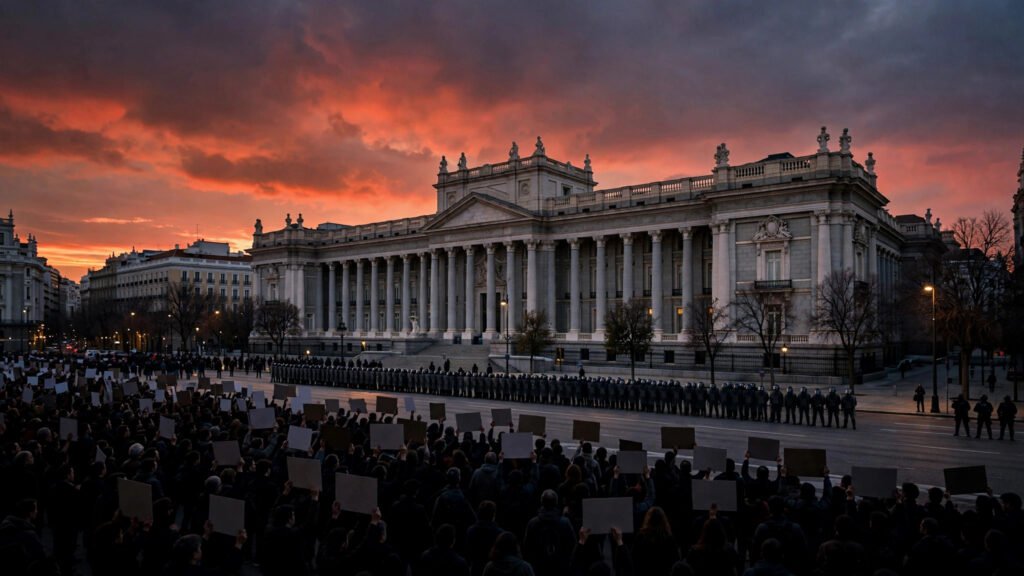
Hundreds of protesters gathered outside Spain’s Transport Ministry in Madrid on Wednesday night, demanding the resignation of Transport Minister Óscar Puente after the train crash that killed at least 68 people in Toledo province. The demonstration, held on the Paseo de la Castellana, turned tense as some in the crowd threw bottles and lit flares, and riot police responded with tear gas and batons to disperse them.
Protesters chanted “Óscar Puente, minister of death” and “Óscar Puente, murderer”, while others held signs reading “Leave!”, “Criminals” and “Corruption kills”. Some demonstrators also called for Prime Minister Pedro Sánchez to step down. Reports put the turnout at anywhere from around 500 to about 1,500 people, with the demonstration ending at around 9.30 pm after nearly two hours. No injuries or arrests were recorded, according to one report.
Key Takeaways
- Hundreds protested outside Spain’s Transport Ministry in Madrid on Wednesday night, demanding Transport Minister Óscar Puente resign after the crash that killed at least 68 people.
- Police used tear gas and batons after some protesters threw bottles and lit flares, and the protest ended after nearly two hours.
- Spain’s CSIF union has also called for Puente’s resignation, accusing him of blaming a railway official instead of accepting responsibility.
What Happened Outside the Ministry
The protest was called on social media and gathered on the Paseo de la Castellana, the wide boulevard outside the ministry headquarters. Reports said far-right groups, including Falange and Revuelta, along with the union Solidaridad, linked to Vox leader Santiago Abascal, had backed the demonstration.
As the crowd pressed forward, protesters chanted “Óscar Puente, minister of death” while police moved in with tear gas and batons.
As the crowd pressed forward, protesters chanted “Óscar Puente, minister of death” while police moved in with tear gas and batons.
The demonstration was the first public eruption of anger since the crash, and it came as Spain began three days of national mourning for the victims. Rescue workers were still searching the wreckage under floodlights as the protest unfolded, with more than 500 emergency personnel deployed to the crash site.
Why the Anger Is Aimed at Puente
Puente has said a disruption to the railway safety system affected a 63-kilometre stretch of track between Madrid and Seville, that the system automatically stopped trains in the area, and that Adif, the state-owned company responsible for railway infrastructure, then took manual control. He described the decision to let trains resume without speed restrictions as “inexplicable”. The crash itself happened at 8.53 am on Wednesday, when a Renfe AVE train travelling from Madrid to Seville ran into the rear of a stationary Iryo train near Urda and Los Yébenes, about 140 km south of Madrid. The Renfe train carried 397 passengers, while the Iryo train carried 147 people, including a baby. Two carriages of the Iryo train derailed.
Spain’s CSIF trade union has also called for Puente’s resignation, accusing him of shifting responsibility onto a railway official instead of accepting accountability. The union urged the government to respect the investigation and the presumption of innocence of Adif’s head of traffic, and said it had warned in September about excessive working hours at Adif. Investigators have yet to officially establish the cause of the accident, and questions remain about the red signal and the LZB safety system.
- At least 68 people killed and around 100 injured in the October 28 collision, described as Spain’s deadliest rail disaster since 2013.
- Protest turnout estimates ranged from around 500 to about 1,500 people outside the Transport Ministry in Madrid.
- Police used tear gas and batons after some protesters threw bottles and lit flares; no injuries or arrests were recorded.
- The CSIF union says it warned in September about excessive working hours at Adif, the state infrastructure manager.
- Prime Minister Sánchez has declared three days of national mourning and promised a thorough investigation.
Grief, Scrutiny and a Suspended Line
Prime Minister Pedro Sánchez, addressing the nation in a televised statement near the crash site, said “all of Spain” was mourning the victims and described the collision as a “terrible tragedy”. He announced three days of national mourning and promised a thorough investigation, assuring citizens that any shortcomings identified would be addressed. Sánchez also said the causes of the country’s two fatal railway accidents this year appeared unrelated, while pledging additional safety measures if required to restore public confidence in Spain’s high-speed rail network.
Rail services between Madrid and the Andalusia region remained suspended for Thursday, and the opposition People’s Party cancelled its campaign events for the day in the wake of the tragedy. The political fallout is only beginning: the protest showed how quickly grief over the crash has turned into a demand for accountability at the top of the transport ministry.
What to Watch Next
What to watch next is only what this article has already set out: whether Puente responds to the resignation calls from protesters and the CSIF union, whether the investigation establishes what went wrong on the 63-kilometre stretch of track, whether rail services between Madrid and Andalusia resume, and whether further protests follow as Spain’s three days of mourning continue. Until those questions are answered, the protest stands as the first public eruption of anger after Spain’s deadliest rail disaster since 2013.