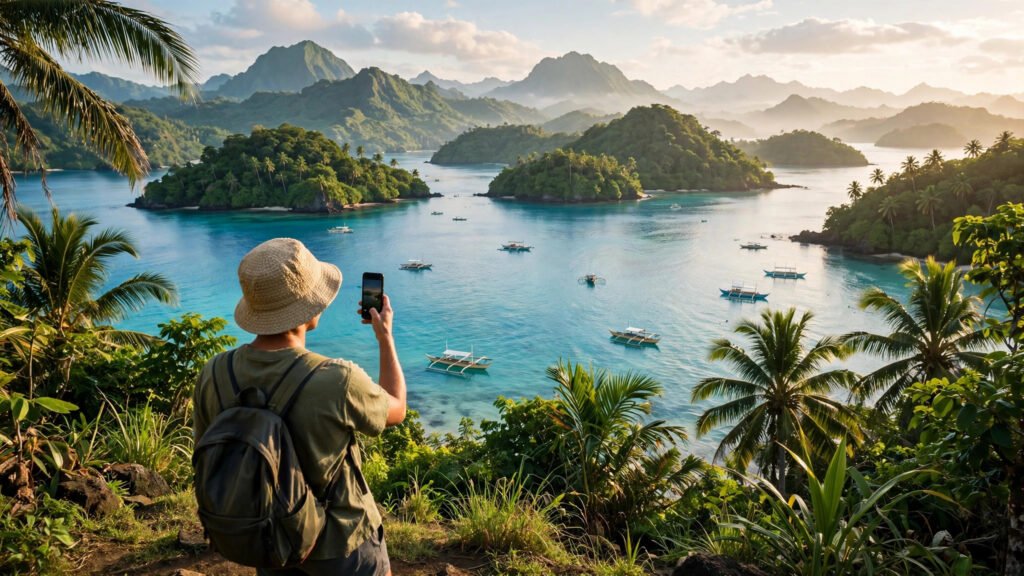
Vanuatu is not one place that can be crossed on foot. It is an archipelago in the South Pacific, a chain of islands separated by stretches of open sea. Villages sit on different islands, families live far apart, and a journey between two communities can mean a boat ride, a small plane, or a long wait for the weather to improve. In such a country, a natural question arises: what holds everyday life together across all that water? For a growing number of Vanuatuans, a large part of the answer fits in a pocket.
The mobile phone has become the everyday link between Vanuatu’s islands. It carries voices across the sea, it carries money between family members, it carries news about the weather, and it helps a small trader reach a customer who lives on another island entirely. The phone does not make the ocean disappear, but it makes distance far less of a barrier than it used to be.
Key Takeaways
- Vanuatu’s islands are separated by sea, so travel between communities can be slow, costly, and weather-dependent.
- A mobile phone lets people stay in touch, trade, and send money without making a boat journey for every task.
- Phones also matter for safety, because warnings and news can reach people quickly when storms approach.
A Country Made of Islands
Life in Vanuatu is organised around islands, each with its own villages, gardens, schools, and markets. Some islands are larger and busier, with towns, shops, and services. Others are smaller and quieter, where daily life depends on fishing, farming, and close community ties. The sea connects these places, but it also separates them: a trip that looks short on a map can take a long time in practice.
That geography shapes almost every practical decision. A student studying away from home cannot simply walk back for the weekend. A parent working on one island cannot easily hand cash to family on another. A farmer with produce to sell must think carefully about transport, timing, and whether a buyer can be reached at all. Distance is not an occasional inconvenience in Vanuatu; it is the background condition of daily life.
Before mobile phones became common, keeping in touch across islands depended heavily on physical travel and on messages carried by others. Letters, radio, and word of mouth all played a part, but none of them was instant. A phone call or a message changes that equation completely. News that once took a journey can now arrive in moments, and a conversation that once had to wait for a visit can happen any evening.
Staying Close to Family Across the Sea
For many Vanuatuans, the most important job of a phone is a simple one: staying close to family. Relatives often live on different islands for work, schooling, or marriage, and the phone is what keeps those bonds alive day to day. A short call can check on a parent, a message can share news of a birth, and a photo can show a child growing up far from home.
This matters even more when family members work away from their home island or overseas. Earnings sent home support households, pay school costs, and help with shared expenses, and a phone makes that support easier to arrange. A relative can confirm that money has arrived, discuss what it is needed for, and plan the next step without waiting for a boat or a visit.
Similar patterns appear across the Pacific, where distance also defines daily life. Families in Tonga receive money from abroad on their phones instead of through banks, and islanders in Kiribati use mobile phones to move money across scattered atolls. In each case, the phone fits a life that is spread across water.
Trade, Markets, and Small Business
Phones also change how small trade works. A fisherman can check whether a buyer is interested before setting out. A market seller can tell a regular customer what will be available that day. A craft maker on one island can take an order from someone on another without either of them travelling first. Each of these small exchanges saves time, and together they make island trade more flexible.
For people who sell produce, timing matters. Fresh food does not wait, and a wasted journey with unsold goods is a real loss. A phone call beforehand can confirm demand, agree a meeting point, or warn that a boat has been delayed. The phone cannot fix a rough sea, but it can stop a journey that no longer makes sense.
Mobile money and phone-based payments fit into the same picture. Where a bank branch is far away, a phone can carry value between people without cash having to travel by boat. A payment can be confirmed quickly, a debt can be settled from a distance, and a small business can keep trading even when its customers are scattered. As with family transfers, the advantage is not speed alone; it is the removal of a journey that might otherwise be needed for every single transaction.
Weather, Warnings, and Safety
Vanuatu sits in a region where tropical cyclones are a serious part of life. When a storm approaches, information can save lives: where the storm is heading, when it is expected to arrive, and what precautions communities should take. A phone puts that information directly into people’s hands, rather than leaving them to wait for a visitor or a broadcast they might miss.
Warnings, updates, and advice from family and neighbours can spread quickly through calls and messages. A village can check on another village, a boat owner can decide not to set out, and a family can prepare while there is still time. No phone can stop a cyclone, but timely information helps people make safer choices, and in island communities that timing can matter a great deal.
The same logic applies to everyday safety at sea. Fishermen and boat travellers use phones to stay in contact, to report a delay, or to ask for help if plans change. When the sea is the road, a working phone is part of travelling safely, not just a convenience.
The phone does not make the ocean disappear, but it makes distance far less of a barrier than it used to be.
That sentence captures the whole story. The phone is not a replacement for boats, roads, or visits. It is a tool that makes the gaps between islands easier to live with, and in a country shaped by the sea, that is a large change.
What Phones Still Cannot Solve
Phones help, but they do not solve everything. Mobile coverage does not reach every island and every valley equally, and a phone is only useful when it is charged and within signal. On remote islands, charging a phone can itself be a task, and a weak signal can turn a simple call into a frustrating one.
Cost is another limit. Handsets, credit, and data all cost money, and for households with tight budgets, every top-up is a choice against something else. People therefore use their phones carefully, favouring short calls, messages, and the services that matter most, rather than treating connectivity as unlimited.
There is also a learning curve, especially for older residents and for people new to mobile money. Trust has to be built: checking a recipient before confirming a transfer, guarding account details, and recognising messages that try to trick people into sending money. These habits matter as much as the technology, because a mistaken transfer can be hard to undo.
- Distance is the core problem: islands separated by sea make travel slow and weather-dependent.
- Phones keep families connected and let relatives support each other across islands and overseas.
- Small traders use phones to confirm buyers, avoid wasted journeys, and accept payments from a distance.
- Weather warnings and messages about storms reach island communities faster through phones.
- Coverage gaps, charging, cost, and scam awareness still limit what a phone can do alone.
None of this means the phone replaces island life as it has always been lived. Boats still cross the water, markets still gather people in person, and visits still matter in ways no call can replace. The phone simply fills the gaps between those moments, keeping people connected in the days and weeks when a journey is not possible.
A similar balance appears in other island nations, where the phone has become part of everyday life without replacing it. In Seychelles, islanders do almost everything on their phones across scattered islands for much the same reason: when the sea sits between you and almost everything else, the device in your pocket becomes the shortest route to the people and services you need.
What to Watch Next
The direction of travel is clear: as coverage improves and more services reach smaller islands, the phone is likely to become even more central to life in Vanuatu. The practical questions to watch are the ones this article has already raised. Will coverage and charging become easier on the most remote islands? Will mobile payments become simpler and safer for everyone, including older residents? And will warnings and news reach every community in good time when the next storm approaches?
For now, the core answer remains unchanged. In a country made of islands, the mobile phone is the thread that runs between them — carrying voices, money, trade, and warnings across water that would otherwise keep people apart.