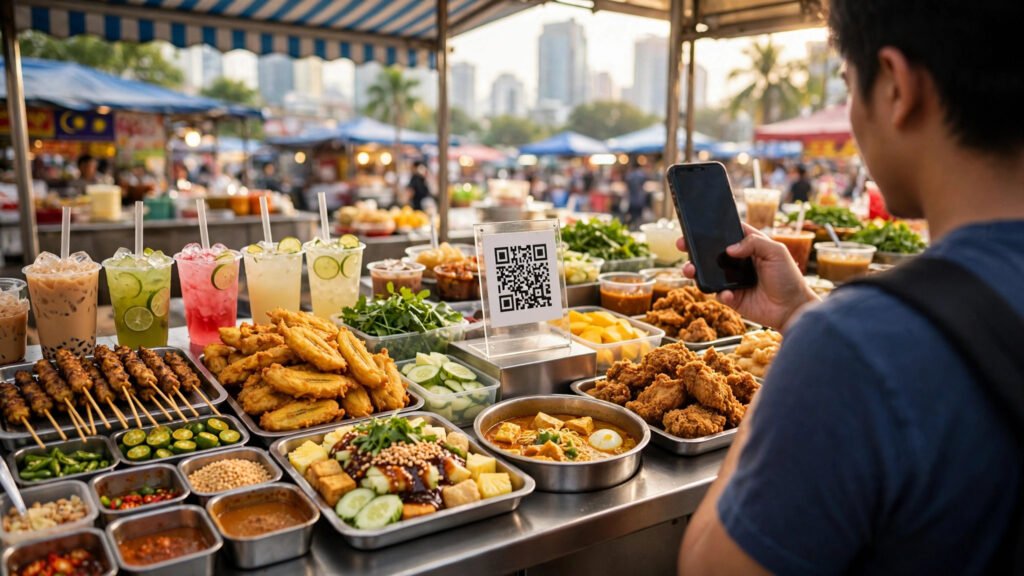
At a night market in Kuala Lumpur, the queue moves fast. A customer orders a plate of fried noodles, points a phone at a small printed square on the stall counter, types in the amount, and shows the screen to the seller. No notes change hands, no card machine beeps, and no change is counted. The whole payment takes a few seconds, and the next customer steps forward.
That little square is a DuitNow QR code, and it has quietly become one of the most familiar sights in Malaysia. It sits on hawker stalls, in corner shops, at petrol stations, and on the counters of small businesses that never owned a card machine. The question many visitors ask is simple: why did Malaysians take to scanning a QR code so quickly, when cash and cards were already there?
Key Takeaways
- DuitNow QR gives small sellers one code that works with many different bank apps and e-wallets.
- Scanning is fast and simple for buyers, and it removes the need to carry exact change or a card machine.
- Cash and cards are still used in Malaysia, but QR payments have become a normal everyday choice.
One Code for Many Apps
The biggest reason DuitNow QR caught on is that it removed a problem that used to slow down digital payments: every app had its own code. A shop that wanted to accept phone payments once needed a different sign for each wallet, and a customer had to hope their app matched the shop’s sign. DuitNow QR changed that by giving Malaysia a shared standard. One printed code can be scanned by customers using different participating banks and e-wallets, so a small seller does not have to choose sides.
For a hawker or a market trader, that simplicity matters enormously. Printing a code costs far less than renting and maintaining a card terminal, and it needs no electricity, no paper rolls, and no extra counter space. A seller can tape a code to a stall, prop it beside the till, or print it on a receipt. When a business can start accepting digital payments with little more than a printed square and a bank account, many more businesses do so.
Built for Small Purchases
Malaysia’s everyday spending is full of small purchases: a coffee, a bun, a bus fare top-up, a packet of snacks, a bowl of noodles. Cash handles small amounts well, but it also creates friction. Buyers hunt for coins, sellers run out of small notes, and both sides waste time on change. Cards handle small amounts too, but for the smallest sellers a card machine was often not worth the cost or the hassle.
QR payments sit neatly in the middle. The buyer already carries a phone, the seller already has a code, and the amount can be typed in exactly, down to the smallest unit. There is no change to count and nothing to lose on the way home. For sellers, the payment also leaves a clear record in their account, which makes it easier to track a day’s takings than a pocket full of notes and coins. That record is useful for a small business owner who wants to know what sold, and when.
Phones Were Already in Every Pocket
DuitNow QR did not have to teach Malaysians to use phones. Smartphones were already part of daily life for chatting, ordering food, hailing rides, and checking bank balances. Scanning a code felt like one more thing a phone could do, not a new skill to learn. Older shoppers who were unsure about cards sometimes found QR codes easier, because the steps are visible: point, check the name and amount, confirm.
Trust grew in stages. People first tried QR payments at larger shops and chain stores, where staff could help if something went wrong. Then they tried them at a favourite food stall, then at a night market, then almost anywhere. Each smooth payment made the next one feel normal. As with other countries in the region, a single shared QR standard helped habits change faster than a patchwork of competing codes, a pattern also seen in how Indonesians adopted one QR standard for many apps and how Cambodians moved to a single QR code for payments.
One printed code can be scanned by customers using different participating banks and e-wallets, so a small seller does not have to choose sides.
Why Sellers Love It Too
It is easy to think of QR payments as a buyer convenience, but sellers gain just as much. A stall owner no longer has to keep large amounts of cash on site, which is safer at a busy night market. There is less time spent counting takings at the end of the day, and fewer mistakes over change during a rush. A payment that lands directly in an account is also easier to separate from personal money, which helps small traders keep business and household spending apart.
QR codes also travel well. A seller at a weekend market, a food truck, or a pop-up stall can take the same code wherever they go. There is no machine to carry, no socket to find, and no signal problem with a card reader. As long as the customer’s phone can connect, the payment can go through. That flexibility suits Malaysia’s lively market culture, where the same seller may trade in a different place every day of the week.
Cash and Cards Have Not Disappeared
None of this means cash is dead in Malaysia. Many people still pay cash at wet markets, for small tips, or when they simply prefer it, and cards remain common in shopping malls, hotels, and larger restaurants. Older Malaysians in particular may still reach for notes out of habit, and some rural areas rely on cash more than cities do. DuitNow QR has not replaced everything; it has joined cash and cards as a third everyday option.
What has changed is the default at the small end of spending. Where a card machine was once rare, a QR code is now expected. A visitor who carries only a card may still be caught out at a small stall, while a local with a phone and a bank app can pay almost anywhere. That shift says a lot about how payment habits change: not by forcing people to give up what they trust, but by offering something that is easier for the purchases they make most often.
- DuitNow QR is one shared code that works across many Malaysian bank apps and e-wallets.
- It suits small, everyday purchases at hawker stalls, night markets, and corner shops.
- Sellers avoid the cost of a card machine and keep less cash on site.
- Cash and cards remain in use, but QR scanning is now a normal everyday choice.
Cross-Border Scanning Adds Another Reason
Malaysia sits at the centre of a busy region, with visitors and workers crossing borders every day. QR payment links between Malaysia and neighbouring countries have made it possible, in supported cases, for travellers to scan and pay in a more familiar way instead of hunting for local cash or a compatible card. For a country that welcomes shoppers and tourists from nearby Singapore, Thailand, and Indonesia, that convenience is a real advantage, and it gives QR codes a role beyond daily local spending.
The wider lesson reaches beyond Malaysia. When one standard works across banks, wallets, and borders, people use it more, and sellers accept it more. Digital identity plays a similar unifying role next door, where Singaporeans use one digital login for many everyday services. In both cases, the winning idea is the same: make the everyday task simpler, and people will adopt it on their own.
What Visitors Should Know
For travellers, the practical point is straightforward. Cards and cash still work widely in Malaysia, especially in malls and hotels, but a phone payment habit will help at hawker stalls and markets. Visitors whose own bank apps support cross-border QR payments may be able to scan in some places, but it is still wise to carry some cash for small sellers, rural stops, and anywhere a code is not displayed. Checking the name shown on screen before confirming, just as locals do, is the simplest way to avoid paying the wrong stall.
What to Watch Next
DuitNow QR is likely to keep spreading into more corners of Malaysian life, from small shops to services that once ran on cash alone. Cash and cards will remain part of the picture, especially for larger purchases and for people who prefer them. But the habit of scanning a small printed square has already proved its point: when one code works for almost everyone, paying becomes quicker, simpler, and easier for buyers and sellers alike, and that is why QR codes now sit beside cash and cards on counters across Malaysia.