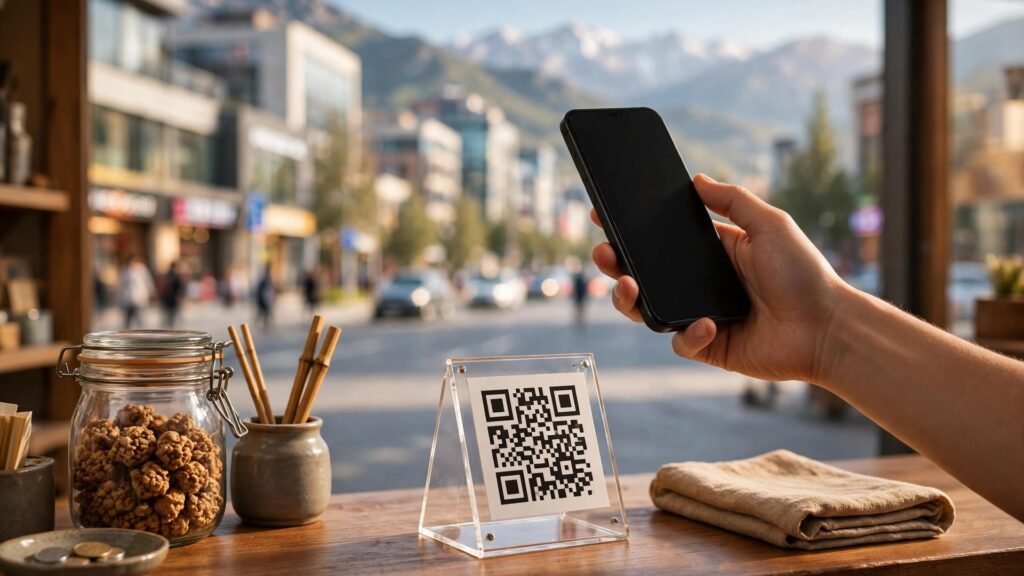
In Mongolia, paying often starts with a phone, not a wallet. A shopkeeper points to a printed QR code on the counter, the customer opens a bank app, scans it, and the payment is done in seconds. For visitors, the habit can look surprising in a country famous for wide open steppe and long distances. For Mongolians, it is simply the easiest way to pay, and it grew out of how banking works there.
The key to the habit is QPay, Mongolia’s shared QR payment standard. Instead of every bank running its own separate code, QPay lets a customer of one bank scan a merchant code and pay through their own bank app. That shared system matters, because it means a small shop only needs one code on the counter, and a customer only needs the app they already use for everyday banking.
Key Takeaways
- QPay is Mongolia’s shared QR standard, so one merchant code works with different bank apps.
- Bank apps became the everyday wallet because branches are far apart outside the capital.
- QR payments suit small shops, taxis and markets, but cash has not disappeared entirely.
What QPay Actually Is
QPay is best understood as a common language for QR payments in Mongolia. A merchant displays a code linked to their bank account, and the customer’s bank app reads it, fills in the recipient, and asks the customer to confirm the amount. The money then moves from one bank account to another, without banknotes changing hands and without the shopkeeper handling change.
Because the system is shared, it avoids the confusion of a different code for every bank. A customer who banks with Khan Bank, Golomt Bank, XacBank or another Mongolian bank can still pay at the same counter. That simplicity is a big part of why QR codes spread from larger stores in Ulaanbaatar to smaller stalls and service providers as well.
Why Bank Apps Became the Everyday Wallet
Mongolia is a large country with a small population spread across great distances, and Ulaanbaatar holds a large share of the population. Outside the capital, a bank branch can be a long trip away, and winter weather can make that trip harder still. A phone app removes much of that distance: salaries arrive in an account, bills can be settled from home, and money can be sent to family in another town without a journey to a branch.
Once people already used a bank app to check a balance or send money to a relative, using the same app to pay at a shop was a short step. The app was already trusted, already installed, and already linked to their money. QR payment did not ask people to adopt a whole new wallet; it added one more job to a tool they already carried.
A phone app removes much of that distance: salaries arrive in an account, bills can be settled from home, and money can be sent to family in another town without a journey to a branch.
Why Shops Prefer a QR Code on the Counter
For small businesses, a printed QR code is cheap and practical. There is no card terminal to rent or maintain, no cash float to prepare, and less risk of running short of change during a busy day. The payment record also sits inside the bank app, which helps a shopkeeper keep track of the day’s takings without counting notes at closing time.
Customers like the same simplicity. There is nothing to count out, no need to carry exact change, and the confirmation appears on screen straight away. In taxis, cafes and market stalls, that speed matters: a payment that takes seconds keeps a queue moving, and neither side has to worry about whether a note is torn or a coin is missing.
- One shared QR code works across different Mongolian bank apps.
- Paying by phone avoids long trips to a branch outside Ulaanbaatar.
- Small shops save on card terminals and cash handling.
- Transfers between people work through the same bank apps.
- Cash still has a place, especially in rural markets and among older customers.
How This Compares With Neighbouring Countries
Mongolia’s QR habit fits a wider Central Asian pattern. In Kazakhstan, shoppers commonly pay by scanning a QR code through the Kaspi app, and the same logic applies: one familiar app covers shopping, transfers and bills. Travellers who have seen why Kazakhstanis pay with Kaspi QR instead of cash or cards will recognise the same convenience in Mongolia, even though the banks and brands are different.
Kyrgyzstan shows a similar story, where people pay through bank and wallet apps such as mBank and O!Money rather than reaching for a card. The shared idea is that the phone becomes the branch, the wallet and the till in one device, which matters most where bank branches are thin on the ground. Belarus shows the same shared-system idea from the bills side: one national system, ERIP, lets people settle many different bills in one place, as explained in why Belarusians pay bills through ERIP instead of separate apps.
Cash Has Not Disappeared
None of this means cash is gone from Mongolia. In rural areas, at herder markets and among older customers, banknotes are still normal, and a phone with a flat battery or no signal is a real limit on any digital payment. Some small traders also prefer cash for its immediacy. The honest picture is a mix: QR and bank apps dominate daily city spending, while cash remains a backup and a habit in places where phones and networks are less reliable.
There are also habits worth keeping. Shoppers should check the merchant name and amount on screen before confirming, just as they would count change from a cash payment. A genuine QR code sits at a real counter or on a real bill; a code stuck over another code, or sent by a stranger asking for payment, deserves a second look. Those small checks keep a convenient system safe.
What to Watch Next
Mongolia’s payment habit now rests on a simple combination: one shared QR standard, bank apps people already trust, and a geography that rewards doing banking from a phone rather than travelling to a branch. Shops gain a cheap way to accept payments, customers gain speed and a record of what they spent, and cash remains as a fallback where phones or signals fall short. The next test for the system is how far it reaches beyond the capital — into smaller towns, rural markets and older customers — and whether the same shared-code idea keeps working as more services move onto the phone.