Ask people who travel with a laptop which European country surprises them most online, and Romania comes up again and again. In many Romanian cities, a home connection feels instant: pages load at once, video calls stay smooth, and large files move far faster than visitors expect. It is a reputation Romania has held for years, and it did not come from being the richest country in the region or from having the oldest phone network. It came, in large part, from people building their own networks first.
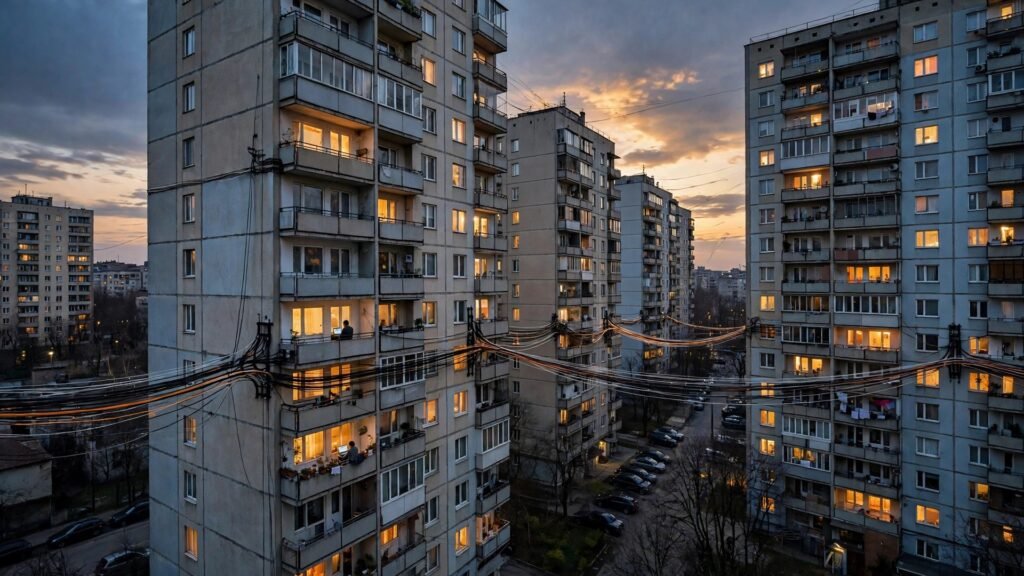
Romania’s internet story is really a story about neighbourhoods. In the years after communism ended, computers were already common in the big apartment blocks of cities like Bucharest and Cluj. Neighbours who wanted to play games together, share films and music, or simply connect their computers began running cables between flats and between blocks. Those informal block networks, known in Romanian as rețele de cartier, were the unlikely foundation of one of Europe’s fastest broadband systems.
Key Takeaways
- Romania’s fast internet grew out of informal neighbourhood networks built between apartment blocks in the 1990s.
- Because the old copper phone network was weak, Romania largely skipped the slow DSL step and moved straight to fibre.
- Dense apartment housing made fibre cheap to roll out, since one connection could serve hundreds of homes.
How Neighbourhood Networks Started It All
In the 1990s, getting online in Romania was not easy. Dial-up was slow, and a phone line tied up while you were connected. For neighbours in the same block, there was a simpler idea: link the computers directly. Cables were run along balconies, across courtyards, and between neighbouring buildings, turning a single block into a small local network.
At first, these networks were mostly about sharing. Friends could play games together without leaving home, swap music and films, and run small local servers. Internet access often arrived later, shared across the network once someone had a connection worth sharing. The networks were informal, lightly regulated, and built by the people who used them, not by a large telephone company.
That informality mattered. In many Western European countries, building new networks meant dealing with established phone companies, underground ducts, and long approval processes. In Romania, the rules were looser in practice, and overhead cables became a familiar sight in cities — tangled bundles of wire hanging between poles and blocks. It was messy, but it worked, and it spread quickly.
Romania did not get fast internet by following the usual path — it got there by skipping a step other countries took.
Skipping the Slow Step
Most of Western Europe reached broadband through DSL, which sends internet signals over old copper telephone lines. That made sense where telephone networks were already strong. Romania’s telephone network, by contrast, was far less developed, so upgrading it was less attractive than building something new.
Instead, the small neighbourhood networks grew into small internet providers. As commercial internet took hold, these local providers jumped straight to fibre-optic cables, which carry data as light and can handle far more traffic than copper. Romania therefore largely bypassed the DSL era that slowed other countries down, and its cities gained fibre while many richer countries were still squeezing speed out of old phone lines.
Competition helped too. Because so many small providers had started in different neighbourhoods, no single company controlled everything from the beginning. Rival providers competed for the same blocks, which kept prices affordable and pushed speeds higher. Over time, many of the smallest networks were bought up or merged into larger companies, but the competitive, fibre-first shape of the market remained.
- Neighbours first linked computers to play games and share files, not to sell internet access.
- Those block networks grew into small local providers when commercial internet arrived.
- Weak copper phone lines meant fibre, not DSL, became the natural next step.
- Competition between many small providers kept prices low and speeds high.
Why Apartment Blocks Made Fibre Cheap
Romania’s housing helped enormously. A large share of city residents live in dense apartment blocks, where hundreds of homes can sit in a single building. Running fibre to one building can therefore serve a great many customers at once, which brings the cost per home down sharply. In a country of scattered houses, the same work would cost far more for far fewer users.
This is one reason the Romanian experience is hard to copy exactly. The combination was unusual: dense housing, a weak legacy phone network, light-touch regulation in practice, and a generation of technically confident young people willing to run cables themselves. Take away any one of those ingredients, and the result looks different. That is also why Romania’s mobile internet, which depends on a different kind of infrastructure, has never stood out in the same way as its fixed home broadband.
The pattern also explains why phones matter so much for staying connected across mountains and coast in Montenegro, and why phones have become the tool for almost everything in South Korea: in each place, the technology that wins is the one that fits local geography and daily life. In Romania, that winning technology was fibre into apartment blocks.
What Fast Internet Changed in Daily Life
For ordinary Romanians, fast and affordable home internet changed what was possible from home. Remote work, video calls with family abroad, online study, and streaming all became practical without the buffering and dropouts that frustrate users elsewhere. Romania has a large diaspora, and a reliable home connection makes it far easier for families to stay in close contact across borders.
It also helped the country’s technology sector. Software developers, freelancers, and small online businesses could work for clients anywhere in the world from a flat in Cluj or Bucharest, without worrying that their connection would hold them back. Gamers, who had helped build the first neighbourhood networks, benefited too, since fibre offers the low delay that online games demand. And as mobile payments have reshaped daily life in Mongolia, Romania’s home broadband reshaped daily life in a quieter way: by making the internet simply fade into the background, reliable enough to forget about.
The Gap That Remains
The story has limits, and they are worth stating plainly. Romania’s cities enjoy excellent fixed broadband, but rural areas have lagged behind. Villages are harder and more expensive to connect, with homes spread further apart and fewer customers per stretch of cable. Public programmes have extended fibre into many rural communities, but the gap between city and countryside has not disappeared.
Mobile coverage tells a similar story. Romania’s mobile networks are solid, but they do not top European rankings the way its fixed broadband has. The country’s internet success is therefore specific: it is a fixed-line, city-first success, built on fibre into apartment blocks, rather than an all-round lead on every kind of connection.
What to Watch Next
The question now is whether Romania can close its remaining gaps while keeping what made its cities so fast. Rural fibre still needs to reach further, mobile networks still need to improve, and the competitive market that drove speeds up will need to stay competitive as larger providers consolidate. What is already clear, though, is the lesson of the neighbourhood networks: Romania’s fast internet was not handed down by one big company, but built up, cable by cable, by neighbours who connected their own blocks first — and then connected a country.