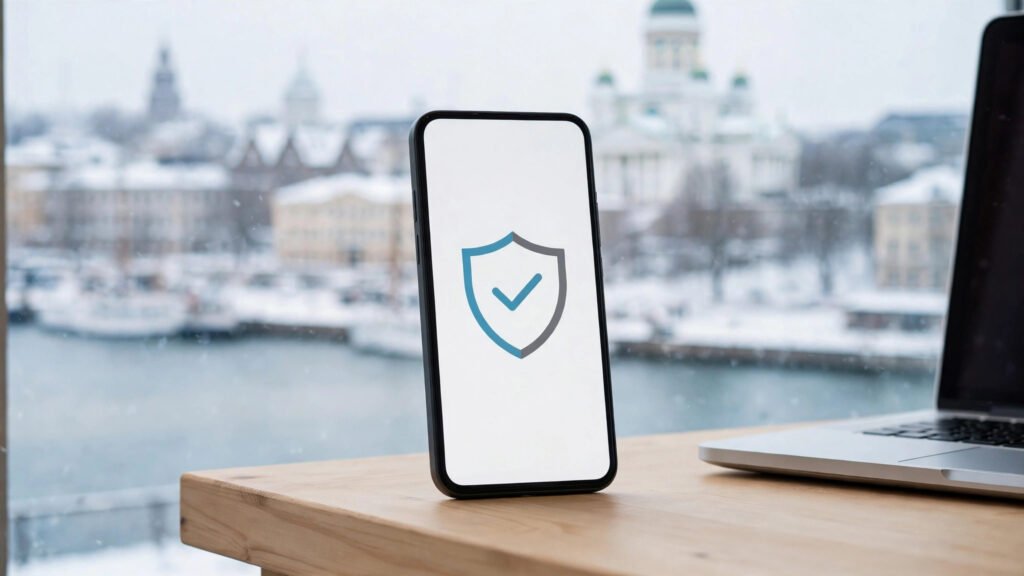
In Finland, a phone is often the key to daily life in a way that surprises visitors. Many Finns confirm their identity on a phone to log in to a bank, check a health record, sign a document, or deal with a government office. There is no single app that does all of this. Instead, a system of trusted electronic identification methods lets people prove who they are online, and the phone has become the most convenient place to carry that proof.
This is the simple answer to a question many travellers and newcomers ask: why do Finns use mobile ID for almost everything? The short version is trust, habit, and design. Banks, public services, and health services were built around secure online identification early, and people grew used to handling important tasks digitally rather than in person or on paper.
Key Takeaways
- Many Finns prove their identity online with bank identification or a mobile certificate, often confirmed on a phone.
- The same kind of strong identification opens banking, health services, and government services, so one trusted login covers many parts of life.
- The system works because services were designed around secure identification, not added to paper routines afterwards.
What Mobile ID Means in Finland
Mobile ID in Finland usually means proving your identity with a method tied to your phone or your bank. One well-known route is bank identification, where a person logs in through their own bank’s secure system to confirm who they are to another service. Another route is a mobile certificate stored on a SIM card or in a phone-based identification app, which can confirm identity with a PIN code.
These methods are not the same as simply creating a username and password. They are forms of strong electronic identification, which means the service can be confident about who is signing in. That confidence matters when the task involves money, medical records, or an official application. A weak login would not be enough for those jobs, so the identification step is deliberately stricter.
For the person using the service, the experience is usually quick. They choose their identification method, confirm on their phone or through their bank, and arrive at the service already verified. There is no need to post a form, visit an office to show a passport for every task, or remember a separate password for each authority.
Why Banking Came First
Banking is where many Finns first meet electronic identification. Online banking has been part of everyday life in Finland for a long time, and banks became trusted issuers of identification because they already checked a customer’s identity when opening an account. When other services needed a reliable way to confirm identity online, bank identification was a natural tool to reuse.
This created a helpful loop. People already had bank identification for managing money, so they could use the same method for other services without learning a new system. Services, in turn, could trust the identification because it came from a regulated bank process. Over time, paying a bill, checking an account, and signing a loan document online became normal rather than exceptional.
That banking habit also shaped expectations. If a bank transfer can be confirmed securely on a phone, people reasonably expect a tax form or a health appointment to work in a similar way. As with phone-first habits elsewhere, South Koreans use their phones for almost everything too, but Finland’s route runs especially through trusted identification rather than through one dominant super-app.
One Login for Health, Tax, and Everyday Services
The real difference shows up when the same identification opens many doors. A person might use it to check laboratory results or book a health appointment, then use it again to file a tax return, apply for a benefit, or sign a rental agreement. Public services in Finland are widely available online, and strong identification is the gate that keeps personal records private while still letting the right person reach them.
This matters most for services that hold sensitive information. Health records, prescriptions, and tax details should not be available to anyone who guesses a password. Strong identification reduces that risk while keeping access fast for the person the records belong to. It also helps services avoid duplicate accounts and mistaken identities, because the identification is tied to a verified person rather than to an email address alone.
For newcomers, the adjustment can feel strange at first. A task that might involve a paper form elsewhere is completed after a phone confirmation in Finland. But once identification is set up, the same method repeats across services, so the learning effort is paid back again and again.
The system works because services were designed around secure identification, not added to paper routines afterwards.
Why the Phone Became the Centre of It
The phone won this role because it is almost always with its owner. A bank identification check or a mobile certificate confirmation can be done wherever the person is, without a separate card reader or a computer. That convenience matters in a country where distances can be long and where people expect to handle errands without travelling to an office.
Phones also make the security step visible. A confirmation request appears on the phone, the person checks what they are approving, and they enter a PIN. That pause is part of the design. It turns an invisible login into a deliberate approval, which helps people notice if something unexpected is being asked of them.
At the same time, the phone is not the only option. People who prefer a computer can often identify themselves through a bank’s website, and help is available for those who cannot use a phone-based method. The point is not that every single task must happen on a phone, but that the phone has become the easiest route for most people, most of the time.
- Bank identification lets many Finns confirm identity through their own bank’s secure login.
- A mobile certificate or identification app turns the phone into a trusted way to approve logins and signatures.
- Strong identification protects health, tax, and banking services while keeping them quick to reach.
- The same trusted method works across many services, so people do not need a new identity for each one.
What About Privacy and Safety?
Using one identification method across many services raises fair questions about privacy. The important detail is that identification is not the same as sharing all your data. Confirming who you are to a health service does not give that service your bank balance, and logging in to a tax service does not hand it your medical history. Each service still holds only the information it needs for its own job.
Safety also depends on habits. A PIN should stay private, a phone should be locked, and a confirmation request should be read before it is approved. If a phone is lost, the identification method can be blocked through the bank or the service provider, which limits what anyone else can do with the device. No system removes risk entirely, but strong identification plus careful habits makes casual misuse much harder than a simple password would.
Finland’s approach also shows why a cashless or phone-first habit alone is not the whole story. In Norway, for example, Norwegians barely use cash anymore because card and phone payments became the norm, while in the Netherlands the Dutch pay with Tikkie and iDEAL instead of cash and cards. Finland goes a step further: the phone does not just move money, it proves identity for the services behind the money.
What to Watch Next
Finland’s mobile ID habit is likely to keep spreading into more everyday tasks, because the same trusted identification can be reused wherever a service needs to know who is signing in. The phone will probably stay at the centre of that habit, since it is convenient, personal, and able to show a clear approval step. What will matter most is keeping the balance the system already aims for: fast access for the right person, strong protection for sensitive records, and workable alternatives for anyone who cannot use a phone-based method. If that balance holds, mobile ID will remain less of a novelty and more of a quiet background habit — the ordinary way Finns get things done.