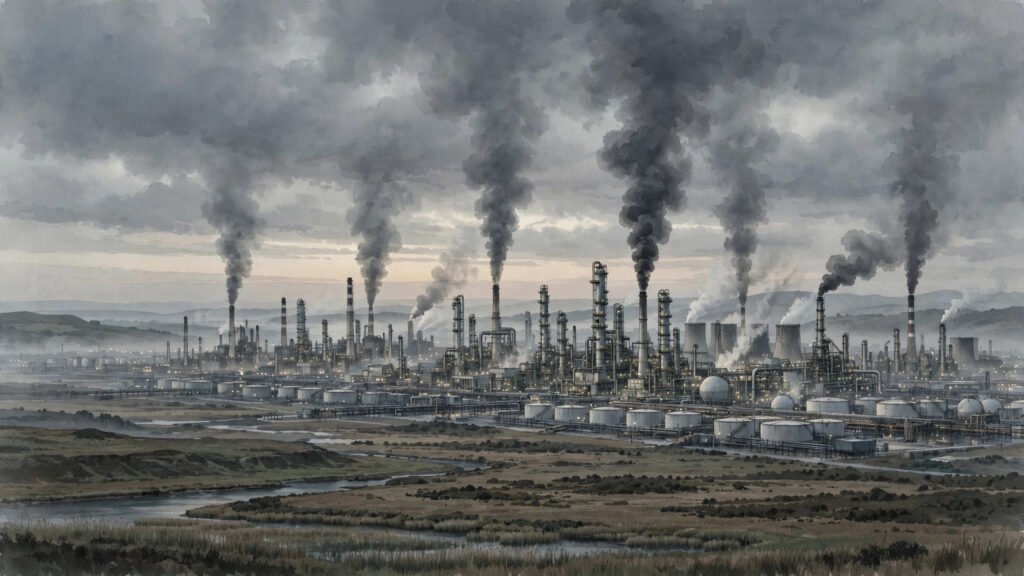
Ukraine struck an oil refinery in Russia’s Samara region early on Friday, October 30, ending a two-week pause in attacks on Russian refineries that had been reported only a day earlier. The strike, on the Novokuibyshevsk refinery, sent columns of smoke over the plant and reopened a campaign that Washington had pressed Kyiv to hold back until after the United States midterm elections.
Videos and photographs shared by residents and monitoring channels showed multiple fires burning across the refinery site in the hours before dawn. The Ukrainian drone maker Fire Point said its FP-1 drones had struck the plant and that one of the units hit hydrotreats diesel fuel. The refinery is owned by Russia’s state-controlled oil company Rosneft and processes about 8.8 million tonnes of crude oil a year, producing aviation fuel, gasoline, diesel, lubricants and other petroleum products.
Key Takeaways
- Ukraine struck the Novokuibyshevsk refinery in Russia’s Samara region overnight on October 30, according to multiple news reports and monitoring channels.
- The strike ends a two-week pause in refinery attacks that the Wall Street Journal reported on October 29, a pause linked to pressure from the Trump administration.
- Fire Point said its FP-1 drones hit the plant, including a unit that hydrotreats diesel fuel, while the full extent of the damage has not been confirmed.
What happened overnight
Residents of Novokuibyshevsk, a city beside Samara on the Volga river, reported drones, explosions and fire before dawn on October 30. The Ukrainian monitoring channel Exilenova+ published the first photographs at 05:24 Kyiv time, and the independent Russian outlet Astra geolocated the fire to the refinery from residents’ photographs. By morning, Exilenova+ counted at least 11 separate fires at the plant, while other counts put the number of smoke columns at six or more. The differing counts reflect how the event was seen from different viewpoints, not a settled damage assessment.
Samara’s regional governor, Vyacheslav Fedorishchev, said air defence and mobile fire teams were repelling an attack and urged residents to remain calm and in a safe place. He did not at that stage specify which objects had been attacked. The Kyiv Independent later reported that Fedorishchev said two people died in Samara Oblast while clearing up the aftermath of the drone attack. The Kyiv Independent also noted that it could not independently verify the footage or establish the extent of the damage, and that Ukraine’s General Staff had not claimed the strike at the time of its reporting.
That caution matters. The strike is reported by the Wall Street Journal, the Kyiv Independent, Euromaidan Press and other outlets, and the fire at the refinery site is documented in resident footage. But the precise damage to individual units, beyond Fire Point’s statement about the diesel hydrotreating unit, has not been confirmed by an independent on-the-ground assessment. Readers should treat the strike itself as widely reported and the damage picture as still developing.
Why the pause mattered
The strike lands one day after the Wall Street Journal reported a reported pause in refinery strikes, an unofficial halt that the Journal said began in mid-October after weeks of pressure from United States President Donald Trump. According to that report, Ukrainian units carrying out long-range strikes were told the refinery campaign was effectively on hold once missions already under way were completed, and the pause was expected to last until after the midterm elections on November 3 and potentially deeper into November.
Trump has publicly blamed Ukraine’s refinery strikes for high global fuel prices, a claim energy experts have mostly attributed to the United States-Iran war instead. The Journal also reported that United States envoy Jared Kushner repeated the demand to stop hitting refineries at a meeting with Ukrainian President Volodymyr Zelenskyy on October 20 in Oslo, and that some of Kyiv’s European backers had nudged Zelenskyy to pause until after the midterms. Zelenskyy himself told reporters in Kyiv on Tuesday that Ukrainian forces had been more careful in recent days, but that they did not have an order not to hit refineries.
The last attack on Russian oil infrastructure before this strike was on October 20, when Ukraine hit an oil pumping station on the Druzhba pipeline in Russia’s Tambov region, and the last refinery hit before that was on October 15. The Novokuibyshevsk plant had itself been hit before, in August 2026, when Ukrainian forces struck the facility and caused a fire. The October 30 strike therefore breaks a sequence that had held for about two weeks, and it does so against the advice reported from European allies, who had urged Kyiv to hold off until after the midterms to reduce tensions with Washington.
The strike, if confirmed in full, would turn a reported pause into a short-lived one, and it would do so before the elections it was meant to outlast.
What is known, and what is not
What is known is the location, the timing and the broad shape of the event: an overnight drone attack on the Novokuibyshevsk refinery in Samara Oblast on October 30, fires and smoke columns documented in resident footage, a statement from Fire Point about its FP-1 drones, and a response from the Samara governor confirming a drone attack on the region. The plant’s scale and output are also a matter of public record: a Rosneft refinery processing about 8.8 million tonnes of crude a year, and one of the main producers of jet fuel for the Russian armed forces.
What is not yet known is the full extent of the damage, whether the plant’s output has been reduced and for how long, and how Kyiv will characterise the strike once its General Staff speaks. Energy markets are sensitive to any disruption to Russian refining, and the strike comes in a week when tanker fires in the Strait of Hormuz and wider oil prices have already kept traders on edge. No confirmed figure for lost refining capacity has been published, and none should be assumed from the number of smoke columns alone.
- The Novokuibyshevsk refinery in Samara Oblast was struck overnight on October 30, 2026.
- Fire Point said its FP-1 drones hit the plant, including a diesel hydrotreating unit.
- The refinery is owned by Rosneft and processes about 8.8 million tonnes of crude oil a year.
- The strike is the first on a Russian refinery since October 15, ending a two-week pause.
- The pause had been reported on October 29 and linked to pressure from the Trump administration.
- The full extent of the damage has not been independently confirmed.
What to Watch Next
What to watch next is only what this article has already set out: whether Ukraine’s General Staff claims the strike and describes its target, whether Russian authorities confirm damage to the refinery and any effect on its output, whether the United States responds to a strike carried out before the midterm elections the reported pause was meant to outlast, and whether further refinery strikes follow or this proves to be a single resumption. Until those answers arrive, the verified picture is the one reported overnight: a strike on the Novokuibyshevsk refinery, fires documented in resident footage, and a two-week pause that has now ended.