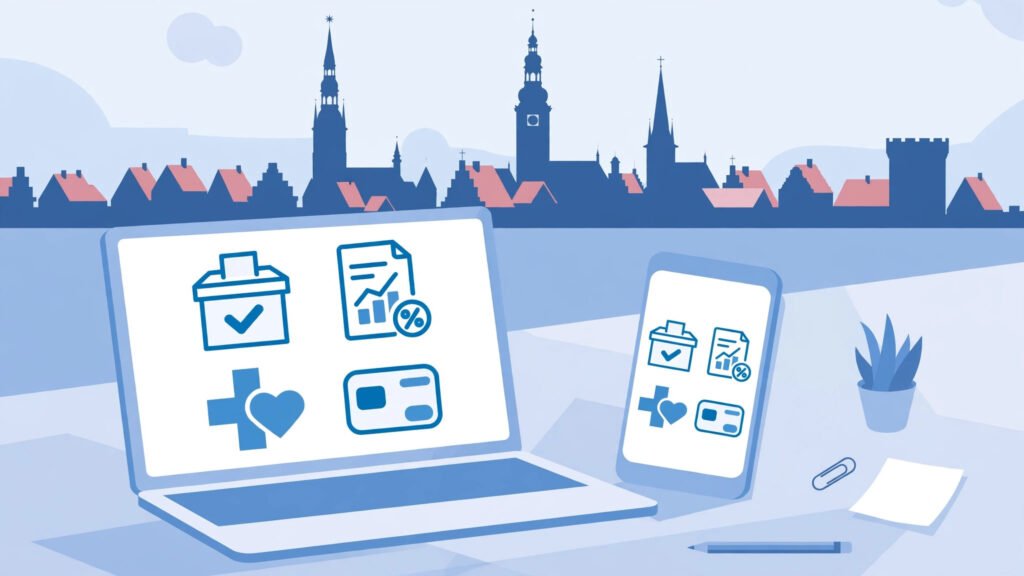
In Estonia, a small northern European country of just over a million people, everyday life runs through a screen in a way that still surprises first-time visitors. Residents file taxes in minutes, sign contracts without a pen, vote from a laptop, and check their health records online. This is not a futuristic experiment. It is ordinary life, built up step by step over more than two decades, and it has made Estonia one of the most watched digital societies in the world.
The story starts with a simple idea: the state should come to the citizen, not the other way around. Instead of queuing at government offices with paper forms, Estonians were given a secure digital identity and a set of online services around it. Over time, that idea grew into a system where nearly all public services can be used online, from registering a business to renewing a prescription.
Key Takeaways
- Estonians use one secure digital identity to reach nearly all public services online.
- Online voting, digital signatures and paperless tax filing are normal parts of daily life.
- The system rests on a data-exchange layer that lets institutions share information securely, so citizens rarely submit the same detail twice.
One ID That Unlocks Everything
At the heart of the system is the Estonian ID card, a chip card that works as proof of identity both in person and online. Alongside it, residents can use Mobile-ID on a phone SIM or the Smart-ID app. With one of these, a person can log in to government portals, banks and health services, and sign documents with a digital signature that carries the same legal weight as a handwritten one.
That single login changes the feel of bureaucracy. A contract can be signed from a kitchen table and sent in seconds. A form that once needed a trip across town becomes a task finished between other errands. For a country with a small population spread across towns, forests and islands, that convenience matters, and it is one reason digital habits took hold so widely.
Voting From the Sofa
Estonia became the first country to let voters cast ballots online in a nationwide election, in local elections in 2005, and internet voting has been part of its elections ever since. Voters identify themselves with their digital ID, cast their vote through a secure application, and can even change their vote during the advance voting period, with only the last vote counting.
Supporters point to convenience: people travelling, living abroad or working long hours can still take part. Critics raise questions about security and trust that apply to any electronic voting system, and Estonia’s system is debated and audited for exactly that reason. Whatever view a voter takes, the fact that online voting is a routine option sets Estonia apart from almost every other democracy.
Taxes in Minutes, Not Days
Tax filing is the example Estonians mention most often. Because employers, banks and other institutions already report income data to the tax authority, most residents find their tax return largely pre-filled when they log in. They check the figures, confirm, and are done — a process that takes minutes for many people, rather than an evening with receipts and forms.
The same joined-up thinking runs through other services. When data already held by the state can be reused securely, citizens are not asked to supply it again. That principle — sometimes called “once only” — is what makes the system feel fast rather than merely digital.
Health Records That Travel With You
Estonia’s health system is also built around shared digital records. Doctors can see a patient’s history, prescriptions and test results through the national health information system, and patients can view their own records and prescriptions online. A prescription issued in one town can be collected at a pharmacy in another, because the prescription itself lives in the system rather than on a piece of paper.
For patients, that means less repeating of the same story at every appointment and less paper to carry. For doctors, it means decisions made with fuller information. As in other countries, privacy rules and access controls sit behind all of this, and patients can see who has looked at their records.
Business Without the Paperwork
Starting a company in Estonia is famously quick. Through the online business register, founders can register a company, file annual reports and manage routine paperwork without visiting an office. That ease of doing business is part of why Estonia also created e-Residency in 2014, a programme that lets people from other countries obtain a government-issued digital identity and run a location-independent business through Estonian online services, even though e-Residency is not citizenship or a right to live in Estonia.
The programme attracted freelancers, founders and small firms around the world who wanted to invoice clients, sign contracts and manage a company online. It also showed how far the Estonian model could travel: the same digital identity idea, offered to people who may never set foot in the country.
In Estonia, the question is rarely whether a service is online — it is why any service would still need a paper form.
Why Other Countries Look to Estonia
Other countries have copied parts of the model, but few have matched its breadth. The difference is not one single app. It is the combination: a trusted digital identity, a secure data-exchange layer known as X-Road that lets public and private systems talk to each other, and laws that give digital signatures and digital records real legal standing.
Digital habits are spreading everywhere, of course. In Kazakhstan, many people now reach for one super-app for payments and daily tasks, in Norway, technology has reshaped everyday transport, and in Uruguay, schoolchildren were each given their own laptop as part of a national digital education push. Estonia’s version stands out because it reaches across the whole state, not just one sector.
- One digital identity opens government, banking and health services.
- Internet voting has been available since 2005 and remains part of elections.
- Tax returns arrive largely pre-filled, so filing takes minutes for many residents.
- Health records and prescriptions are shared digitally between doctors and pharmacies.
- Companies can be registered and run almost entirely online.
What to Watch Next
Estonia’s digital state keeps evolving, and the questions around it evolve too. Security experts keep testing the voting system, privacy debates continue over how much data should be shared between institutions, and other countries keep borrowing pieces of the model for their own services. The next steps are less about adding another app and more about keeping trust in the system as it grows.
For anyone curious about how a whole country moved online, Estonia remains the clearest working example: not a promise of a digital future, but a place where that future is already part of paying taxes, seeing a doctor and casting a vote.