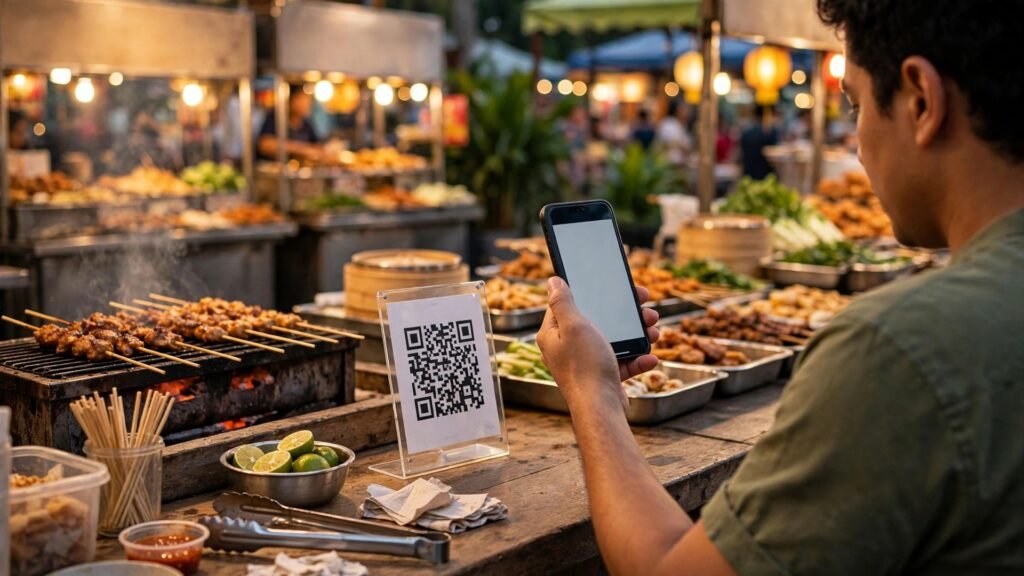
In Malaysia, paying often starts with a small black-and-white square. At a hawker stall, a neighbourhood cafe, a night market or a petrol station counter, the seller shows a printed QR code, the buyer opens a bank app or an e-wallet, scans it, checks the amount, and the payment is done. No notes change hands, no card is tapped, and no change is counted. That is why so many people ask: why do Malaysians scan QR codes to pay instead of using cash or cards?
The short answer is that one shared QR system made phone payments simple enough for almost any seller to accept. Cash still works, and cards still work, but a QR code costs a small trader almost nothing to display, and it lets a buyer pay from an app they already use every day. In a country where phones are part of daily life and small businesses are everywhere, that combination is hard to beat.
Key Takeaways
- Malaysia’s shared DuitNow QR standard lets many different bank apps and e-wallets pay the same code.
- A printed QR code is cheap and easy for small traders, hawkers and market sellers to accept.
- Cash and cards still have a place, but QR payments fit quick, everyday purchases best.
Why One QR Code Works Almost Everywhere
The key idea behind QR payments in Malaysia is interoperability. Rather than each bank or wallet having its own code that only its own customers can scan, the DuitNow QR standard means a code shown by one seller can usually be paid from many different apps. A buyer does not need to ask which wallet the seller uses, and a seller does not need to print a different code for every app. That removes the awkward moment that slows down new payment methods everywhere: the fear that the other person’s app will not work with yours.
For small sellers, the advantage is practical. A card terminal needs hardware, a connection and often a monthly arrangement, while a printed QR code can sit on a counter, a stall front or a laminated card by the till. A hawker selling noodles, a florist at a morning market or a barber in a small shop can accept phone payments without changing how the shop itself works. The customer scans, the seller sees a confirmation, and the queue keeps moving.
For buyers, the advantage is familiarity. Most people already carry a banking app or an e-wallet on their phone for transfers, bills or transport. Paying by QR code is one more use of the same app, not a new habit to learn. The steps are short, the amount is shown before confirming, and the payment record stays in the app for later checking.
How QR Payments Fit Daily Life in Malaysia
QR payments fit the rhythm of everyday spending in Malaysia, which is full of small, frequent purchases. Breakfast at a kopitiam, a drink from a street vendor, groceries from a wet market, a top-up at a phone shop or a meal at a mamak restaurant are all moments where cash used to be the default. A QR payment keeps those moments quick: there is no searching for small notes, no waiting for change, and no need to carry a wallet full of coins for the rest of the day.
The same pattern works for slightly larger everyday spending. Cafes, pharmacies, clinics, bookshops and convenience stores commonly display a QR code at the counter, so a buyer who is already paying by phone for a coffee can pay the same way for medicine or stationery. Because the code is the same kind of square everywhere, the habit transfers easily from one shop to the next, and new users can copy what they see friends and family doing without any instruction.
QR codes also suit Malaysia’s mix of languages and communities. A payment does not depend on reading a long menu or explaining an amount in words: the seller enters the amount or shows a fixed code, the buyer sees the number on screen, and both sides can confirm it at a glance. In busy markets and food courts, where noise and queues make conversation harder, that visual simplicity matters.
E-Wallets, Bank Apps and the Same Little Square
Malaysians do not all pay from the same app, and that is part of the point. Some people prefer an e-wallet such as Touch ‘n Go eWallet, GrabPay, Boost or ShopeePay, which they top up and use for daily spending, rewards and transport. Others prefer to pay straight from their bank’s app, so the money leaves their account directly. Because both kinds of app can scan the same DuitNow QR code, the choice is personal rather than technical: friends at the same table can pay from different apps to the same seller.
A similar pattern appears in other countries where one phone payment method has become the everyday default. In Bolivia, many people pay with QR codes and mobile wallets instead of cash and cards for much the same reason: the code is easy for small sellers to show. In Brazil, many people pay with Pix instead of cash or cards, because an instant phone transfer fits daily life. And in Bangladesh, many people pay with bKash and Nagad instead of bank cards, because the phone reaches people a card system does not always reach.
- One shared QR standard means buyers do not need the seller’s exact app.
- A printed code costs a small trader far less than a card terminal.
- Small, frequent purchases — food, drinks, markets — are where QR payments shine.
- E-wallets and bank apps both work, so the buyer chooses what suits them.
- Seeing the amount on screen before confirming builds trust in the payment.
Cash and Cards Have Not Disappeared
It would be wrong to call Malaysia cashless, because it is not. Cash remains essential in some wet markets, rural shops, older food stalls and places where a phone signal is weak or a seller simply prefers notes. Some people keep cash for budgeting, for giving to children, or for small donations and tips. Cards, meanwhile, remain popular for larger purchases, online shopping and travel, where buyer protections and instalment options matter more than speed at a counter.
People choose the method that fits the moment. Cash wins when the seller only takes notes, when a phone battery is low, or when someone wants to spend a fixed amount without opening an app. A card wins for a bigger purchase in a store with a working terminal. A QR code wins when the purchase is small, the queue is long, or the seller is a small trader without a terminal. Understanding QR payments in Malaysia means understanding that mix, not declaring one winner.
A printed QR code can sit on a counter, a stall front or a laminated card by the till, and the queue keeps moving.
What Still Holds People Back
QR payments are not without friction. A payment needs a charged phone and a working connection, and in a basement car park or a remote village either one can fail at the wrong moment. Older users, or people who rarely use banking apps, can find the first scan confusing, especially when an app asks for a password, a fingerprint or a confirmation step they do not expect. A mistaken amount, typed in by hand by the seller, is another worry, which is why checking the number on screen before confirming matters so much.
Trust is the slower part of adoption. Scams that misuse QR codes, fake codes pasted over real ones, and messages pretending to be from a bank are real worries everywhere phone payments are used. People protect themselves by scanning only codes shown by the seller, checking the merchant name on screen, and never sharing login codes with anyone. When those habits become routine, confidence grows, but a single bad experience can push someone back to cash for a long time.
Phone access itself is another limit. A lost, broken or stolen phone can temporarily lock someone out of their money, and not everyone can afford a replacement handset quickly. That is why cash remains a safety net, and why the most useful payment systems are the ones that work simply, recover gracefully, and do not punish a user for a single mistake.
What to Watch Next
Cash will remain part of daily life in Malaysia, and cards will keep their place for larger purchases and travel. What to watch instead is steadier and more telling: more hawker stalls and market sellers displaying a QR code, more everyday bills and small purchases settled from a phone, more buyers comfortable paying from either an e-wallet or a bank app, and more sellers who treat a printed code as normal as a cash box. Each small step keeps cash and cards in their place while giving Malaysians one more way to pay, and over time those steps add up to a genuinely mixed payment culture, where notes, cards and the phone share the counter rather than fighting over it.