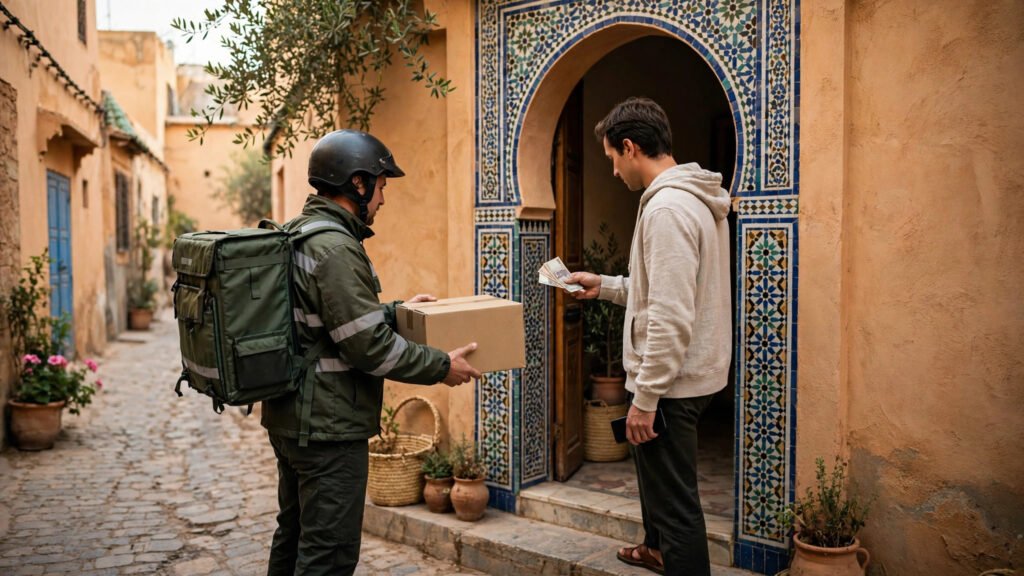
In Morocco, online shopping often follows a pattern that surprises visitors: a customer browses on a phone, places an order in a few taps, and then pays only when the parcel arrives at the door. The phone does the ordering, but cash still does the paying. This habit, known as cash on delivery, remains a defining feature of Moroccan e-commerce, even as bank cards and mobile payment apps become more common.
The question is why. The answer is not that Moroccans dislike technology. Smartphones are everywhere, social media drives product discovery, and delivery networks now reach far beyond the big cities. Cash on delivery survives because it solves a trust problem that technology alone has not yet solved: many shoppers want to see the product before they part with their money.
Key Takeaways
- Moroccans order on their phones but often pay cash when the parcel arrives, because seeing the product first feels safer.
- Cash on delivery suits shoppers without cards and small sellers who want to reach customers beyond the big cities.
- Cards and mobile payments are growing, but trust, habits and everyday cash use keep cash on delivery part of Moroccan shopping.
Ordering on a Phone Is Already Normal
For many Moroccans, the phone is the shop window. People discover clothes, electronics, cosmetics and household goods through social media pages, messaging apps and online stores, then order directly from the same device. Browsing on a phone fits daily life: it is quick, it works anywhere, and it lets shoppers compare options without travelling to a market or a mall.
This is a pattern seen in other countries too, where the phone has become the main way to shop. In Vietnam, for example, shoppers have embraced wallet apps for everyday payments, as explained in why Vietnamese shoppers pay with MoMo instead of cash and cards. Morocco’s story is different in one important respect: the ordering moved to the phone faster than the payment did.
Why Cash on Delivery Feels Safer
Paying in advance online asks the shopper to trust a seller they have never met, a product they have only seen in photos, and a delivery journey they cannot watch. Cash on delivery removes that leap of faith. If the parcel arrives damaged, late, or different from the photos, the buyer can refuse it on the spot and keep the money. That single protection matters more than convenience for many first-time online shoppers.
Trust also matters because online shopping is still relatively new for a large share of buyers. A shopper who has always bought from a market stall, where goods can be touched and checked before paying, naturally wants the same reassurance online. Cash on delivery recreates that market-stall moment at the front door.
Cash on delivery recreates that market-stall moment at the front door.
Cards Are Not Yet in Every Pocket
Another reason is practical. Not every Moroccan shopper owns a bank card, and not every card works smoothly for online payments. Some people are paid in cash, keep their savings in cash, or share a household budget that runs on cash. For them, cash on delivery is not a preference for old habits; it is simply the payment method that fits how money already moves through their lives.
Small sellers benefit too. A seller on social media can take orders through messages and send parcels through a courier without setting up a card payment system. Cash on delivery lowers the barrier to selling online, which is one reason so many small Moroccan businesses use it.
- Shoppers can inspect the parcel before paying, which builds trust in unfamiliar sellers.
- Cash fits households and workers who are paid in cash rather than by bank transfer.
- Small sellers can sell online without card payment systems or complex checkout tools.
- Delivery couriers already handle cash, so the system works with existing logistics.
What Is Changing
None of this means Morocco is standing still. Bank apps, mobile wallets and QR payments are spreading, especially among younger shoppers in cities such as Casablanca, Rabat and Marrakech. As more people grow comfortable paying online, and as return policies and buyer protections improve, some shoppers are shifting to paying in advance. Similar shifts are under way elsewhere: in Singapore, instant bank transfers have become a routine way to pay, as described in why Singaporeans pay with PayNow instead of cash and cards, and in Malaysia shoppers increasingly scan codes to pay, as covered in why Malaysians scan QR codes to pay instead of cash and cards.
In Morocco, however, change is likely to be gradual rather than sudden. Cash on delivery will probably shrink as trust grows, but it is unlikely to disappear quickly, because it serves shoppers and sellers who still live largely in a cash economy. The phone and the cash payment are not in conflict; together they describe a market in transition, adopting digital ordering first and digital payment at its own pace.
What to Watch Next
Moroccans will keep ordering on their phones, and cash on delivery will keep offering the reassurance of paying only when the parcel arrives. The balance will shift as cards, wallets and buyer protections reach more shoppers, and as trust in online sellers grows with experience. For now, the phone finds the product and cash closes the sale, and that combination continues to shape how Morocco shops online.