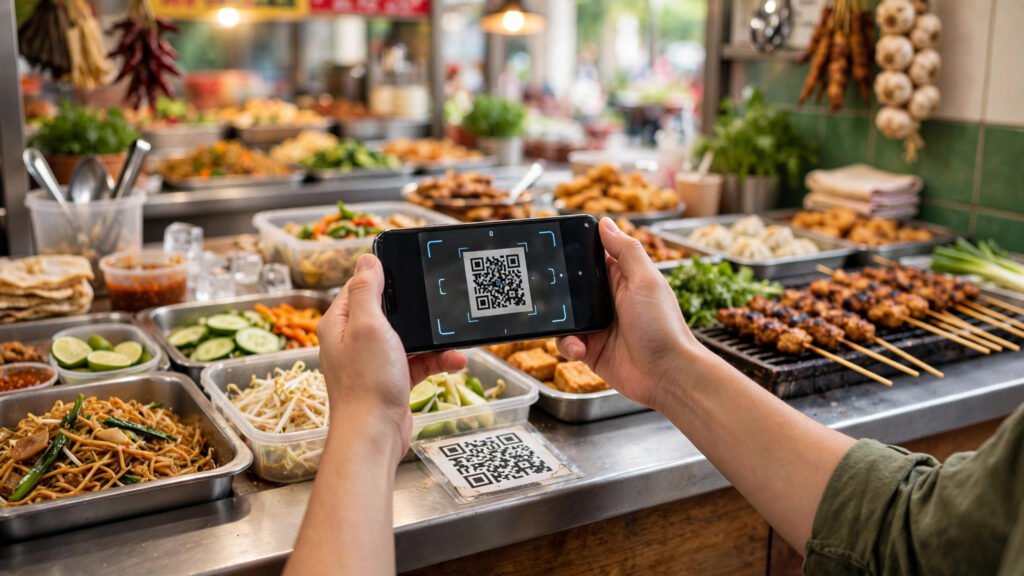
At a hawker centre in Singapore, lunch rarely ends with a hunt for coins or a card machine. The customer points a phone at a small printed code, confirms the amount, and walks away with lunch in hand. The stallholder never touches cash, and nobody asks for a bank account number. Behind that quick scan is PayNow, the payment habit that quietly became part of everyday life in Singapore.
PayNow did not ask Singaporeans to change how they live — it simply removed the most annoying step from paying. Instead of copying long account numbers, people send money to a mobile number. That one change explains why it spread from friends splitting a bill to market stalls, shops, and even government services.
Key Takeaways
- PayNow lets people send money using a mobile number instead of a bank account number.
- It works across participating banks, so the sender and receiver do not need the same bank.
- QR codes brought the same tap-free payment to hawker stalls and small shops that never had card machines.
What Is PayNow, Exactly?
PayNow is a bank-based instant transfer service in Singapore. A person links a mobile number, or a national identity number, to a bank account through their own bank. Once registered, anyone can send them money using just that number. The money moves from one bank account to another, usually within moments, without either side sharing account details.
The important detail is that PayNow is not a separate wallet that holds your money. The funds stay in your bank account. PayNow is simply the addressing system that tells the banks where the money should go. That design matters, because it keeps the familiar safety of a bank account while making the payment feel as easy as sending a message.
Why It Beat Cash at Hawker Centres
Hawker centres are the heart of everyday eating in Singapore, and for years they ran almost entirely on cash. Card machines made little sense for a small stall selling a few dollars of food at a time: the equipment costs money, and handling change slows down a lunch queue.
QR codes solved that problem neatly. A single printed code, under the shared SGQR standard, can accept payments from different banks and apps. The stallholder prints one code and sticks it on the counter. The customer scans it, types the amount, and pays. There is no change to count, no machine to maintain, and no trip to the bank with a bag of notes at the end of the day.
Why It Beat Cards Between Friends
PayNow first took off among friends and family, and the reason is simple: splitting a bill used to be awkward. One person paid the restaurant, and everyone else owed them money. Asking for someone’s bank account number felt formal, and typing a long string of digits invited mistakes.
With PayNow, settling up takes a phone number you already have in your contacts. Dinner, a shared taxi ride, or a group gift becomes a transfer that takes seconds. Because it works across participating banks, it does not matter whether your friends bank with the same institution you do. That cross-bank reach is what turned a useful feature into a national habit.
PayNow did not ask Singaporeans to change how they live — it simply removed the most annoying step from paying.
Why Singapore Built It This Way
PayNow works so smoothly because Singapore’s banks built it together rather than each launching a rival system. When the banks share one addressing system, a payment works no matter which bank sits on either side. Shoppers do not have to check compatibility before they pay, and small businesses do not have to juggle several different apps.
Trust played a role too. Because the money never leaves the banking system, people did not have to learn a new kind of account or wonder where their balance was held. PayNow felt like an upgrade to the bank account they already had, not a replacement for it. That familiarity helped older users and small traders adopt it alongside younger, phone-first customers.
PayNow Beyond Singapore’s Borders
The same idea is now travelling. Singapore’s PayNow has been linked with Thailand’s PromptPay system, letting people send money across the border using a phone number, much as they do at home. A similar cross-border QR payment link connects Singapore with Malaysia, where shoppers can pay with familiar apps on either side of the causeway.
These links follow the same pattern seen elsewhere in the region. In Thailand, PromptPay QR codes replaced cash for many everyday payments, while in Malaysia, DuitNow QR codes play a similar role. Indonesia took the same road with QRIS codes at markets and shops. Each country built its own system first, and now the systems are learning to talk to each other.
- No bank account numbers to copy or mistype — a mobile number is enough.
- Payments work across participating banks, not just within one bank.
- One printed QR code lets a hawker stall accept payments without a card machine.
- Cross-border links now extend the same convenience to Thailand and Malaysia.
Does Cash Still Have a Place?
Cash has not disappeared from Singapore. Some older residents still prefer notes and coins, and some small transactions still settle the old way. PayNow did not win by banning cash; it won by being easier in the moments where cash was a hassle — splitting bills, paying a stall, or sending money to family without a trip to an ATM.
Cards, too, are still widely used, especially for larger purchases and for shoppers who value card rewards. PayNow’s strength is the everyday middle ground: small, fast, person-to-person and person-to-stall payments where speed matters more than anything else.
What to Watch Next
PayNow’s story in Singapore is a story of friction removed: no account numbers to share, no change to count, no card machine needed at a hawker stall. Its cross-bank design made it useful from the start, and its QR codes carried it from phones between friends to counters across the island. The next chapter to watch is the one already under way — more cross-border links with neighbouring countries, and more small merchants joining a system that began with a simple idea: paying someone should be as easy as knowing their phone number.