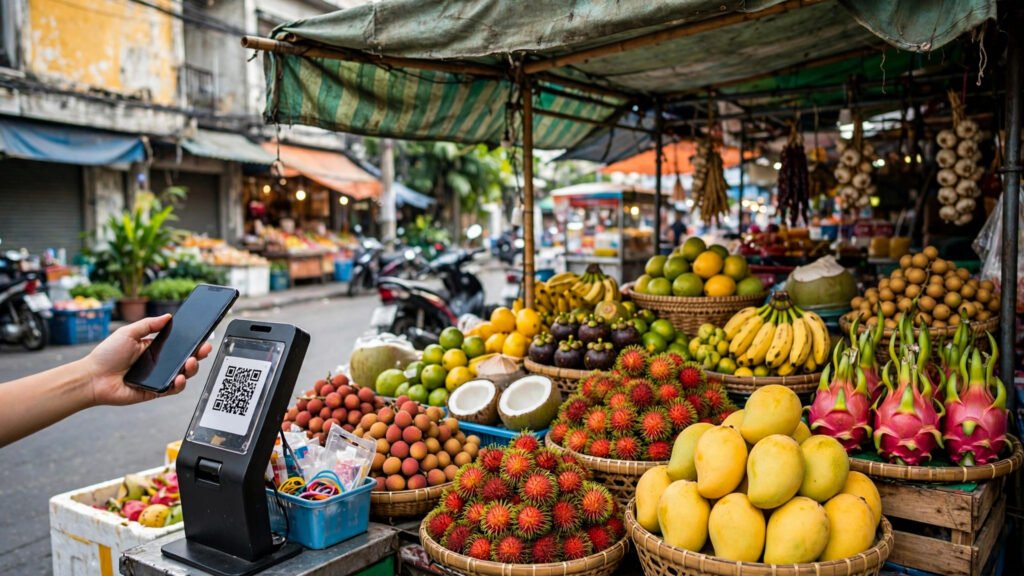
At a fruit stall in Bangkok, a shopper picks up a bag of mangoes, points a phone at a small printed square on the counter, and walks away. No coins change hands, no card is tapped, and no one asks for change. The payment took a few seconds, and the vendor never had to touch a banknote. For millions of people in Thailand, this is now an ordinary way to pay — and the system behind it is called PromptPay.
So why did Thais take to PromptPay so quickly, when cash had worked perfectly well for generations? The answer lies in how the system was built: it fits the way Thais already buy, sell, and send money, from big shopping malls to the smallest street stall.
Key Takeaways
- PromptPay links a bank account to a mobile number or national ID, so money can be sent without typing long account numbers.
- Printed QR codes made the system usable for the smallest vendors, from market stalls to motorcycle taxi drivers.
- Cash has not disappeared in Thailand, but for everyday payments the phone has become the default for millions of people.
What Is PromptPay?
PromptPay is Thailand’s national instant payment system. It was launched in 2017 as part of the country’s push toward electronic payments, with the Bank of Thailand behind the effort. The idea was simple: let anyone send or receive money using something easy to remember — a mobile phone number or a national ID number — instead of a bank account number.
To use it, a person registers through their own bank’s mobile app and links their account to their phone number or ID. After that, sending money is as simple as entering the recipient’s phone number. There is no need to ask for bank details, and the money moves between banks almost instantly. Receiving money works the same way: a vendor can print a QR code tied to their account and display it at the counter, and any customer with a banking app can scan it and pay.
Why QR Codes Won Over Cash at Thai Markets
Thailand’s daily economy runs on small transactions. Street food, fresh markets, motorcycle taxis, and neighbourhood shops all deal in small amounts, many times a day. Cash works for this, but it brings friction: vendors must carry change, count notes, and keep cash safe, while customers must visit ATMs and carry coins.
A printed QR code removes almost all of that. For a market vendor, a printed QR code costs almost nothing — and it means never having to find change again. There is no machine to rent, no card terminal to maintain, and no monthly fee to worry about. A piece of paper on the counter is enough, and the payment lands directly in the vendor’s bank account.
For customers, the phone they already carry becomes the wallet. There is nothing extra to sign up for beyond the bank account most Thais already have, and the payment takes seconds. Thailand is not the only country in the region to go down this road: Indonesia’s QRIS system works on a similar idea, giving small merchants one shared QR code for all payment apps.
How PromptPay Changed Everyday Money
PromptPay spread beyond shopping. Friends split restaurant bills by sending money to a phone number. Small businesses pay suppliers without a trip to the bank. Landlords collect rent by transfer. The government also uses the system to send welfare payments and subsidies directly to citizens’ accounts, which helped bring people who had never used digital banking into the system.
Because transfers between individuals are usually free or cost very little, there is little reason to go back to cash for person-to-person payments. The habit formed quickly: once paying by phone becomes normal among friends and family, it becomes normal everywhere else too. Across Southeast Asia, similar habits have taken hold in different forms, from Vietnam’s all-in-one apps like Zalo to national QR standards elsewhere in the region.
- No account numbers needed — a phone number or national ID is enough to send money.
- A printed QR code turns any stall, shop, or taxi into a cashless checkout.
- Money moves between banks almost instantly, even on weekends and public holidays.
- Government payments and subsidies can reach citizens directly through the system.
- Cross-border links now connect PromptPay with payment systems in neighbouring countries.
What About Tourists?
Visitors to Thailand often notice the QR codes everywhere and wonder whether they can use them too. In practice, PromptPay requires a Thai bank account, so most short-term tourists cannot sign up for it directly. Cash and cards remain the practical option for visitors, and most hotels, malls, and larger restaurants accept cards without any problem.
That may change gradually. PromptPay has already been linked with payment systems abroad, including Malaysia’s DuitNow and Singapore’s PayNow, making it easier to move money across borders in the region. For now, though, the system belongs mainly to residents — and that is exactly why it works so well for them. It was designed around Thai daily life, not around visitors.
For a market vendor, a printed QR code costs almost nothing — and it means never having to find change again.
What to Watch Next
PromptPay’s rise shows how a payment system succeeds when it fits everyday life: easy to join, free or cheap to use, and useful at the smallest stall as well as the biggest store. Cash is still part of Thai life, especially for older people and in rural areas, and it is unlikely to vanish entirely. The questions now are whether tourist access to QR payments will widen, whether cross-border links will keep expanding, and whether the QR code on the counter remains Thailand’s favourite way to pay as newer payment methods arrive.