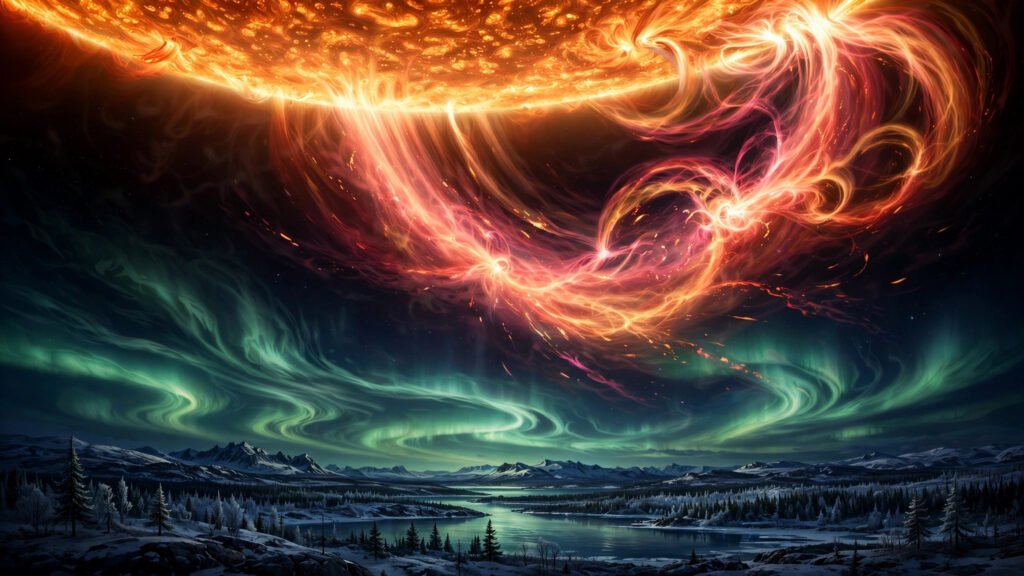
A minor geomagnetic storm watch is in effect for October 31 and November 1, 2026, as forecasters track a fast stream of solar wind heading toward Earth — and it arrives just days after the Sun threw off a prominence about 500,000 kilometres long. The United States Space Weather Prediction Center issued a G1, or minor, geomagnetic storm watch on October 29, with storming expected on October 31 and November 1 and no storm conditions predicted for October 30. The watch is the lowest level on the five-point geomagnetic storm scale, but it is still a signal for skywatchers at high latitudes: auroras may appear farther from the poles than usual, while most people and most technology should notice little or nothing at all.
The trigger for this watch is not a major solar flare. According to the forecast discussion summarised with the watch, the expected disturbance comes from a recurrent coronal hole high-speed stream — a fast flow of charged particles escaping through a gap in the Sun’s outer atmosphere — that was expected to begin arriving late on October 30 and continue into October 31. Solar activity was described as very low at the time of the watch, with no significant flare activity reported, which helps explain why the forecast stops at G1 rather than rising to stronger levels.
Key Takeaways
- A G1 minor geomagnetic storm watch is valid for October 31 and November 1, 2026, issued by NOAA’s Space Weather Prediction Center on October 29.
- The expected driver is a coronal hole high-speed stream, not a major solar flare, with solar activity described as very low.
- A separate giant solar prominence about 500,000 kilometres long erupted on October 29, but scientists said its main mass was heading away from Earth.
What a G1 Storm Means
Geomagnetic storms are ranked from G1, minor, to G5, extreme, based on how strongly Earth’s magnetic field is disturbed. A G1 storm is the mildest category. Its potential impacts are mainly felt poleward of 60 degrees geomagnetic latitude, where power systems may see weak fluctuations and where auroras can become visible. High-latitude observers, including people in the northern tier of the United States such as northern Michigan and Maine, were named in forecasts as having a chance to see visible auroras during this event.
For most readers, the practical meaning is reassuring rather than alarming. A G1 watch does not mean a storm is certain, and it does not mean widespread disruption. Forecasts describe geomagnetic activity rising to a Kp index of 5.0, the threshold for G1, and some forecasts noted that activity could briefly strengthen before easing. The geomagnetic situation was expected to stabilise in early November, according to forecasts reported on October 30. In other words, this is a watch to look up for, not a warning to prepare for damage.
A G1 watch does not mean a storm is certain, and it does not mean widespread disruption.
Elsewhere this week, Mayon volcano in the Philippines was under an alert-level warning, a reminder that natural-event alerts, from volcanoes to space weather, are issued on forecasts that can still change. NASA’s Astronomy Picture of the Day for October 31, 2026, captured the same mood from the ground: a night scene from Hverir in north-eastern Iceland, where green auroras danced over steaming geothermal ground. Its explanation noted that auroral activity on Earth remains in a high state as the Sun is only in the early phases of decline from the peak of its solar activity cycle. That context matters, because even in a quiet week for flares, the Sun can still produce striking night skies when the solar wind lines up.
The 500,000-Kilometre Prominence
Separately, space telescopes captured an unusually large solar prominence on October 29. A prominence is a huge cloud of relatively cool gas held above the Sun’s surface by its magnetic field, and this one stretched about 500,000 kilometres — several times the diameter of Earth. The Laboratory of Solar Astronomy at the Space Research Institute reported the eruption, with images captured by the SUVI telescope aboard the GOES-R satellite between about 8:30 a.m. and 5:00 p.m. Moscow time on October 29.
What makes this eruption less threatening than its size suggests is its direction. The prominence erupted on the edge, or limb, of the Sun’s visible disk, so its main mass was directed to the side rather than straight at Earth. According to the laboratory’s assessment, of the nearby planets, only Mars appears to lie in its path, and the gas cloud could still graze Earth with its edge, although the consequences in that case would be minor. The laboratory said there was little reason for serious concern so far, and that the likelihood of a serious magnetic storm caused specifically by this ejection was low.
That distinction is important for readers following space weather news. A dense filament striking Earth directly can, in general, cause strong geomagnetic storms, but a glancing blow from the edge of a sideways eruption is a different event. The prominence is therefore best understood as a spectacular solar event in its own right, rather than as the cause of the G1 watch, which forecasters linked to the coronal hole stream instead.
- G1 is the lowest level on the geomagnetic storm scale, from G1 minor to G5 extreme.
- The watch was issued on October 29, 2026, and is valid for October 31 and November 1, 2026.
- The driver is a recurrent coronal hole high-speed stream expected from late October 30 into October 31.
- Auroras may be visible at high latitudes, including northern Michigan and Maine.
- The October 29 prominence measured about 500,000 kilometres, several times Earth’s diameter.
- Scientists said the prominence’s main mass was heading away from Earth, with only a possible minor glancing effect.
What to Watch Next
What to watch next is what the article has already set out: whether geomagnetic activity reaches G1 levels on October 31 as forecast, whether auroras appear at high latitudes, and whether conditions ease as expected into early November. The other test is whether the edge of the giant prominence produces any detectable glancing effect, or whether, as scientists assessed, it passes largely to the side. Until those observations come in, the picture remains a forecast, not an outcome: a minor storm watch for the weekend, a spectacular eruption on the Sun’s edge, and a night sky worth looking up at for those far enough north.