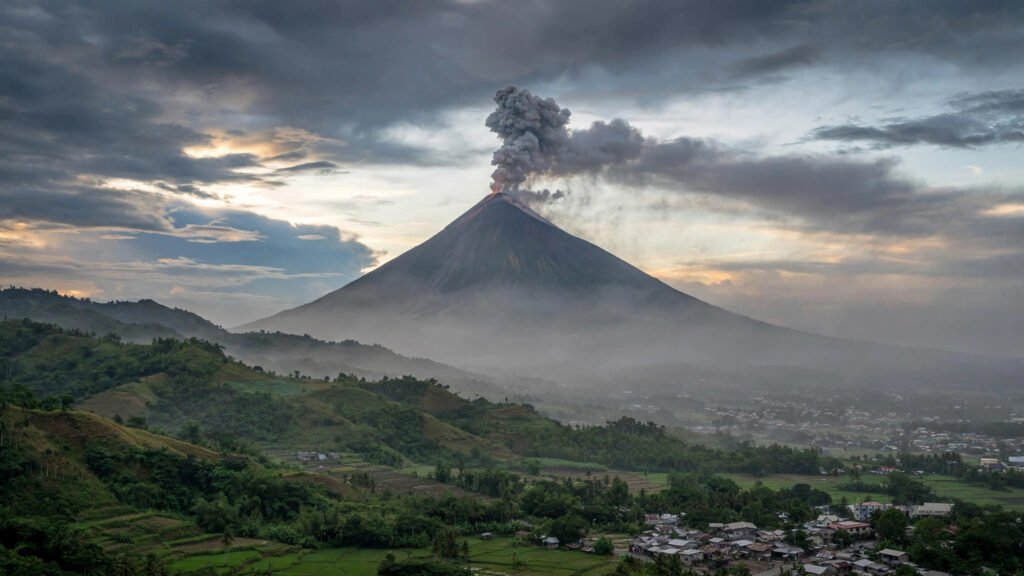
Mayon Volcano in Albay, Philippines, erupted on Friday, October 30, 2026, sending a tall ash plume into the sky and forcing hundreds of families from their homes, as the Philippine Institute of Volcanology and Seismology (PHIVOLCS) raised the volcano’s alert status to Level 3.
PHIVOLCS reported a moderately explosive eruption at around 11:53 a.m. on Friday. The eruption lasted about six minutes and produced a greyish plume that rose approximately 3,000 metres above the crater before drifting west-southwest. The event prompted the agency to raise the alert level from Level 2 to Level 3, which signals intensified unrest and an increased tendency toward a hazardous eruption.
Key Takeaways
- Mayon Volcano erupted on October 30, 2026, with a plume rising about 3,000 metres above the crater.
- PHIVOLCS raised the alert to Level 3, warning of possible lava flows, pyroclastic currents and rockfalls.
- More than 700 families were evacuated, and entry into the 6-kilometre Permanent Danger Zone is prohibited.
Alert Level 3: What It Means
At Alert Level 3, Mayon is considered to be in a state of intensified unrest. PHIVOLCS warned that the volcano could produce hazardous activity including lava flows, pyroclastic density currents, rockfalls, landslides, ballistic fragments and moderate-sized explosions. The agency also warned of possible lahars, or sediment-laden streamflows, along channels draining the volcano, particularly during heavy and prolonged rainfall.
Entry into the 6-kilometre Permanent Danger Zone around the volcano is prohibited, and PHIVOLCS advised that aircraft should not fly close to the volcano. Residents in affected areas were advised to follow official guidelines and stay away from the danger zone.
Entry into the 6-kilometre Permanent Danger Zone around the volcano is prohibited, and residents in affected areas were advised to follow official guidelines.
More Than 700 Families Evacuated
More than 700 families were evacuated in parts of Albay after the eruption, according to the Albay Provincial Information Office. As of 5 p.m. on Friday, a total of 746 families, or 2,041 individuals, had been evacuated, the Albay Public Safety and Emergency Management Office (APSEMO) reported.
Tabaco City implemented a mandatory evacuation for its residents after the eruption. The Provincial Disaster Operation Center of APSEMO was placed on red alert to ensure coordination with local government units and response clusters.
The eruption followed a period of heightened activity at the volcano. In its monitoring summary issued on Saturday, PHIVOLCS recorded 15 volcanic earthquakes and 30 rockfall events during the monitoring period, a sign that unrest at the volcano was continuing.
- Moderately explosive eruption on October 30, lasting about six minutes
- Ash plume rose approximately 3,000 metres above the crater
- Alert Level raised from Level 2 to Level 3
- 746 families, or 2,041 people, evacuated as of Friday evening
- 6-kilometre Permanent Danger Zone closed to entry
Ash Emission Reported Again on Saturday Morning
On Saturday morning, October 31, Mayon again showed signs of unrest. PHIVOLCS reported an ash emission from the summit crater, captured on camera at 5:17 a.m., a day after the main eruption. Alert Level 3 remained in effect over the volcano.
Authorities continued to monitor the volcano closely, with ashfall expected in nearby municipalities depending on wind direction. On Friday, ashfall was expected in Daraga, Guinobatan, Camalig and nearby municipalities in Albay, based on the prevailing wind conditions.
For communities around Mayon, the days ahead will depend on whether the volcano’s unrest eases or escalates. Evacuations during natural disasters often test local response systems, and in Albay the red-alert coordination is now central to keeping evacuated families safe. Similar sudden natural events, such as the glacial lake outburst flood in Bhutan, show how quickly conditions can change for nearby communities.
Volcanic activity is also part of daily life in other parts of the world. In Iceland, for example, communities have learned to live alongside volcanic landscapes, as explained in why Icelanders heat their homes with geothermal energy from volcanoes, although the risks at Mayon at Alert Level 3 are of a different and more immediate kind.
What to Watch Next
What happens next at Mayon will be decided by PHIVOLCS monitoring in the coming days. The agency will watch for further eruptions, volcanic earthquakes and rockfall events, and whether Alert Level 3 remains in place or changes. Evacuated families will be watching for official advice on when it is safe to return home, while authorities will keep the 6-kilometre Permanent Danger Zone closed until conditions allow otherwise. Residents are advised to follow official guidelines and avoid entering the danger zone.