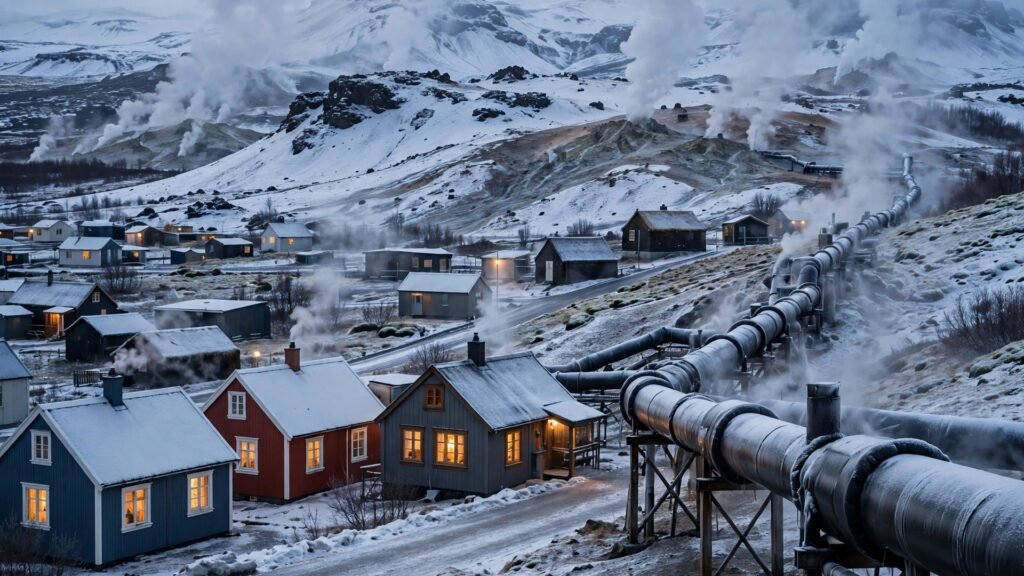
On a cold Icelandic morning, the snow stays on the roofs, the windows glow warm, and thin plumes of steam rise from the hillsides. It looks like a village living next to a volcano, and in a sense, that is exactly what it is. In Iceland, the ground itself does much of the work that a boiler does elsewhere.
For most Icelandic homes, heating does not begin with a furnace burning fuel in the basement. It begins deep underground, where volcanic heat warms water held in rock. That hot water is brought to the surface, carried through insulated pipes, and delivered to towns and homes as part of a shared heating network. It is one of the most distinctive everyday systems in the country, and it shapes how Icelanders live through long, dark winters.
Key Takeaways
- Iceland’s volcanic geology heats groundwater, which is then piped to homes through district heating networks.
- Geothermal heat warms houses, tap water, greenhouses, swimming pools and, in some places, pavements.
- The system fits Iceland because of its geology, but it depends on local hot water and a costly pipe network.
Why Iceland Sits on a Natural Heater
Iceland is a volcanic island, formed where two of the Earth’s great plates pull apart. That restless geology means hot rock sits unusually close to the surface in many places, and groundwater that seeps down into that rock comes back up hot. Where the heat is strong enough, steam and hot water reach the surface on their own, in hot springs and steaming ground.
Icelanders have used that heat for a very long time. Hot springs were places to bathe, wash clothes and cook food long before modern pipes existed. What changed in the twentieth century was scale: engineers learned to drill wells, capture the heat in a controlled way, and move it to where people actually live. A curiosity of nature became a public utility.
That history matters because it explains why the system looks so different from heating in most other countries. Elsewhere, heat is usually made inside each building, one boiler at a time. In Iceland, heat is often made in one place and shared across a whole town.
How Hot Water Reaches a Home
The heart of the system is district heating. Hot water from geothermal wells is pumped into a network of insulated pipes that run under streets and across the countryside to homes, schools, offices and hospitals. Inside a house, the hot water passes through a heat exchanger, which transfers its warmth to the radiators and the hot tap water without mixing the two supplies.
Because the water arrives already hot, a typical Icelandic home needs little extra equipment to stay warm. There is no coal bunker, no oil tank and, in homes connected to the network, no gas boiler to maintain. The radiators simply do their job, quietly, through the winter.
The same network explains a small detail visitors often notice: Icelandic tap water can smell faintly of sulphur. That is the natural character of geothermal water, and it is a reminder that the heat in the radiator and the water in the shower share the same volcanic origin. Cold tap water, by contrast, comes from separate cold springs and tastes fresh.
In Iceland, the ground itself does much of the work that a boiler does elsewhere.
What Geothermal Heat Does Beyond Radiators
Heating homes is only the most visible use. Once a town has a supply of cheap, steady heat, people find many other uses for it, and Iceland is full of examples.
Greenhouses are one of the best known. With geothermal heat, growers can keep glasshouses warm through the Icelandic winter and grow tomatoes, cucumbers and herbs that would otherwise never survive outdoors. That is why fresh local produce appears in Icelandic shops even in the depths of winter.
Swimming pools are another. Icelanders swim outdoors all year round, in pools kept warm by geothermal water, and the pool is a social place as much as a sporting one. Friends meet, families gather and neighbours catch up in the warm water while snow falls around them.
In some areas, heat is even piped under pavements and roads to melt snow and ice, keeping walkways safer in winter. Fish drying, food processing and other industries also use geothermal heat where it is available. The same underground resource that warms a living room can warm a whole working day.
- District heating carries geothermal hot water from wells to whole towns through insulated pipes.
- Geothermal heat warms homes, tap water, greenhouses and outdoor swimming pools.
- The system grew out of Iceland’s volcanic geology and a long history of using hot springs.
- Its limits are geology and distance: it works best where hot water is close to where people live.
Why This System Fits Iceland So Well
Three things come together in Iceland. First, the geology supplies the heat, reliably and without burning fuel. Second, the population is concentrated enough in towns and cities for a pipe network to make sense. Third, the climate makes heating a necessity for much of the year, so the investment in pipes pays back in comfort every winter.
That combination is also why the model is hard to copy wholesale elsewhere. A country without volcanic heat close to the surface cannot simply build the same system. It can use other kinds of district heating, including heat pumps and waste heat from industry, but it cannot drill into the same geology. Iceland’s advantage is literally under its feet.
There are trade-offs, too. Building and maintaining a pipe network is expensive, and pipes lose some heat on long journeys, so the system works best near the heat source. Geothermal fields also need careful management so that water and pressure are not drawn down faster than nature replenishes them. Iceland’s answer has been to treat geothermal fields as a resource to be managed over decades, not emptied in a rush.
For Icelanders, though, the everyday result is simple and easy to take for granted: a warm house in a cold climate, heated by the island itself. When visitors ask why the pavements steam, why the pools stay open in winter, or why so many data centres built in Iceland look to the same clean energy, the answer usually comes back to the same underground heat. It even shapes daily life during winter storms, when a warm home and a charged phone matter more than ever, and it sits alongside the wider Nordic turn to cleaner energy seen in Norway’s electric cars.
What to Watch Next
Geothermal heating in Iceland is not a finished story. Towns continue to extend their networks, growers keep finding new uses for steady heat, and engineers keep learning how to manage geothermal fields for the long term. The question for the years ahead is how far this island model can go: more homes connected, more industries warmed, and more of Iceland’s daily life running on heat from below. What will not change is the starting point. In Iceland, winter warmth begins not in a boiler, but in the volcanic ground itself.