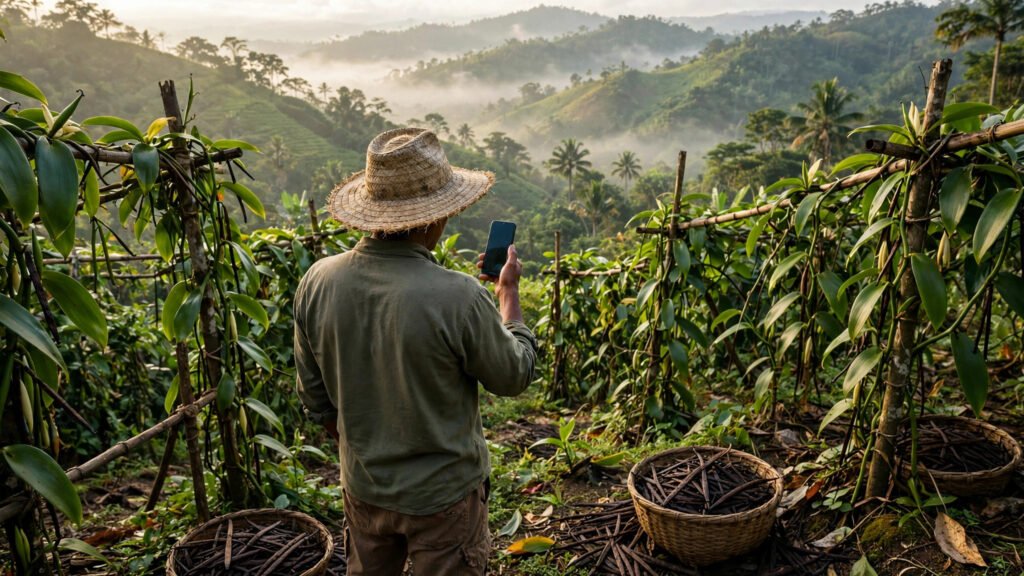
In the vanilla-growing areas of Madagascar, the sale of a harvest is rarely a quick decision. Vanilla vines take time to grow, flowers must be pollinated by hand, and the pods must be picked, cured and dried before they are ready to sell. After months of work, a farmer faces a simple but important question: is this the right moment, and the right buyer, for this crop?
More and more often, the first step is not a trip to market. It is a phone check. A farmer may call a neighbour, message a buyer, or ask in a farming group what others have been offered. That short check, made before any deal is agreed, can change what a season’s work is worth.
Key Takeaways
- Malagasy vanilla farmers check their phones before selling because vanilla prices can vary by buyer, quality and timing.
- A price check lets a small grower compare offers instead of accepting the first price on the table.
- Phones also carry weather and transport information that affects drying, curing and getting the crop to market.
Why the Price Before the Sale Matters So Much
Vanilla is not sold like a fixed-price item in a shop. The price a farmer is offered can depend on the quality of the cured pods, on how much buyers are looking for at that moment, and on who is buying. A farmer who sells without knowing the going price is negotiating in the dark. A farmer who has checked first walks into the same conversation with a reference point: what others are being paid, and whether the offer on the table is close to it.
That matters all the more because a vanilla harvest is usually sold in a limited quantity by each small grower. A small difference in the price agreed for one batch, repeated across the harvest, adds up to real money for a household. It can affect whether the family covers transport costs, pays for school needs, or sets something aside for the next planting season.
The same logic shows up in other farming communities. In Grenada, for example, spice growers check their phones for prices before selling their harvest, because a few sacks of nutmeg or cinnamon can carry a season’s income. The crop is different in Madagascar, but the question is the same: what is this harvest worth this week, and to whom?
How a Phone Check Works in Practice
For most small growers, the check is informal and social rather than formal. One farmer hears a price at a market or from a buyer and passes it on. Another asks in a group chat whether anyone has sold recently and at what level. A cooperative or a local buyer may share an update with its members. None of this requires a special trading terminal. It requires a charged phone, a signal, and a network of people who trust each other’s information.
That network matters because vanilla prices are not posted on a single board that every grower can walk past. Buyers may offer different prices on different days, and quality affects what is paid. A grower who talks to several people before selling builds a fuller picture than a grower who hears a single offer and takes it. The phone makes those conversations fast: what once took a walk to a neighbour’s plot or a trip to town can now happen in a few messages.
Trust is part of the skill. Not every price shared in a group is accurate, and a rumour can travel as fast as a fact. Experienced growers tend to cross-check: one message is a hint, two or three matching reports are a pattern. That habit of comparing sources before acting is learned through seasons of buying and selling, not through the phone itself.
Drying, Weather and Timing Come First
Price is only one part of the decision. Freshly picked vanilla pods are not ready to sell at once. They must be cured and dried, a process that takes time, care and dry weather. A farmer may check the forecast, check the price, and then decide the order of the work: keep drying, sell a smaller amount now, or wait for a better moment. The phone holds both kinds of information at once, which is why it has become a farming tool as much as a way to stay in touch.
Weather matters in another way too. Madagascar’s vanilla areas can face heavy rain and tropical storms, and a wet spell can slow drying or damage a crop left exposed. A forecast check helps a farmer plan drying days, protect pods, and avoid moving a harvest in bad conditions. In coastal Madagascar, fishermen check their phones before going to sea for similar reasons: conditions decide whether the day’s work is safe and worthwhile.
Transport shapes the sale as well. If the road to market is difficult, or if only one buyer visits a remote plot, the grower’s room to negotiate is smaller. A phone check saves a wasted journey: a farmer can find out whether selling today is worthwhile before loading pods onto a vehicle. In that sense, the phone is not replacing the market. It is helping growers arrive at the market better prepared.
- Vanilla prices vary by buyer, quality and timing, so a check before selling matters
- Growers compare offers through messages, calls and farming groups
- Curing and drying take time and dry weather, and forecasts help plan that work
- Transport and buyer access affect how much room a grower has to negotiate
What a Better Price Means for a Small Grower
For a household that depends on a few crops, a better price is not abstract. It can mean covering the cost of transport to market, paying for household needs, or setting a little aside for the next season. It can also mean avoiding a sale made in a hurry, when a grower needed cash quickly and accepted whatever was offered. Knowing the price does not guarantee a good sale, but it removes one disadvantage: selling without knowing what the crop is worth that week.
There are limits, and growers know them. A phone check gives a sense of the market, not a promise. A buyer may still offer less for a lower-grade crop, or a price may move between the check and the sale. Quality grading, moisture and appearance all affect what is paid, and those are judged when the buyer sees the pods, not over the phone.
A farmer who has checked first walks into the same conversation with a reference point: what others are being paid, and whether the offer on the table is close to it.
The Phone as One Tool Among Many
The phone has not replaced farming knowledge in Madagascar. Growers still judge their vines, their pods and their buyers through experience. What the phone has changed is the speed of information: prices, weather and buyer news that once travelled slowly now arrive in minutes, where signal allows.
Signal and charging remain real limits. In remote growing areas, coverage can be patchy, and charging a phone can mean a trip to a shop, a shared charger or a solar setup. A phone with a dead battery helps no one on selling day. For that reason, many growers use simple, sturdy phones and use them mainly for calls, messages and basic checks, rather than for complicated apps.
Payment habits are changing too, though cash still plays a large part in rural trade. In Kenya, mobile money has become an everyday way to pay and receive money, and similar phone-based payment habits are spreading in other African farming and market communities. For a vanilla grower, a phone payment can reduce the need to carry large amounts of cash home from a sale, even if the price itself was agreed face to face.
What to Watch Next
For Malagasy vanilla farmers, the phone check is likely to stay part of selling, because it solves a simple problem: no one wants to sell a season’s work without knowing what it is worth. As more growers share prices and compare offers, the information they rely on may become more regular, and the habit may spread further among small growers.
What will not change is the core decision itself: when to sell, to whom, and at what price. The phone does not make that decision. It gives the grower a little more information before making it, one message at a time, after a long season of work behind every pod.