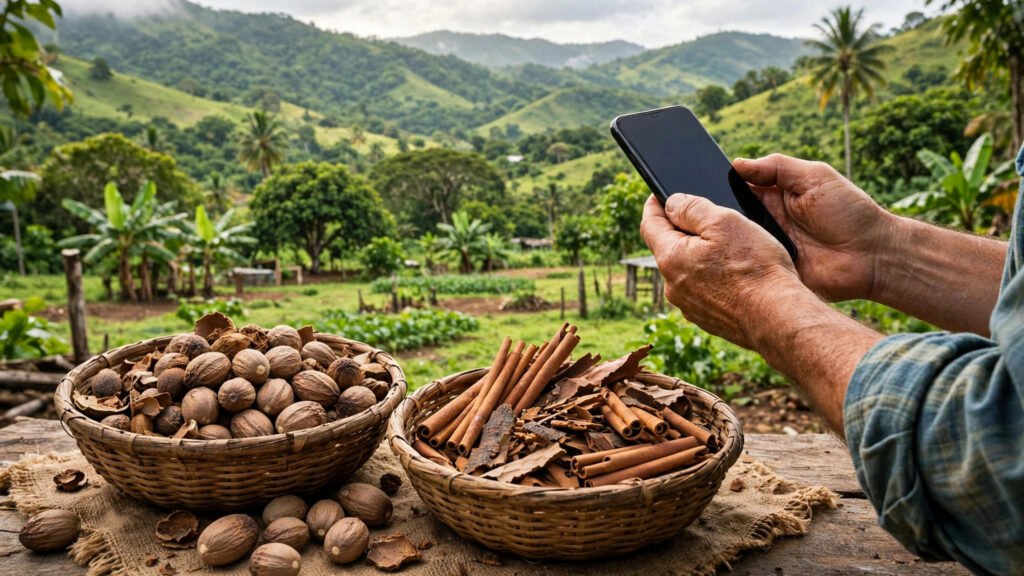
In Grenada, a farmer deciding when to sell a sack of nutmeg or cinnamon does not always wait for a buyer to arrive at the farm gate. More and more often, the first step is a phone: checking a price, comparing it with what a neighbour was offered, and only then deciding whether to sell, hold, or take the harvest to a different buyer. For small growers on an island where farming is woven into daily life, that quick check can change the outcome of a whole season’s work.
Grenada is often called the Spice Island, and the name fits the landscape. Nutmeg, cinnamon, cloves, ginger, and turmeric grow alongside cocoa and bananas on small plots across the island. Many of these crops are harvested by hand, dried, and sold onward through buyers and cooperatives. A grower may only have a few sacks to sell at a time, so the price agreed for those sacks matters a great deal. A small difference per sack, repeated across a harvest, adds up to real money for a household.
Key Takeaways
- Grenadian spice growers use their phones to check prices before agreeing a sale.
- A price check helps a small grower compare offers instead of accepting the first one.
- Phones also carry weather and transport information that affects when a harvest can be moved and sold.
Why the Price Before the Sale Matters So Much
Spices are not sold like a fixed-price item in a shop. Prices can shift with the season, with the quality of the dried crop, and with demand from buyers further along the chain. A grower who sells without knowing the going price is negotiating in the dark. A grower who has checked first walks into the same conversation with a reference point: what others are being paid, and whether the offer on the table is close to it.
That is where the phone earns its place. A message from a fellow farmer, a call to a cooperative, or a post in a farming group can give a grower a sense of the current price before any deal is struck. The information does not need to be formal or complicated. Even a rough sense of the range — whether prices are holding steady, rising, or softening — helps a grower decide whether to sell now or wait a little longer.
The same habit shows up in other farming communities. In Uruguay, growers check their phones for rain forecasts before farm work, because the weather decides what can be done that day. In Senegal, fishermen check their phones before going to sea, because conditions decide whether a trip is worth it. The crop is different in Grenada, but the logic is the same: a phone check before a decision beats guessing after it.
How a Phone Check Works in Practice
For most small growers, the check is informal and social. One farmer hears a price at a market or from a buyer and passes it on. Another asks in a group chat whether anyone has sold recently and at what level. A cooperative may share an update with its members. None of this requires a special app or a trading terminal. It requires a charged phone, a signal, and a network of people who trust each other’s information.
That network matters because spice prices are not posted on a single board that every grower can walk past. Buyers may offer different prices on different days, and quality affects what is paid. A grower who talks to several people before selling builds a fuller picture than a grower who hears a single offer and takes it. The phone makes those conversations fast: what once took a walk to a neighbour’s plot or a trip to town can now happen in a few messages.
Timing is part of the decision too. Freshly harvested spices usually need drying before they are sold, and drying takes time and dry weather. A grower may check the forecast, check the price, and then decide the order of the work: dry first, sell later, or sell a smaller amount now and keep the rest. The phone holds both kinds of information at once, which is why it has become a farming tool as much as a way to stay in touch.
What a Better Price Means for a Small Grower
For a household that depends on a few crops, a better price is not abstract. It can mean covering the cost of transport to market, paying for school supplies, or setting a little aside for the next planting season. It can also mean avoiding a sale made in a hurry, when a grower needed cash quickly and accepted whatever was offered. Knowing the price does not guarantee a good sale, but it removes one disadvantage: selling without knowing what the crop is worth that week.
There are limits, and growers know them. A phone check gives a sense of the market, not a promise. A buyer may still offer less for a lower-grade crop, or a price may move between the check and the sale. Transport can also decide the outcome: if the road to market is difficult or the buyer is the only one visiting a remote plot, the grower’s room to negotiate is smaller. The phone helps, but it does not change geography.
Trust is another limit. Not every price shared in a group is accurate, and a rumour can travel as fast as a fact. Experienced growers tend to cross-check: one message is a hint, two or three matching reports are a pattern. That habit — comparing sources before acting — is the real skill behind the phone check, and it is learned through seasons of buying and selling, not through the phone itself.
Why This Habit Fits Grenada
Grenada’s farming is small-scale and spread out, with growers on the main island and on smaller islands such as Carriacou. Distances are short on a map but not always quick in practice, and a trip to market costs time and money. A phone check saves a wasted journey: a grower can find out whether selling today is worthwhile before loading sacks onto a vehicle. In that sense, the phone is not replacing the market. It is helping growers arrive at the market better prepared.
The habit also fits a community where farming knowledge is shared. Growers already talk about weather, pests, and harvest timing. Adding prices to that conversation is natural. When one grower shares a price, others benefit, and when others share theirs, the first grower benefits in return. Over time, that sharing makes the whole local market a little more transparent, one message at a time. A similar sharing pattern helps fishermen in Madagascar, who check their phones before going to sea and pass on what they learn to others.
A grower who has checked first walks into the same conversation with a reference point: what others are being paid, and whether the offer on the table is close to it.
What to Watch Next
For Grenadian spice growers, the phone check is likely to stay part of selling, because it solves a simple problem: no one wants to sell a season’s work without knowing what it is worth. As more growers share prices and compare offers, the habit may spread further, and the information growers rely on may become more regular. What will not change is the core decision itself — when to sell, to whom, and at what price — only that growers now make it with a little more information in their pockets before they agree.
- Spice prices shift with season, quality, and buyer demand, so a check before selling matters.
- Growers compare offers through messages, calls, and farming groups rather than a single formal price board.
- Weather and transport information on the same phone also shapes when a harvest is moved and sold.
- A price check removes the disadvantage of selling blind, but it cannot guarantee a buyer or a price.