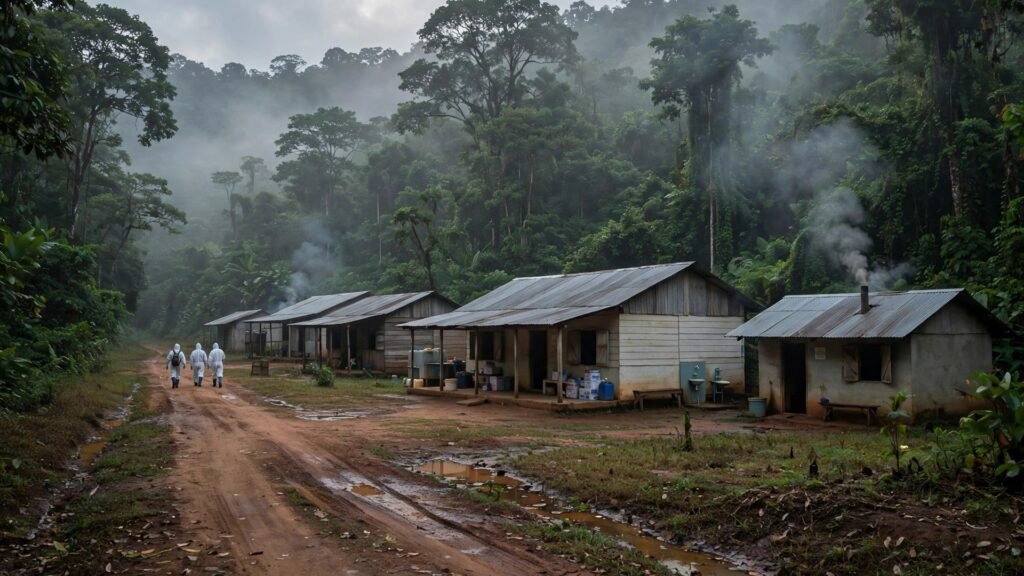
Unidentified attackers set fire to an Ebola treatment centre in the town of Bafwasende in the Democratic Republic of Congo’s north-central Tshopo province in the early hours of Saturday, destroying two rooms meant for suspected cases and forcing deployed doctors to flee to the provincial capital, Kisangani.
Key Takeaways
- Two rooms for suspected Ebola cases were set ablaze at a treatment centre in Bafwasende, Tshopo province, early on Saturday.
- Local security guards intervened and put out the flames, and suspected cases were moved to Nia-Nia in neighbouring Ituri province.
- Doctors sent to support the response fled to Kisangani, in the latest blow to an outbreak that has passed 10,000 confirmed cases.
Marcel Likilo, the medical doctor overseeing the Bafwasende health zone, said local security guards managed to intervene and extinguish the flames after the two rooms were set alight. He told reporters in Kisangani that doctors deployed to support the Ebola response had left Bafwasende for the city following the attack.
Suspected cases previously housed at the facility were transferred to Nia-Nia in the neighbouring Ituri province, Likilo added. Local reporting differed on whether the centre had already opened, with some outlets describing it as a facility still under construction.
The attack strikes at the very part of the response that cannot be replaced from a distance: local trust.
An outbreak already under strain
The attack comes as the country battles its deadliest Ebola epidemic on record. According to the latest Health Ministry figures, confirmed cases have exceeded 10,000 since mid-May, with more than 5,000 deaths recorded across affected areas. The outbreak, the country’s 17th, was first detected in the eastern Ituri province before spreading further.
The epidemic is being driven by the Bundibugyo strain of the virus, a relatively rare variant for which there is currently no approved vaccine or treatment developed specifically against it. Testing has been under way to determine whether a vaccine proven against the more common Zaire strain could also offer protection against Bundibugyo.
The attack strikes at the very part of the response that cannot be replaced from a distance: local trust. Health workers have faced mounting community resistance to containment efforts, including conspiracy theories accusing medical staff of spreading the disease, and several facilities have been damaged or shut down in recent weeks.
A pattern of attacks on health workers
The Bafwasende fire happened about a week after a nurse was killed and another health worker seriously injured during an Ebola-alert response in the same area on October 24, an incident confirmed by the World Health Organization’s director-general. In that earlier case, local people accused the workers of trying to infect residents.
Elsewhere in the region, the outbreak has already disrupted travel and trade. Kenya has demanded that Saudi Arabia lift its suspension of travel and visas over the Ebola outbreak, warning that the restrictions threaten trade, tourism and employment. The death toll in DR Congo itself has passed 5,000, making this the country’s worst Ebola epidemic.
- Two rooms for suspected cases burned at the Bafwasende treatment centre early on Saturday.
- Deployed doctors fled to Kisangani; suspected cases were moved to Nia-Nia in Ituri province.
- Confirmed cases have passed 10,000 since mid-May, with more than 5,000 deaths, per Health Ministry figures.
- The Bundibugyo strain behind the epidemic has no approved vaccine or treatment developed specifically for it.
- The fire followed the killing of a nurse during an Ebola-alert response in the same area a week earlier.
Neighbouring countries have also been on alert. Suspected cases in Nigeria tested negative, but health authorities across the region remain on heightened watch as the Congolese epidemic continues to spread across borders.
What to Watch Next
What happens next in Bafwasende will show whether the response there can recover from the fire. The immediate questions are whether deployed doctors return to the town, whether suspected cases can be safely cared for in Nia-Nia, and whether local security can protect the remaining facilities. Beyond Bafwasende, the wider test remains the same: containing an epidemic that has already passed 10,000 cases while rebuilding the community trust on which every part of the response depends.