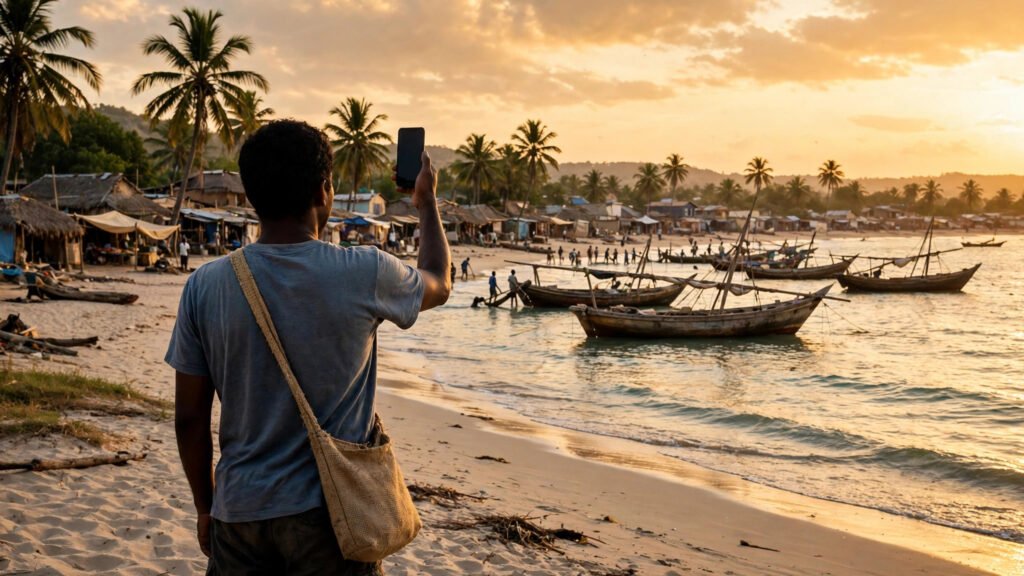
In Mozambique, a country with a long coastline, wide rural areas and many families spread between villages, towns and cities abroad, the mobile phone has quietly become one of the most useful tools of everyday life. It is not only for calls. For many Mozambicans, the phone is where money arrives, where the weather is checked before a fishing trip, where a crop price is compared, and where family news travels fastest.
That is why the question matters: why do Mozambicans rely on their phones for money, fishing and family news? The answer is practical. Where bank branches, markets and government offices can be far away, a phone shortens the distance. It does not replace roads, boats or banks, but it helps people plan, send, receive and decide without always travelling first.
Key Takeaways
- Phones help Mozambicans move money, check weather and market information, and stay in touch with family without always travelling long distances.
- For fishers and farmers, a phone check before setting out can save time, fuel and a wasted trip.
- Charging, signal and cost still shape how much a phone can do, so phone use in Mozambique is practical and selective rather than unlimited.
Money That Travels by Phone
For many households, the most important phone job is money. A relative working in a city, or in another country such as South Africa, can send money home, and the family can receive it on a phone rather than waiting for someone to carry cash over a long journey. Mobile-money agents in towns and trading centres help people cash in and cash out, and the phone keeps a record of the transfer that both sides can check.
This matters most when a payment is urgent. School costs, medicine, seed for planting, or a repair to a boat or a roof rarely wait for a convenient travel day. A phone transfer can arrive in minutes, while a physical journey might take hours or longer. It also lets the sender and the receiver confirm the amount, which reduces misunderstanding about whether money was sent, received or spent.
Phones are also used for everyday payments and bills. Instead of queuing to pay for a service or travelling to a shop, people can settle small amounts from the phone itself. The pattern is familiar across southern Africa: Zambians buy electricity units on their phones instead of queuing, and Mozambicans use the same kind of shortcut for the payments their own households face. The point is not the brand of the wallet. It is the saved journey.
Before the Boat Leaves: Fishing and Weather
Mozambique’s coastline supports fishing communities from north to south, and the sea does not forgive a careless departure. Fishers check weather and wind before they launch, and the phone has made that check easier. A forecast, a message from another fisher, or a call to someone already at sea can change the plan for the day.
The phone also helps after the catch. A fisher who knows the price at the landing site, or who can tell a buyer that fish are coming, wastes less of the day’s work. Fresh fish spoil quickly in heat, so timing matters. A short call can mean the difference between selling the catch the same day and watching it lose value while waiting for a buyer who never knew it was there.
Fishers elsewhere face the same daily judgement. In Madagascar, for example, fishermen check their phones before going to sea, because the sea, the weather and the market all reward preparation. Mozambique’s fishing communities use their phones for the same reason: the phone is a planning tool before it is anything else.
A phone check before setting out can save time, fuel and a wasted trip.
Farming, Markets and Prices
Inland, the phone plays a similar role for farmers. Mozambique grows crops such as maize, cassava, rice and cashew, and the price a farmer gets depends on where and when the crop is sold. A phone call to a trader, a message about a market day, or news that a buyer is in the area can change whether a farmer loads a cart today or waits until tomorrow.
Phones also carry farming advice in a practical form: when to plant, what the rain is expected to do, and whether a pest or disease is affecting nearby fields. None of this replaces experience, but it adds information that a farmer working alone in a field would otherwise not have. In a country where distances between farms and markets are large, that extra information is valuable.
For small traders, the phone is a shop window and a ledger in one. A trader can tell regular customers what has arrived, take an order, and arrange a meeting point, all without closing a stall to go looking for buyers. The phone does not create the market, but it connects the people who already trade with each other.
Family News Across Distance
Perhaps the most human reason Mozambicans rely on their phones is family. Many families live apart for work: one parent in Maputo or Beira, another in a village, children studying elsewhere, relatives across the border. The phone carries birthdays, illness, funerals, exam results and ordinary news that would once have waited for a letter or a visit.
Voice notes and calls matter here because they carry tone, not just words. A short voice message can reassure a parent, settle a family decision, or pass on news to relatives who cannot read a long text. Group chats keep extended families in one conversation, even when members are in different provinces. In a crisis, that speed matters most of all: the phone is often the first way a family learns that someone is safe, or that help is needed.
That family role also links back to money. A message saying money has been sent, and a reply saying it has arrived, closes the loop that once depended on trust and waiting. The phone does not remove the worry of distance, but it shortens it.
The Limits: Signal, Charging and Cost
None of this means phone use in Mozambique is easy everywhere. Signal can be weak in remote areas, and a phone is only useful when it is charged. People plan around both: charging at home when power is available, at a neighbour’s house, at a shop, or at a charging point in town. Solar charging has become part of daily life in parts of the region, and Malawians charge their phones at solar kiosks for the same reason Mozambicans guard battery life so carefully.
- Mobile money lets families send and receive support without a long journey.
- Weather and market checks help fishers and farmers plan before they travel.
- Calls and voice notes keep families connected across provinces and borders.
- Charging and signal remain the everyday limits on what a phone can do.
Cost is the other limit. Data, airtime and a handset itself are real expenses for a household budget, so people use phones selectively: a short call instead of a long one, a message instead of a video, a check of the weather rather than hours of browsing. That selectivity is not a failure of phone culture. It is evidence of how carefully phones are used where every unit of credit counts.
Why the Phone, and Not Something Else?
The deeper answer is that the phone fits Mozambique’s geography. A single device serves a fisher on the coast, a farmer inland, a trader in a market town and a student in a city. It does not need a new building, a new road or a new office to be useful. It works with the networks and agents that already exist, and it improves as coverage and charging options improve.
It also fits how Mozambican life is organised: around family networks, informal trade and seasonal work. The phone strengthens those networks rather than replacing them. A market still needs buyers and sellers, a boat still needs a crew, and a family still needs trust. The phone simply makes the connections between them faster.
What to Watch Next
What to watch next is whether coverage, charging and affordable data keep improving in rural and coastal areas, because those three things decide how much of daily life a phone can carry. If signal reaches further and charging becomes easier, more fishers, farmers and families will be able to use the phone for money, weather, markets and family news without travelling first. If costs stay high, people will keep using phones carefully and selectively, choosing the calls and messages that matter most. Either way, the phone’s role in Mozambique is already clear: it is the practical link between money, work and family across distance.