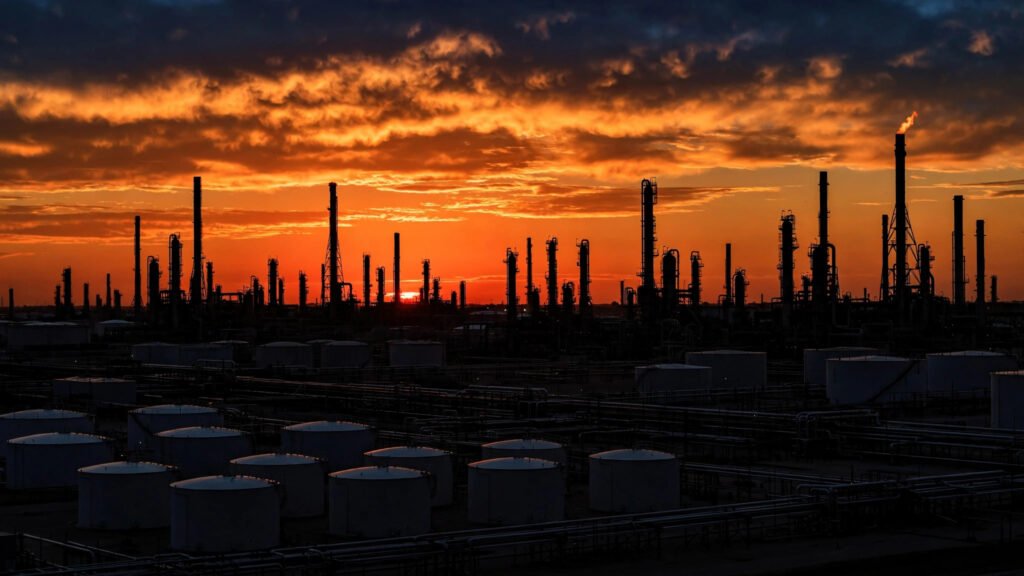
ExxonMobil reported third-quarter profit of $15.4 billion on Friday, October 30, more than double the $7.5 billion it earned in the same quarter a year earlier, as a surge in refining margins more than offset softer crude prices. The result, reported at $3.72 per share, also topped the $14.5 billion, or $3.48 per share, the company earned in the second quarter of 2026.
On the company’s adjusted measure, which strips out one-off items and timing effects, earnings reached $17.5 billion, or $4.23 per share, above the $4.08 average analyst estimate cited in reports and up from $14.7 billion in the second quarter. Revenue was about $113.2 billion, roughly 33 percent higher than a year earlier, while oil prices averaged around $85 a barrel during the period, about a third more than in the 2025 quarter.
Key Takeaways
- ExxonMobil earned $15.4 billion in the third quarter of 2026, more than double the $7.5 billion of a year earlier.
- Adjusted earnings were $17.5 billion, or $4.23 per share, above the $4.08 average analyst estimate cited in reports.
- Refining drove the result: adjusted Energy Products earnings rose to $9.1 billion from $4.1 billion in the second quarter, while upstream earnings fell to $7.3 billion.
What Drove the Jump
The main driver was not higher crude prices alone. Reports attributed the surge in refining margins to disruption to global fuel supplies linked to the Middle East conflict and to attacks on Russian refining infrastructure, including the United States-Israel attacks on Iran launched in late February and Ukrainian strikes on Russian refineries. That disruption tightened supplies of diesel and other fuels, widening the gap between what crude oil costs and what the fuels made from it sell for.
ExxonMobil said higher refining margins added an estimated $4.5 billion to third-quarter earnings, while lower oil prices cut earnings by about $1.3 billion, according to a company presentation summary reported in coverage of the results. The benchmark refining margin reached $50.3 a barrel, up from $29.0 a barrel in the second quarter and almost three times the level of a year earlier, in one of the clearest signs of how tight fuel markets became during the quarter.
The lift came from refining, not from pumping more crude.
Refining Did the Heavy Lifting
The lift came from refining, not from pumping more crude. Adjusted earnings in the Energy Products business, which covers refining and fuels, rose to $9.1 billion from $4.1 billion in the second quarter, more than doubling in three months. On a reported basis, refining profits of about $7.2 billion edged out the about $7.1 billion earned from extracting oil and gas, a rare inversion for a company whose fortunes are usually tied to the wellhead.
Operations helped as well as prices. ExxonMobil reported strong refinery operations, including 100 percent crude-unit utilization at its United States Gulf Coast refineries and the second-highest diesel production from those refineries on record. When refineries run flat out while fuel supplies elsewhere are disrupted, every extra barrel of diesel and petrol they can produce is sold into a tight market, and that combination of volume and margin is what turned the quarter into one of the company’s most profitable on record. The wider oil price surge earlier in October, driven by attacks on Saudi energy infrastructure, is part of the same disrupted-supply story.
Production Earned Less
The oil and gas production business, by contrast, had a weaker quarter. Adjusted upstream earnings fell to $7.3 billion from $9.2 billion in the second quarter, a decline of about 20 percent, primarily reflecting lower crude oil prices and accelerated Guyana production-entitlement effects. Chemicals also had a weak quarter, according to earnings coverage, underlining that the headline profit was not a story of every part of the business firing at once.
Cash generation remained strong. Cash flow from operations totalled $25.7 billion and free cash flow was $19.1 billion in the quarter. For the first nine months of 2026, ExxonMobil reported earnings of $34.1 billion, compared with $22.3 billion in the corresponding period of 2025, a reminder that the third quarter built on an already strong year rather than standing alone.
- Reported third-quarter profit: $15.4 billion, or $3.72 per share, versus $7.5 billion, or $1.76 per share, a year earlier.
- Adjusted earnings: $17.5 billion, or $4.23 per share, versus a $4.08 average analyst estimate cited in reports.
- Benchmark refining margin: $50.3 a barrel, up from $29.0 a barrel in the second quarter.
- Adjusted Energy Products earnings: $9.1 billion, up from $4.1 billion in the second quarter.
- Adjusted upstream earnings: $7.3 billion, down from $9.2 billion in the second quarter.
- Cash flow from operations: $25.7 billion; free cash flow: $19.1 billion.
- Shareholder returns in the quarter: $9.4 billion, made up of $4.3 billion in dividends and $5.1 billion in share buybacks.
What It Means Beyond Exxon
ExxonMobil was not alone. Chevron’s net income surged nearly 200 percent in the third quarter to $9.9 billion, or $5.06 a share, while Shell nearly doubled its own earnings to $10.8 billion, according to earnings coverage. Together, the three companies pulled in just over $36 billion in the quarter, with executives telling investors on earnings calls that a good share of the profits was going to shareholders through dividends and stock buybacks.
For ExxonMobil itself, shareholder returns in the quarter totalled $9.4 billion, made up of $4.3 billion in dividends and $5.1 billion in share buybacks, and the company raised its dividend for the 44th consecutive year, reporting its highest-ever quarterly dividend. That payout story matters to investors because it shows the company converting a refining windfall into cash returned to shareholders rather than simply holding it on the balance sheet, at a time when the wider debate about energy profits, fuel prices and the cost of the Middle East conflict remains politically charged.
What to Watch Next
What to watch next is whether refining margins stay near the $50.3-a-barrel level or ease back toward the $29.0 seen in the second quarter, whether crude oil prices keep falling from their third-quarter average of around $85 a barrel, and whether the production business recovers from its $7.3 billion adjusted result. The other tests are whether fuel supplies ease as disruption linked to the Middle East conflict and attacks on Russian refining infrastructure fades, and whether shareholder returns stay near the $9.4 billion paid out in the third quarter. Until those questions are answered, the quarter stands as a refining story first: a profit more than doubled by margins, not by pumping more crude.