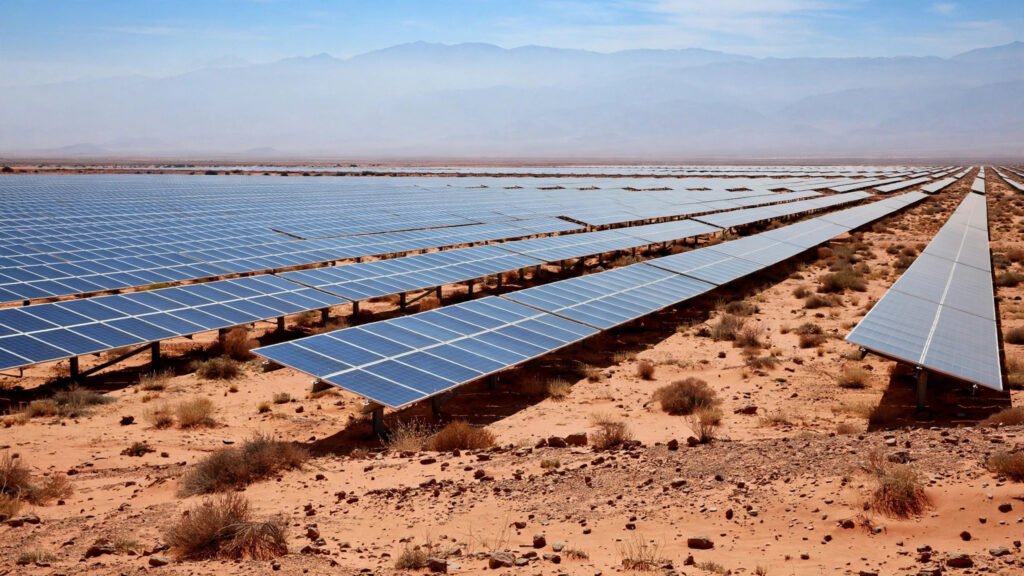
If you stand in Morocco’s southern desert at midday, the first thing you notice is the light. It is bright, direct, and almost constant, beating down on open ground that stretches to the horizon. For most of history, that sunshine was simply part of life in a hot, dry place. Today, Morocco is treating it as something else entirely: a national resource.
That is why the country has been building large solar power plants in its desert regions, with long rows of panels laid out across land where few people live and little else grows. The question people often ask is simple: why go to all that trouble in the desert, of all places? The answer touches on geography, energy bills, jobs, and the kind of future Morocco wants for itself.
Key Takeaways
- Morocco’s desert offers intense sunshine and vast open land, making it a natural site for large solar plants.
- Home-grown solar power reduces the country’s reliance on imported fossil fuels, whose prices it cannot control.
- The benefits go beyond electricity, bringing jobs and skills, but dust, heat, grid upgrades, and storage remain real challenges.
Why the Desert Is the Ideal Site
A solar plant needs two things above all else: sunshine and space. Morocco’s desert regions offer both in abundance. The sun shines strongly for much of the year, with long days and relatively few cloudy spells, so panels there can produce power far more steadily than they would in a grey, northern climate.
Space matters just as much. A large solar plant covers a great deal of ground, and putting it in the desert avoids taking land from crowded cities or from the farmland that feeds people. The desert, in other words, is not empty land waiting for a use — for Morocco, it is the power station itself.
There is a practical side too. Building on flat, open ground is simpler than building on hillsides or between existing towns, and the plants can be expanded row by row as demand grows.
Why Morocco Needs Its Own Electricity
Morocco has long depended on imported fossil fuels to generate much of its electricity. That leaves the country exposed: when fuel prices rise on world markets, the cost of keeping the lights on rises too, and that cost eventually reaches households and businesses.
At the same time, demand for electricity keeps growing. Cities are expanding, industry is developing, tourism is booming, and on hot days air conditioning alone places a heavy load on the grid. Water pumping for farms and towns adds to that demand. A country in that position has a strong reason to generate more of its own power from a source that no one can switch off or charge more for: the sun.
Solar power also fits with a wider shift. Morocco has been developing wind power along its Atlantic coast and hydropower in its mountains, so solar is one part of a mix rather than a single bet. Each source covers some of the weaknesses of the others.
More Than Just Panels
A solar plant is only useful if its power can reach people when they need it. That is one of the trickiest parts of the whole plan. Solar panels produce most during the day, but households tend to use the most electricity in the evening, when the sun has gone down.
Bridging that gap means upgrading transmission lines so power can travel from remote desert sites to cities, and investing in storage and flexible grid management so daytime power can be saved or balanced for later use. Without that supporting work, even the biggest solar plant cannot do its job properly.
Technology is changing daily life across Africa in other ways too, from medical deliveries by drone to small-scale solar charging far from the grid, and Morocco’s desert plants sit at the large, national end of that same story.
The desert, in other words, is not empty land waiting for a use — for Morocco, it is the power station itself.
What It Means for Ordinary Moroccans
For people living near these projects, the effects are practical rather than abstract. Building a solar plant creates construction work, and running one creates longer-term jobs in maintenance, cleaning, security, and supervision. Local businesses, from transport to catering, often benefit while a project is being built.
There is also a skills effect. Workers trained to install and maintain solar equipment carry that knowledge with them, and as solar panels become more common on rooftops and in smaller installations, those skills stay in demand. Elsewhere in Africa, solar power already reaches people in small, practical ways, from phone-charging kiosks to power for schools and clinics, and Morocco’s experience adds to that wider picture.
Over time, the hope is that home-grown electricity brings more stable prices and a more reliable supply, especially as the grid is strengthened. For families, that means fewer worries about the cost of power; for businesses, it means more confidence to invest and grow.
- Sunshine and open land make Morocco’s desert a natural home for large solar plants.
- Solar power cuts exposure to imported fuel prices and supports energy independence.
- Projects bring construction and maintenance jobs, plus skills that stay in local communities.
- Wind, hydro, and storage must grow alongside solar to cover evenings and cloudy days.
The Hard Parts Nobody Should Ignore
None of this is easy. Desert dust settles on panels and must be cleaned off regularly, or output falls. Cleaning needs water in a place where water is scarce, so operators must find ways to clean efficiently. Extreme heat can also slightly reduce how well panels perform, even as the sun shines strongly.
The upfront cost of large plants and grid upgrades is high, even if sunshine itself is free. Land questions matter too: desert land may look empty, but local communities, herders, and fragile ecosystems all have a stake in how it is used, and projects need to be planned with them, not simply placed on top of them.
Finally, solar power on its own cannot run a country. It must be balanced with other sources and with storage, or the grid will struggle on calm, cloudy evenings. Morocco’s desert solar story is therefore not a finished success but an ongoing test of planning, engineering, and patience.
What to Watch Next
What happens next will show whether Morocco’s desert bet keeps paying off. Watch for new solar plants being built and connected to the grid, for storage and transmission upgrades that let daytime power serve the evening, and for whether jobs and skills around the projects continue to grow in nearby communities. The desert sun is not going anywhere; the question is how fully Morocco can turn it into reliable, affordable power for its people.