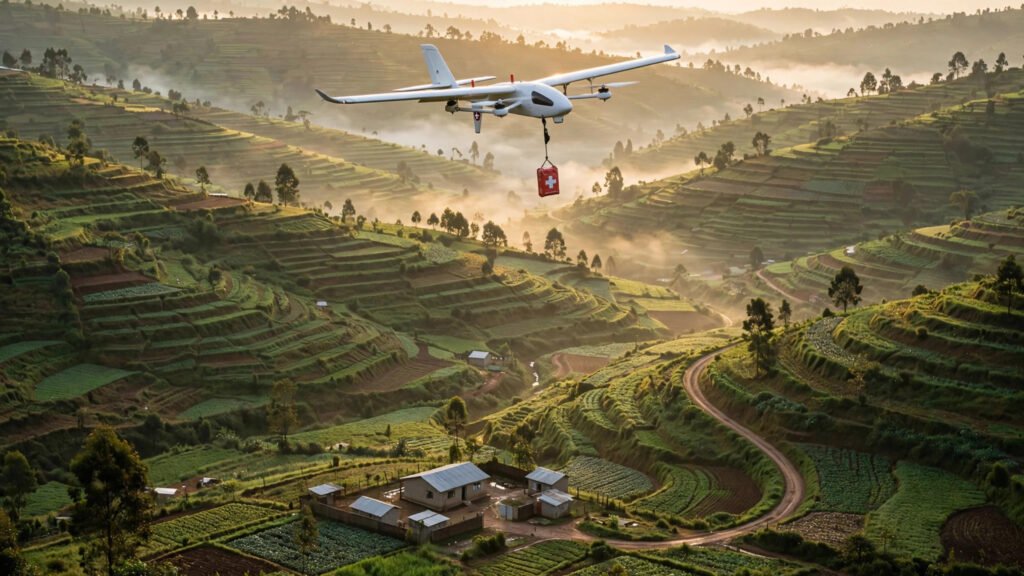
When a hospital in rural Rwanda needs blood urgently, the answer does not always come down a road. Sometimes it comes down from the sky. A small fixed-wing drone leaves a distribution centre, flies straight over hills and valleys, and drops a small package by parachute near the hospital that asked for it. For many Rwandans, this is not science fiction. It is how part of their health system works.
So why does Rwanda deliver blood by drone instead of relying on road transport alone? The short answer is geography. Rwanda is known as the land of a thousand hills, and its beauty comes with a practical problem: many hospitals sit far from central blood supplies, connected by winding roads that climb, dip and slow every journey. A drone does not need to follow those roads. It flies directly to where it is needed.
Key Takeaways
- Rwanda’s hilly terrain and winding roads make urgent road deliveries slow, so drones fly directly to remote hospitals.
- Blood cannot be stockpiled in every type at every small hospital, so on-demand drone delivery fills the gap when a transfusion is needed.
- Drones support the health system rather than replacing it — hospitals, staff and roads still do most of the work.
Why blood is different from other deliveries
Blood is not like a parcel that can sit on a shelf until someone wants it. It has a limited shelf life, it must be kept at the right temperature, and it comes in different types that are not interchangeable. A small rural hospital cannot realistically keep large stocks of every blood type on hand, especially types that are rarely needed. When a patient arrives who needs a transfusion — after childbirth complications, surgery or a serious injury, for example — the hospital may not have the right type available at that moment.
That is where an on-demand system matters. Instead of every hospital holding large reserves that may expire unused, blood can be stored centrally and sent only when a hospital requests it. The drone makes that model practical, because the delivery can arrive far faster than a vehicle travelling the same route by road.
How a drone blood delivery works
The process is deliberately simple. A health worker at a hospital sends a request for the blood product that is needed. Staff at a distribution centre prepare the package, load it onto a drone and launch it toward the hospital. The drone follows a planned route, and when it reaches the delivery area, it releases the package, which floats down by parachute to a designated drop zone. Staff on the ground collect it and take it straight to the patient.
The drone then returns to its base, ready for the next request. No landing strip is needed at the hospital itself, which matters in places where flat open ground is scarce. The system works through the day as requests come in, rather than on a fixed timetable, so a hospital is not left waiting for the next scheduled vehicle.
A drone does not need to follow those roads. It flies directly to where it is needed.
Why Rwanda was ready for this idea
Rwanda adopted drone delivery early, becoming one of the first countries in the world to use drones as a regular part of its national health supply chain. That did not happen by accident. The country is compact, its government has invested heavily in digital and health infrastructure, and its hospitals already worked with a centralised blood service. Drones slotted into a system that was already organised around moving supplies from a centre to many facilities.
There is a wider pattern here too. Across Africa, mobile technology has often arrived before older infrastructure caught up, and people have adopted it quickly. In neighbouring countries, mobile money has become an everyday way to pay and send money, as explained in our look at why Ugandans pay with mobile money instead of bank cards and why Kenyans pay with M-Pesa instead of bank cards. Rwanda’s drone network follows the same logic: where the old route is slow or expensive, a newer technology can leapfrog it. Tanzanians paying with M-Pesa and Tigo Pesa instead of bank cards show the same leapfrogging habit in everyday finance.
- Hills and winding roads slow ambulances and supply vehicles, but not aircraft.
- Central blood stocks stay fresher when they are sent on demand instead of sitting unused.
- Parachute drops mean hospitals need no runway or landing strip.
- Requests are handled as they arrive, not on a fixed delivery timetable.
What drones cannot do
It is important not to overstate what drones can achieve. A drone carries a small payload, so it cannot move large equipment or many patients. Bad weather can delay flights, just as it can delay road travel. And a drone delivery is only useful if the hospital has trained staff, refrigeration and the facilities to use the blood safely once it arrives. The drone solves one problem — distance and speed — not the whole challenge of healthcare.
Roads still matter enormously. Most medical supplies, most patients and most health workers still travel by road every day. Drones handle the urgent, small and time-sensitive deliveries that roads handle worst. The two systems work together, and neither replaces the other.
Why this matters beyond Rwanda
Rwanda’s experience is watched closely by other countries with similar geography: mountainous regions, scattered islands, or remote communities where a hospital can be hours from the nearest blood bank. If a small, light, urgent item can be flown to where it is needed on demand, the same idea can apply to vaccines, laboratory samples and other essential medical supplies, provided the rules, safety checks and local health systems are in place.
That is the real lesson of Rwanda’s drone deliveries. The technology is impressive, but the reason it works is simpler: it was matched to a specific problem — getting blood across difficult terrain, quickly, to hospitals that could not stock everything themselves. Technology that solves a real, local problem tends to last. Technology that merely looks futuristic does not.
What to Watch Next
Rwanda’s drone deliveries will be judged on whether they keep reaching remote hospitals reliably, in all weather, as demand grows. The wider question is whether other countries with difficult terrain adopt the same on-demand model for urgent medical supplies, and whether drones remain a complement to roads and hospitals rather than a replacement for them. For now, the sky above Rwanda’s hills remains part of its health system — carrying small packages that, for the patient waiting below, can make all the difference.