Why the Phone Became the Wallet
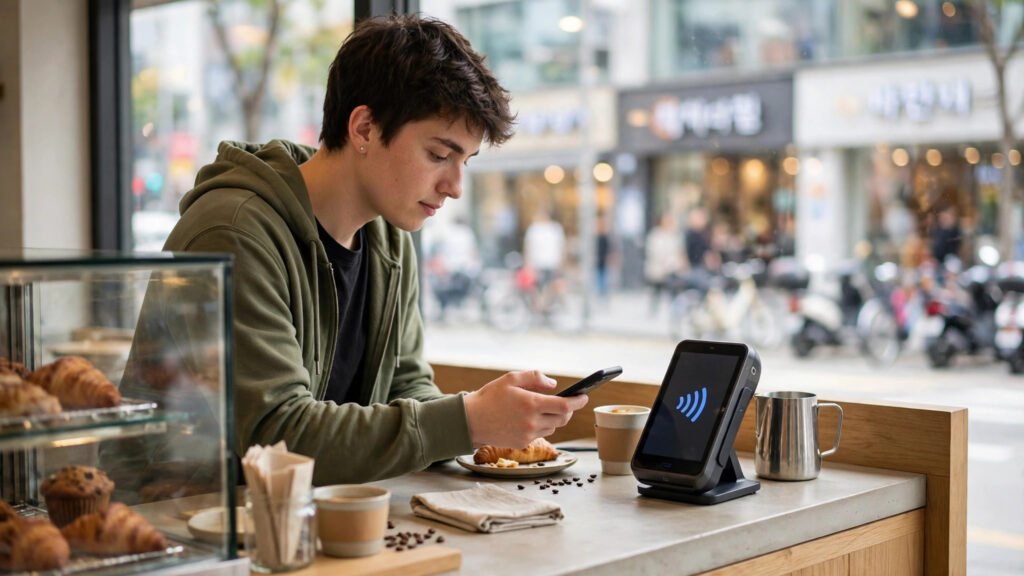
In South Korea, paying with a phone is not a novelty. It is an everyday habit, as ordinary as tapping a transport card or ordering coffee. Visitors often notice it quickly: at a cafe counter, in a convenience store, or on the subway, people hold a phone near a terminal and walk away. Cash is still accepted in many places, and plastic cards are still common, but the phone has quietly become the first choice for millions of people.
The shift did not happen overnight. It grew out of a combination of fast mobile networks, phones that come with payment features built in, and services that bundle shopping, transport, banking, and messaging into one device. When the phone already holds the train pass, the loyalty card, and the bank app, reaching for a separate wallet starts to feel like an extra step.
One Device for Almost Every Payment
For many South Koreans, the phone replaces several separate items. A single device can store a debit or credit card, a prepaid transport balance, membership points, and coupons. At the checkout, one tap can apply a discount and complete the payment at the same time. That convenience matters in a fast-moving city like Seoul, where queues are short and people expect transactions to be quick.
Phone makers and local technology companies played a large part in this change. Payment tools built into popular phones made it possible to pay without carrying a card at all, and local wallet apps added everyday services on top of payments. People could send money to a friend, split a restaurant bill, pay a delivery rider, or top up a transport card without opening a separate banking app. The result is a payment habit that feels less like banking and more like messaging.
Transport, Food Delivery, and Daily Life
Public transport helped make phone payments normal. Commuters already used rechargeable transport cards for buses and subways, so moving that balance onto a phone felt natural. Once the phone could open the subway gate, using it at a convenience store or a street food stall was a small step rather than a big change.
Food delivery and online shopping pushed the habit further. Ordering a meal, booking a taxi, or buying groceries from a phone is part of daily life for many city residents, and paying inside the same app removes friction. When a payment method works for a late-night delivery, a morning coffee, and a subway ride, there is little reason to switch back to cash for small purchases.
This pattern is not unique to South Korea. In Estonia, people run much of daily life through online services, and in Vietnam, one super-app covers messaging, payments, and more. The details differ, but the direction is the same: the phone becomes the place where daily life happens.
Why Cash Feels Less Necessary
Cash has not disappeared, and older residents and small traditional markets still use it. But for younger city dwellers, cash brings small inconveniences: finding an ATM, carrying coins, and waiting for change. A phone payment leaves a clear record too, which makes it easier to track spending, check a receipt, or confirm that a transfer arrived.
Businesses have adapted as well. Small shops, cafes, and market stalls widely accept phone and card payments, so customers rarely need to ask whether a phone will work. When almost every checkout accepts the same method, the habit reinforces itself: people stop carrying cash because they rarely need it, and shops keep supporting phone payments because customers expect them.
Trust, Speed, and the Social Side of Paying
Trust is a quiet but important part of the story. People use phone payments because the systems around them feel reliable: a failed payment can usually be retried in seconds, a transfer shows up immediately, and a lost phone can be locked remotely. Fingerprint and face recognition add a layer of reassurance that a payment is really coming from the owner of the device.
There is also a social side. Splitting costs with friends, sending a small gift of money on a birthday, or paying back a colleague are all easier when money moves inside an app people already use every day. In the Philippines, mobile wallets play a similar social role, letting people send money to family without visiting a bank. In South Korea, that same ease has made the phone the default way to settle small everyday debts.
What About Visitors and Older Residents?
Visitors sometimes find the system confusing at first, especially if their own bank cards or wallet apps are not supported everywhere. Transport cards and widely accepted card payments still provide a fallback, and many tourist areas accept international cards. Older residents, meanwhile, have adopted phone payments at their own pace, often starting with transport and simple transfers before using wallets for shopping.
The lesson is not that everyone pays the same way. It is that when a payment method fits into transport, shopping, food, and social life at once, it stops feeling like technology and starts feeling like habit. South Korea reached that point earlier than most countries because its networks, devices, and local apps matured together.
What to Watch Next
Phone payments in South Korea are likely to keep spreading into more parts of daily life, from transport and food delivery to small neighbourhood shops and peer-to-peer transfers. The open question is not whether people will keep using their phones to pay, but how far that habit extends: whether cash keeps a role in traditional markets and among older residents, and how easily visitors can join a system built around local apps and devices. For now, the phone remains the wallet most South Koreans reach for first, because it already holds so much of their day.
Key Takeaways
- South Koreans pay with phones because one device covers transport, shopping, food delivery, and money transfers.
- Built-in phone payments and local wallet apps made paying feel as easy as messaging.
- Cash is still used, but phone payments keep growing because almost every checkout accepts them.
When the phone already holds the train pass, the loyalty card, and the bank app, reaching for a separate wallet starts to feel like an extra step.
- One phone can hold cards, transport balance, points, and coupons.
- Transport cards made phone payments feel natural for commuters.
- Food delivery and online shopping pushed phone payments into daily life.
- Instant records and biometric checks help people trust phone payments.