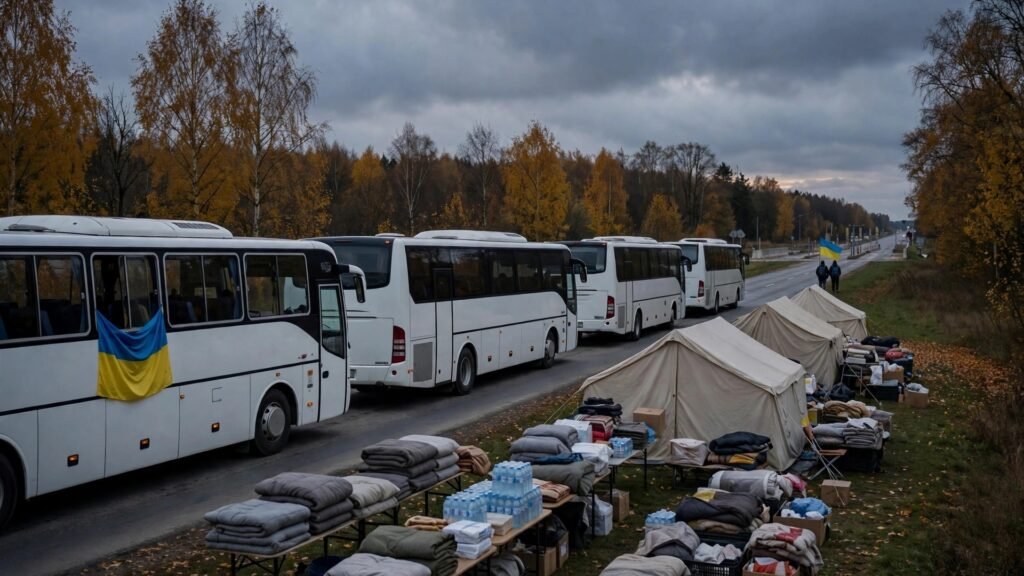
Hundreds of people evacuated from the Russian-occupied town of Oleshky arrived back in Ukrainian-controlled territory on Saturday, October 31, in emotional reunions at the border that closed a long and difficult journey through Russia and Belarus. Travellers wrapped in blue and yellow Ukrainian flags stepped off buses and into the arms of relatives they had not seen for years, in the most visible moment yet of a rare local ceasefire in southern Ukraine.
The return was the latest step in a humanitarian operation that began earlier in the week. A six-day local ceasefire in Oleshky, in the Kherson region, was reached after mediation efforts by United States First Lady Melania Trump and with the involvement of Pope Leo XIV, according to reports of the operation. It has been described as the longest local pause in fighting since Russia’s full-scale invasion of Ukraine in 2022, and the first humanitarian truce of its kind in more than four years of war.
Key Takeaways
- Hundreds of Oleshky evacuees crossed into Ukrainian-controlled territory on Saturday, October 31, after travelling through Russia and Belarus.
- The return took place under a six-day local ceasefire mediated by Melania Trump with the involvement of Pope Leo XIV, which is due to end on Sunday.
- Ukrainian officials have not given an exact number of returnees, saying the figure and the crossing location are restricted to protect those who stayed and future missions.
Reunions at the border
Ukraine’s President Volodymyr Zelensky announced the arrival of the evacuees on Telegram, thanking the United States and Melania Trump for the mediation. He said Ukrainian citizens from Oleshky had crossed the border in the Chernihiv region and would receive the assistance they need. At the border, Ukrainian officials greeted the evacuees with posters reading “You’re not alone” and “We embrace with our hearts”, and medical staff were waiting to help people who arrived exhausted after years under occupation.
For some families, the reunion ended a separation measured in years. One man, Dmytro, had not seen his wife Larisa for 1,711 days, according to reports of the reunion, and the couple, both 54, embraced at the border wrapped in Ukrainian flags. Another family, Zhanna Ptakhova and her daughters Elizaveta and Daria Paliy, were reunited with their husband and father Mykhailo Paliy on Saturday. Reports also described evacuees arriving with their pets, and aid tents, coffee stands and provisions for animals set up for people stepping off the buses.
Travellers wrapped in blue and yellow Ukrainian flags stepped off buses at the border where they were reunited with family members.
A journey through Crimea, Anapa and Belarus
The route the evacuees took shows why the operation needed a ceasefire at all. After an aid convoy entered Oleshky and evacuations began, people who chose to leave travelled by bus through the occupied Crimean peninsula to Anapa, in Russia’s Krasnodar region. From there they flew to Gomel in Belarus, as covered in our report on the evacuees arriving in Belarus, before travelling by bus onward into Ukraine.
Ukraine’s human rights ombudsman, Dmytro Lubinets, travelled to Oleshky to personally escort the evacuees, becoming the first high-profile Ukrainian official to openly travel to occupied areas under Russian control since the start of the war, according to reports. Lubinets said the oldest returning resident was 94, while the youngest was a baby just over one year old. He gave no exact number for how many people returned to Ukraine, and Ukrainian authorities imposed restrictions on disclosing the number of evacuees or the border crossing location, to safeguard those who chose to remain in Oleshky and to protect future humanitarian missions.
- Hundreds of evacuees, along with many pets, arrived in Ukraine on Saturday, October 31.
- The six-day Oleshky ceasefire began on Tuesday and is expected to continue until Sunday evening.
- Evacuees travelled by bus via Crimea to Anapa, flew to Gomel in Belarus, then travelled by bus into Ukraine.
- The oldest returning resident was 94 and the youngest a baby just over one, according to Ukraine’s ombudsman.
- About 2,000 residents were estimated to remain in Oleshky and were offered the choice of travelling to Ukraine, travelling to Russia, or staying.
- No exact official number of returnees has been disclosed.
What life under occupation had meant
Reports from the border described people arriving starved and exhausted. One elderly man in a wheelchair told reporters he had lost 20 kilograms over the past year and had become so weak that he required hospital treatment. Another evacuee, Tamara, said she had initially been reluctant to leave because of her animals. Those accounts are consistent with the picture of Oleshky in recent days: a town where residents were reported to lack gas, electricity and running water, and where the remaining population was offered replenished food and medical supplies as part of the ceasefire arrangement.
The scale of the town’s loss is also part of the story. About 40 percent of Oleshky’s prewar population of around 24,000 managed to flee to Ukrainian-controlled territory when it was still possible early in the fighting, according to the Institute for the Study of War, a United States-based conflict observer. That leaves the roughly 2,000 residents estimated to remain in the town facing the choice the ceasefire offered them: travel to Ukraine, travel to Russian-held territory, or stay. Reports said some residents decided to go to Russia, while others elected to remain in Oleshky even as the ceasefire neared its end. Melania Trump had posted on social media on Friday that the humanitarian convoy could safely evacuate more than 750 people, but neither Russia nor Ukraine specified how many people ultimately chose to leave.
Why this ceasefire matters
The truce that began on Tuesday was limited in place and time, covering Oleshky and the surrounding Kherson sector, with roads cleared of mines so humanitarian aid could be delivered. Both Ukrainian and Russian officials said the ceasefire had held since Tuesday without violations, according to reports. That record is what made Saturday’s crossings possible, and it is also why organisers have been careful about what they disclose: a local pause that works once may be needed again, and details about routes and numbers could put the next mission at risk.
Commentators have described the operation as a significant humanitarian breakthrough, with one foreign affairs correspondent calling it the largest de-escalation in the conflict so far. That language should be read carefully: the ceasefire is local, it covers one town’s sector, and it is due to expire on Sunday. It does not end the wider war, and it does not settle the fate of the residents who stayed behind or travelled elsewhere. What it did do, on Saturday, was bring hundreds of people home to relatives who had waited years for them.
What to Watch Next
What to watch next is what the article has already set out: whether the ceasefire holds until Sunday evening as expected, what happens to the residents who chose to stay in Oleshky or travel to Russian-held territory once it expires, and whether Ukrainian officials release any further confirmed details about the number of returnees and the assistance they receive. The other question is whether this local pause leads to any further humanitarian missions of the same kind, or whether it remains a single, limited opening in a war that continues elsewhere. Until those questions are answered, Saturday’s reunions stand as the operation’s clearest result: families back together after years apart, and a town’s remaining residents facing a choice with the clock running on the truce.