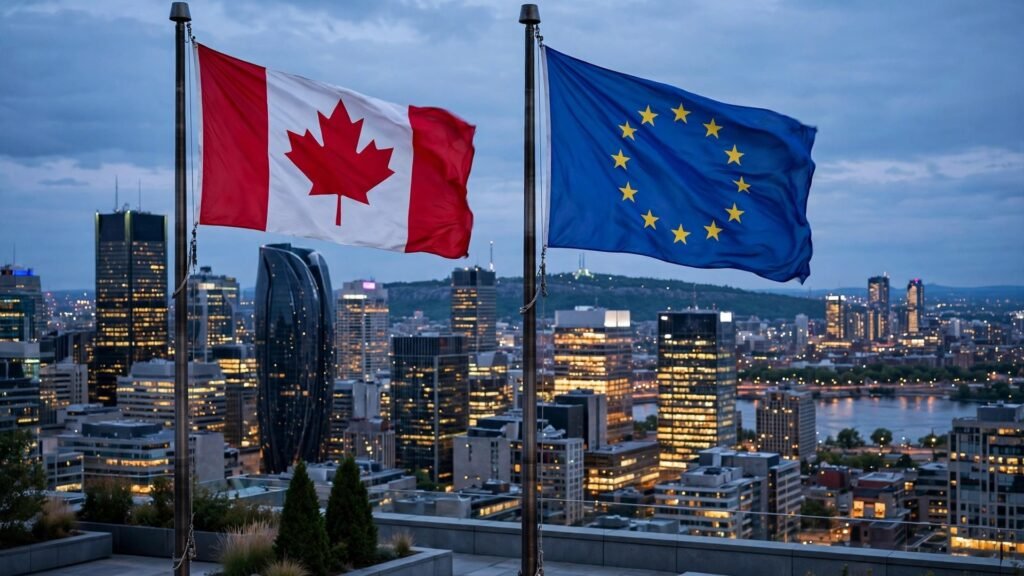
When Canada and the European Union closed their summit in Montreal on October 30, 2026, the headline phrase was striking: Canada was moving toward becoming the EU’s first so-called “associate member.” It sounded like a new category of membership. It is not, at least not yet. The phrase describes a direction of travel agreed at the summit, not a status that already exists in EU law, and understanding that distinction is the key to everything that follows.
The two sides launched what they called an Alliance for the Future, after a two-day summit hosted by Canadian Prime Minister Mark Carney with European Commission President Ursula von der Leyen and European Council President Antonio Costa. A seven-page joint statement set out more than twenty measures intended to increase affordability, create opportunities and protect sovereignty on both sides of the Atlantic. The next step, both sides said, is eight months of talks on what closer association would actually mean in practice.
Key Takeaways
- Canada and the EU launched an “Alliance for the Future” at their Montreal summit on October 29-30, 2026, and agreed to spend the next eight months talking about associate membership.
- The term “associate member” has no legal basis in EU treaties, and it is contested by some EU states, so it is a political ambition for now, not a legal status.
- What was concretely agreed includes a digital trade agreement, European Investment Bank investment in Canadian critical minerals, and Canada’s intention to join the EU’s 90-billion-euro Ukraine Support Loan with an initial contribution of 500 million euros announced by Carney.
What “Associate Member” Actually Means So Far
In plain terms, associate membership as discussed in Montreal means a closer association than Canada has today, but far from full EU membership. Carney put it in those words himself, saying Canada and the EU were working to establish the closest possible partnership, which would be far from full membership, but which would make Canada the first associate member of the European Union. The joint statement, building on the existing Strategic Partnership Agreement between the two sides, said they would create an even closer association.
That wording matters because it leaves the hardest questions open. The term “associate member” has no legal basis in EU treaties, and it is contested by some EU states. There is, at this stage, no treaty text, no defined voting rights, no defined obligations and no agreed institutional form for such a status. The eight months of talks now planned are where those questions would have to be answered, if they can be answered at all. Until then, readers should treat “associate member” as a label for an ambition, not as a membership card.
The term “associate member” has no legal basis in EU treaties, and it is contested by some EU states.
What Was Actually Agreed in Montreal
Beneath the headline phrase, the summit produced several concrete items. The two sides concluded negotiations on a Digital Trade Agreement, which the European Commission described as a political conclusion rather than a formal signature, meaning further work remains before it takes legal effect. They also agreed that the European Investment Bank will invest in critical Canadian resources, particularly raw minerals, a step aimed at supply-chain integration at a time when both sides have been affected by United States tariff measures.
On Ukraine, Carney announced that Canada would join the EU’s 90-billion-euro support loan for Kyiv, with an initial contribution of 500 million euros. The joint statement itself welcomed Canada’s intention to join the Ukraine Support Loan, without setting out an amount, repayment terms or payment schedule in the text reported so far. The 500-million-euro figure comes from Carney’s remarks at the summit, and he described it as an initial contribution, which leaves room for further announcements. Kyiv expects a budget shortfall of at least 70 billion euros next year, according to reporting on the announcement, which is why the loan mechanism, and who joins it, matters beyond Canada alone.
- The Montreal summit on October 29-30, 2026 was the 21st EU-Canada summit, hosted by Prime Minister Mark Carney with Ursula von der Leyen and Antonio Costa.
- The joint statement announced more than twenty measures under an “Alliance for the Future,” building on the existing Strategic Partnership Agreement.
- A Digital Trade Agreement was concluded at a political level, and the European Investment Bank will invest in Canadian critical minerals projects.
- Canada announced an initial 500-million-euro contribution to the EU’s 90-billion-euro Ukraine Support Loan; the joint statement welcomed the intention to join.
- Canada and the EU already have a trade framework through the Comprehensive Economic and Trade Agreement (CETA), which eliminates tariffs on 98 percent of traded goods.
What It Does Not Mean
Associate membership, as discussed so far, does not mean Canada joins the EU, votes in EU institutions, or adopts EU law wholesale. None of that was agreed in Montreal, and none of it follows automatically from the joint statement. It also does not mean the idea is uncontested inside Europe. Reporting on the summit noted objections to the “associate member” language on both sides of the Atlantic, which is a warning that the next eight months of talks could narrow, rename or reshape the proposal.
It is also worth separating the summit’s concrete agreements from its political signalling. A digital trade deal, critical-minerals investment and a Ukraine loan contribution are tangible steps that can proceed on their own timelines. The associate-member label, by contrast, is a framework for future talks. The two should not be confused: progress on trade and investment does not by itself create a new membership category, and difficulty in defining that category does not by itself undo the trade and investment agreements.
Why Now
The timing helps explain why both sides wanted a bold phrase. Canada and the EU have stepped up cooperation after both were affected by US tariff measures, and the summit agenda covered trade, digital issues, critical raw materials, defence and security, and wider cooperation. For Canada, closer EU ties offer diversification beyond its largest trading partner. For the EU, a closer Canadian partnership offers critical minerals, defence-industrial cooperation and another partner for support for Ukraine at a moment when Kyiv’s funding needs remain large. The associate-member push sits inside that wider shift, rather than standing apart from it.
What to Watch Next
What to watch next is only what this article has already set out: whether the planned eight months of talks produce a defined form of associate membership or a different, narrower arrangement; whether the Digital Trade Agreement moves from political conclusion to a formal, signed text; whether the European Investment Bank’s critical-minerals investment takes shape in specific projects; and whether Canada’s initial 500-million-euro Ukraine loan contribution is followed by further, additional support, as reporting on the summit suggested could happen. Until those steps are taken, the Montreal summit is best read as a direction agreed, with its most eye-catching label still to be defined.