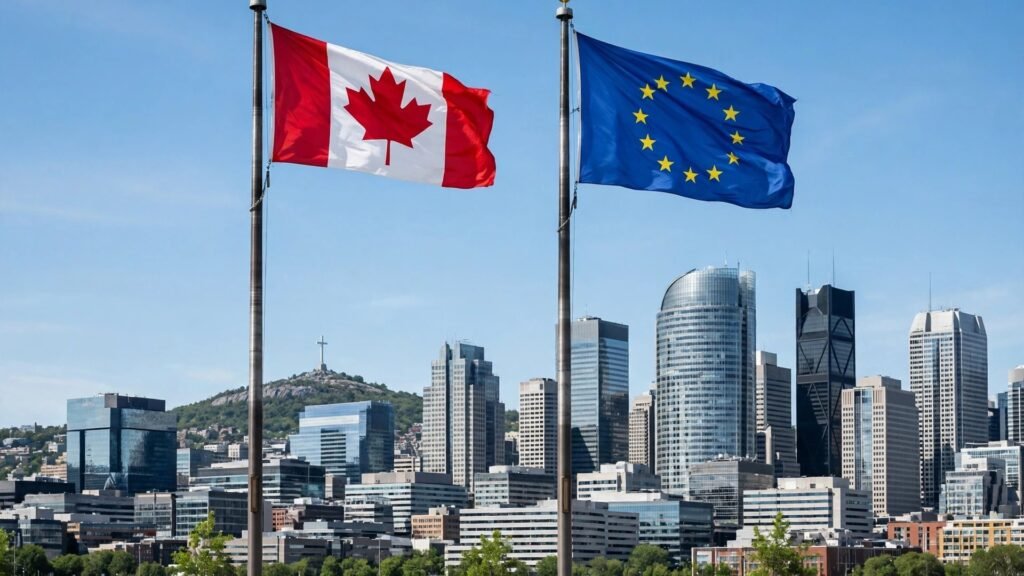
Canada and the European Union used a summit in Montreal on Thursday, October 29, 2026, to push for an unusually close partnership, including a proposal that could make Canada the bloc’s first “associate member” and a broader “Alliance for the Future” open to other like-minded countries. Canadian Prime Minister Mark Carney and European Commission President Ursula von der Leyen presented the plan as a response to economic pressure from foreign governments and powerful technology companies, arguing that closer cooperation would protect sovereignty, trade and security on both sides of the Atlantic.
Key Takeaways
- Canada and the EU are pursuing an “associate member” arrangement for Canada, which would deepen cooperation without full EU membership.
- The proposed “Alliance for the Future” would cover trade, defence, critical minerals, technology and research, with Canada and the EU at its core.
- The plan still faces resistance inside the EU, and Carney has said any enhanced partnership would require a vote in Canada’s Parliament.
The summit brought together Carney, von der Leyen and European Council President António Costa for two days of talks in Montreal, as Canada and Europe seek to reduce their dependence on Washington. The meeting comes during United States President Donald Trump’s trade war and after his threats against traditional allies, a backdrop both leaders addressed directly, even when they did not always name the United States.
What “Associate Member” Would Mean
Von der Leyen proposed last month that Canada become the EU’s first associate member, a designation that would bring Ottawa closer to the bloc without formal membership. Carney has ruled out formally joining the EU, and he said any enhanced partnership would face a vote in Canada’s Parliament. Speaking in Montreal, he said the designation itself mattered less than the practical benefits of the partnership, and he later used the term “associate member” himself while sitting beside von der Leyen at a business roundtable.
That caution reflects the politics on both sides. The structure and even the name of the proposed partnership remain unsettled, with some EU member states questioning the associate-member designation. Anand Sundar, a special adviser at the European Council on Foreign Relations, said France and Germany were among the countries unhappy with the designation and that it might not survive the summit. Von der Leyen, however, showed no sign of abandoning the idea in Montreal.
When trade becomes a tool of economic pressure, it is families that pay the price, from the supermarket shelf to the cost of a new car.
For Canadian businesses, researchers and consumers, the pitch is practical rather than symbolic. Carney said the partnership could create new opportunities for Canadian students, businesses and researchers while strengthening the country’s independence and sovereignty. Von der Leyen said Canada and the EU would finalise an agreement on October 30 giving Canadian companies, startups and researchers access to Europe’s network of 12 supercomputers, strengthening cooperation on artificial intelligence. Reports from the summit also said Carney announced that Canada would invest up to C$1.6 billion in Canadian artificial intelligence company Cohere.
Why Leaders Say Sovereignty Is at Stake
Von der Leyen warned that economic relationships once considered sources of stability were increasingly being used as instruments of pressure, citing dependence on single suppliers of energy, semiconductors and critical minerals. She said countries faced a choice between acting alone or working with trusted partners to protect their economic security.
“We are seeing in real time our sovereignty being attacked,” von der Leyen said. Carney put the same argument in plainer terms: “Why does sovereignty matter in a dangerous and divided world? It allows us to withstand shocks. It allows us to live our lives as we choose.” He said the proposed alliance would help Canada withstand economic shocks and prevent foreign governments and technology companies from dictating its choices.
The argument builds on a case Carney made at the World Economic Forum in Davos in January, when he warned that the United States-led international order was breaking down and urged middle powers to unite against economic coercion by great powers. The Montreal summit puts that vision to the test, with Canada and Europe now trying to turn shared concern into shared institutions, supply chains and defence cooperation.
Canada is already the only non-European country participating in the EU’s 150-billion-euro SAFE defence procurement programme, allowing Canadian companies to take part in European defence projects. That existing link gives the new alliance a concrete starting point, even as negotiators work out how far the associate-member idea can go. Carney said the summit would be followed by further negotiations over the next year, a timetable that underlines how much remains undecided.
The Trump Factor
Trump has suggested Canada’s proposed EU arrangement could be a “hostile act” and threatened tariffs on Europe if he considered it unfriendly. A senior Canadian government official told reporters that the closer relationship was not directed against the United States but reflected longstanding shared interests, and the White House said United States trade and commerce officials had held discussions with their Canadian counterparts in recent days.
That tension is part of a wider strain in the Canada-United States relationship, even as trade talks between the two neighbours continue. Readers following that thread can read our earlier coverage of Trump’s comments on a Canada trade deal and steel and auto talks. At home, Canada’s own economic picture remains in focus too, including the Bank of Canada’s rate decision this week.
- Montreal summit: Carney, von der Leyen and Costa met for a two-day Canada-EU summit aimed at deepening trade, defence and economic ties.
- Associate member: the proposed designation would make Canada the EU’s first associate member, short of full membership and subject to a Canadian parliamentary vote.
- Alliance for the Future: a broader framework covering trade, defence, critical minerals, technology and research, with other trusted partners welcome to join.
- Supercomputers and AI: an agreement due October 30 would give Canadian firms and researchers access to Europe’s 12-supercomputer network.
- Resistance: France and Germany are reported to be unhappy with the associate-member label, so the final name and structure are not settled.
What Europe’s Own Divisions Mean
The debate inside Europe matters because the EU acts through its member states, and a designation that some capitals resist may be softened or renamed before it is finalised. That is not unusual for EU diplomacy, where ambitious proposals often survive in substance even when their labels change. The question for Canada is whether the practical benefits — defence procurement access, supercomputer access, critical-minerals cooperation and more resilient supply chains — arrive even if the associate-member title does not.
The contrast with other European debates is also striking. While Canada seeks closer ties to the EU, Poland’s opposition leader has floated EU exit talks as leverage, a proposal covered in our report on Kaczynski floating EU exit talks to force reforms. The two stories point in opposite directions, but both turn on the same question: what membership, partnership or exit is worth, and who pays when economic ties become a tool of pressure.
What to Watch Next
What to watch next is only what this article has already set out: whether the associate-member designation survives the summit in its current form or is renamed after resistance from some EU member states, whether the October 30 supercomputer agreement is finalised as described, whether Canada’s Parliament is asked to vote on an enhanced partnership, and whether the further negotiations Carney promised over the next year turn the Alliance for the Future from a summit proposal into lasting cooperation on trade, defence, critical minerals, technology and research. Until those steps happen, the Montreal plan remains a proposal with powerful backers, open questions and a clear test ahead.