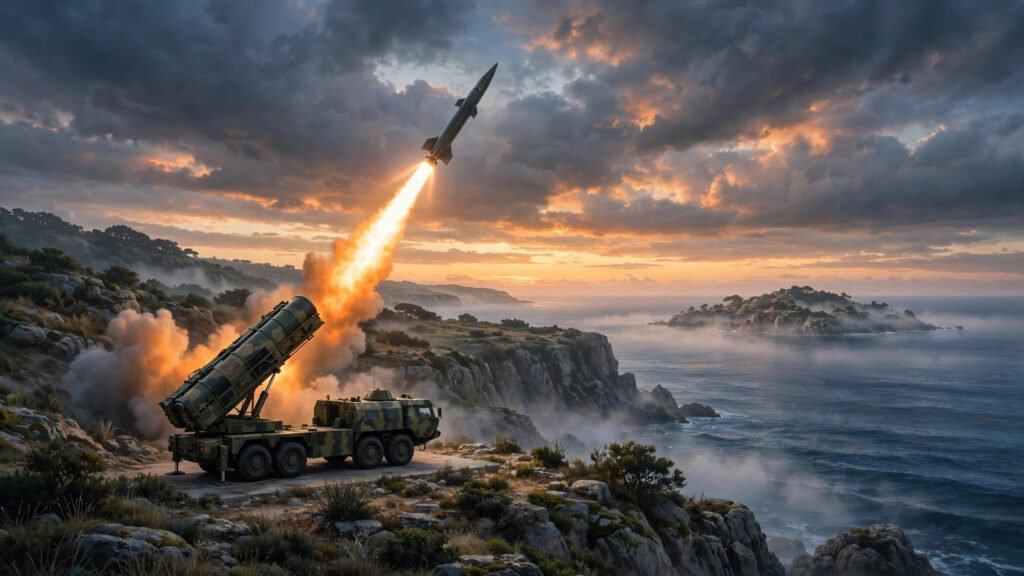
North Korea has tested a cluster-bomb warhead designed to be mounted on tactical ballistic missiles, its state media reported on Sunday, November 1, in the latest in a series of weapons tests by the nuclear-armed country. The test was conducted on Saturday, October 31, by the North’s Missile Administration, according to the Korean Central News Agency (KCNA), which said the exercise was intended to assess the combat adaptability and power of the warhead.
According to KCNA, research institutes under the Missile Administration confirmed that the Standard Type 2 cluster-bomb warhead is capable of turning into ashes a target area of 12 to 13 hectares with its highest-density power. That figure is a claim made by North Korea’s state media about its own weapon, not an independently verified measurement, and it was reported as such by international news agencies covering the test.
Key Takeaways
- North Korea tested a cluster-bomb warhead for tactical ballistic missiles on October 31, KCNA reported on November 1.
- KCNA claimed the Standard Type 2 warhead could devastate a target area of 12 to 13 hectares at its highest-density power.
- North Korea said it would field four categories of cluster-bomb warheads for military units by the end of the year.
What KCNA Said About the Test
KCNA described the test as an assessment of a warhead intended for tactical ballistic missiles, which are shorter-range weapons designed for battlefield use rather than long-range strikes. Cluster munitions work by scattering smaller submunitions over an area, rather than delivering a single explosive charge to one point, which is why claims about the size of the area affected are central to how the weapon is presented.
The general director of the Missile Administration was quoted by KCNA as saying that cluster-bomb warheads are classified into four categories depending on their purposes. KCNA also reported that, within this year, North Korea would enable military units to select and use all of those types according to operational aims and the specific features of targets. The report framed the test as part of regular scientific research aimed at boosting the power of combat systems.
The test was conducted to assess the combat adaptability and power of a cluster-bomb warhead to be mounted on tactical ballistic missiles.
Who Oversaw the Test, and What South Korea Observed
KCNA said the test was overseen by Gen. Kim Jong-sik, a member of the Central Military Commission of the ruling Workers’ Party of Korea and a senior official involved in the country’s munitions programme. North Korean leader Kim Jong Un was not reported to have attended this test, a contrast with an April test of cluster bombs mounted on a tactical ballistic missile, which KCNA said he oversaw alongside his daughter Ju-ae.
South Korea’s military said it had been monitoring the launch, adding that the missile was fired toward the Yellow Sea from an area around the northwestern county of Chongju. Shin Jong-woo, secretary-general of the Seoul-based Korea Defense and Security Forum, said the missile appeared to be from the Hwasong-11 Ra family, the same type associated with the April cluster-bomb test. That identification is an expert assessment reported by Yonhap, not a statement by KCNA itself.
- Test date: Saturday, October 31, 2026, as reported by KCNA on November 1.
- Warhead described by KCNA: Standard Type 2 cluster-bomb warhead for tactical ballistic missiles.
- Claimed area effect: 12 to 13 hectares at highest-density power, according to KCNA.
- Launch direction observed by South Korea: toward the Yellow Sea from around Chongju.
- Stated plan: four categories of cluster-bomb warheads available to units by the end of the year.
- Leader attendance: Kim Jong Un was not reported to have attended this test.
A Spate of Recent Weapons Tests
The cluster-warhead test did not come in isolation. In recent weeks, North Korea has trialled a range of weaponry, including attack drones, a new precision-guided torpedo system and an intermediate-range hypersonic missile, according to reporting on the latest test. That pattern has kept regional militaries and analysts watching each announcement for signs of what capability Pyongyang is prioritising next, and how quickly new systems move from testing to deployment.
The latest test also follows an earlier North Korean ballistic missile launch toward the sea reported on October 29, and a recent display of AI drones, a sniper system and a rocket launcher. Together, those events underline a sustained period of weapons activity, even as diplomatic attention in the region has focused on other crises.
Why the Test Matters for the Region
Tactical ballistic missiles matter to South Korea and Japan because of their range and their role in a conflict on the Korean Peninsula. A cluster warhead, if deployed as KCNA describes, would be presented by Pyongyang as a weapon for striking area targets rather than a single hardened site, and that is part of why Seoul monitors each launch closely and reports its trajectory and launch area.
At the same time, the test lands in a diplomatic context in which Seoul, Washington and Tokyo reaffirmed the goal of North Korea’s denuclearization on October 31. The gap between that stated diplomatic goal and Pyongyang’s continuing weapons tests is itself part of the story: each new test is both a technical step for North Korea’s military and a signal to its neighbours and to the United States.
What to Watch Next
What to watch next is whether North Korea follows through on its stated plan to make all four categories of cluster-bomb warheads available to military units by the end of the year, whether further tests of the Standard Type 2 warhead or related systems are reported, and how South Korea, Japan and the United States respond in their public statements and military posture. Until then, the verified picture remains the one reported by KCNA and monitored by Seoul: a cluster-bomb warhead test on October 31, a claimed area effect of 12 to 13 hectares, and a stated plan to field the new warhead types before the year ends.