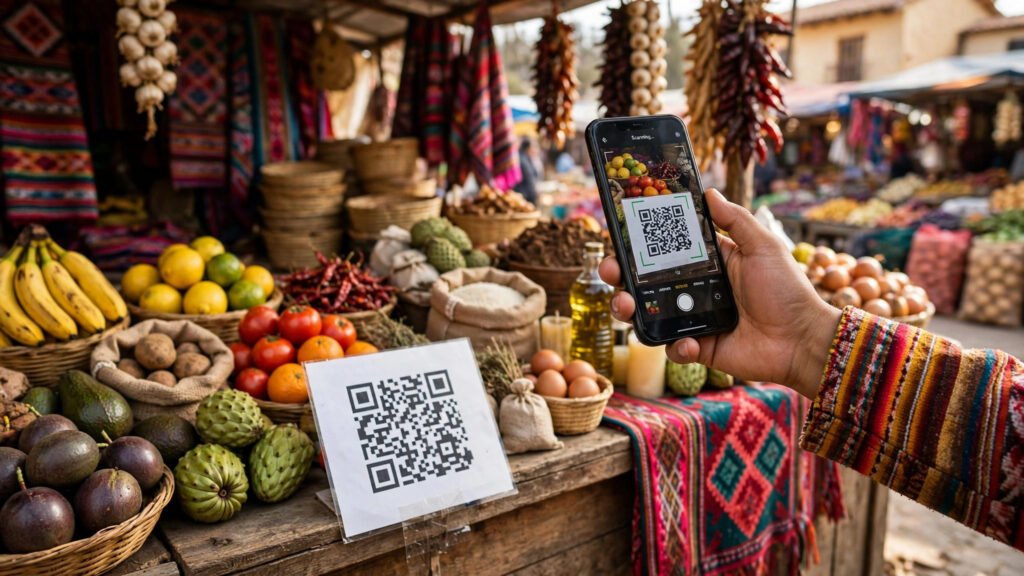
In a busy market in Bolivia, a shopkeeper does not reach for a card machine when a customer wants to pay. Instead, the shopkeeper points to a small printed square on the counter, the customer opens a banking app on a phone, scans the square, types in the amount, and shows the confirmation screen. The whole exchange takes only a few moments, and neither side needs cash, change, or a card terminal.
That little square is a QR code, and it has quietly become one of the most practical ways to pay in Bolivia. For many shoppers and small sellers, it sits in a useful middle ground: easier than carrying exact cash, and simpler than setting up card payments. To understand why it caught on, it helps to look at how Bolivians actually buy and sell every day.
Key Takeaways
- QR codes let small sellers accept phone payments without buying or renting a card terminal.
- For shoppers, a QR payment avoids the hunt for exact change and keeps the payment inside a familiar banking app.
- Cash is still important in Bolivia, so QR works best as an addition to cash, not a replacement for it.
Why QR Codes Took Off in Bolivia
Bolivia has a large number of small businesses, market stalls, street vendors, and family-run shops. For these sellers, a traditional card terminal can be a poor fit. It may need a contract, a monthly arrangement, a reliable connection, and a device that has to be charged and maintained. A printed QR code, by contrast, costs almost nothing to display once a seller has an account that can receive payments through a banking app.
That low barrier matters most where margins are thin and every sale counts. A vendor selling fruit, bread, clothing, or phone accessories does not need to change how the stall works. The QR code sits beside the goods, the buyer scans it, and the seller checks the confirmation before handing over the purchase. The shop does not need new hardware, and the buyer does not need a separate payment card.
Phones themselves helped the shift. Many Bolivians already carry a smartphone for messaging, calls, photos, and social media, and banking apps have become a normal part of that daily phone use. Once a person is comfortable checking a balance or sending money inside an app, scanning a QR code to pay a shop feels like a small next step rather than a new skill to learn.
A printed QR code costs almost nothing to display, and that low barrier is exactly why it fits Bolivia’s many small stalls and family-run shops.
What Makes QR Different From Cards
Cards and QR codes both move money without cash, but they feel different in a small shop. A card payment usually needs the seller’s terminal to read the card, connect, and print or show a result. If the terminal is out of battery, out of signal, or simply not available, the sale stalls. A QR payment shifts the work to the buyer’s phone and the seller’s printed code, so the transaction does not depend on a single piece of shop equipment.
QR codes also solve a small but constant problem with cash: change. Anyone who has paid with a large note for a small purchase in a market knows the awkward pause while the seller searches for coins. A QR payment is for the exact amount, so there is nothing to count back and no need to keep a float of small notes and coins ready all day.
For buyers, there is another quiet advantage. The payment happens inside an app they already trust for their own money, and the app usually shows a record of the payment straight away. That record helps people keep track of spending without keeping paper receipts, and it gives the seller a confirmation to check on the spot.
Cash Still Matters in Bolivia
None of this means cash has disappeared, and it would be a mistake to describe Bolivia as cashless. Cash remains essential in many places, especially where mobile signal is weak, where a phone battery is low, or where a buyer simply prefers notes and coins. Some sellers accept QR payments some of the time and cash the rest of the time, depending on the day, the customer, and the connection available.
That mix is normal, and it is also sensible. A payment method only works if both sides can use it in that moment. In a city with strong signal, a QR payment may be the fastest option. In a rural market or a mountain town where the connection drops, cash may be the only option that works. The strength of QR in Bolivia is that it adds a choice, rather than forcing everyone onto a single system before the infrastructure is ready for it.
- Small sellers can start accepting phone payments with just a printed code and a bank account.
- Buyers pay the exact amount, so neither side has to find change.
- QR payments work alongside cash, which still matters where signal or battery is limited.
- The payment record inside a banking app helps both sides confirm the sale at once.
Who Benefits Most From QR Payments
Small and informal sellers benefit first, because they gain a way to accept digital payments without the setup that card terminals demand. A market trader, a food stall owner, or a neighbourhood shopkeeper can serve customers who do not carry cash, without turning those customers away or asking them to find an cash machine first.
Shoppers benefit too, particularly younger buyers and city dwellers who already manage much of their lives on a phone. Paying by QR fits naturally into a trip that already involves checking messages, looking up a price, or ordering a ride. It also helps people who want to avoid carrying larger amounts of cash while moving around a busy city.
QR codes have spread in other countries too, and the reasons often rhyme: in Indonesia, QR codes have become a common way to pay without relying on cash or cards, while in Cambodia, shoppers also pay by scanning codes instead of handling notes and coins. In places where mobile money has taken hold, the phone itself has become the wallet, and Bolivia’s QR habit belongs to that same wider story of phones replacing the till.
What to Watch For
QR payments are not without their cautions. A buyer should always check the amount and the recipient name before confirming, since a payment sent to the wrong code can be hard to undo. Sellers, for their part, should wait for a proper confirmation rather than trusting a screenshot alone, because a picture of a payment is not the same as a payment arriving.
Phone security matters as well. A banking app should be protected with a lock the owner actually uses, and a phone that is lost or shared casually can become a risk if the app is left open. Connection problems are another everyday limit: a QR payment still needs enough signal for the app to complete the transfer, so sellers in low-signal areas keep cash ready as a backup.
There is also a simple human habit to keep in mind. QR codes work best when they are visible, clean, and easy to scan. A faded printout, a code stuck behind goods, or a code placed in dim light slows everything down and sends customers back to cash. The sellers who get the most from QR are often the ones who treat the code like part of the counter: in plain sight, undamaged, and ready to scan.
What to Watch Next
QR payments in Bolivia are best understood as a practical addition to cash, not a replacement for it. They help small sellers accept phone payments without a card terminal, they save buyers the search for exact change, and they fit phones that Bolivians already use every day. At the same time, cash stays essential where signal is weak or a battery is low, and both buyers and sellers still need to check amounts and confirmations carefully. The next step to watch is not a sudden switch away from cash, but a gradual one: more stalls and shops displaying a code, more buyers comfortable scanning it, and a payment mix in which cash and QR sit side by side, each used where it works best.