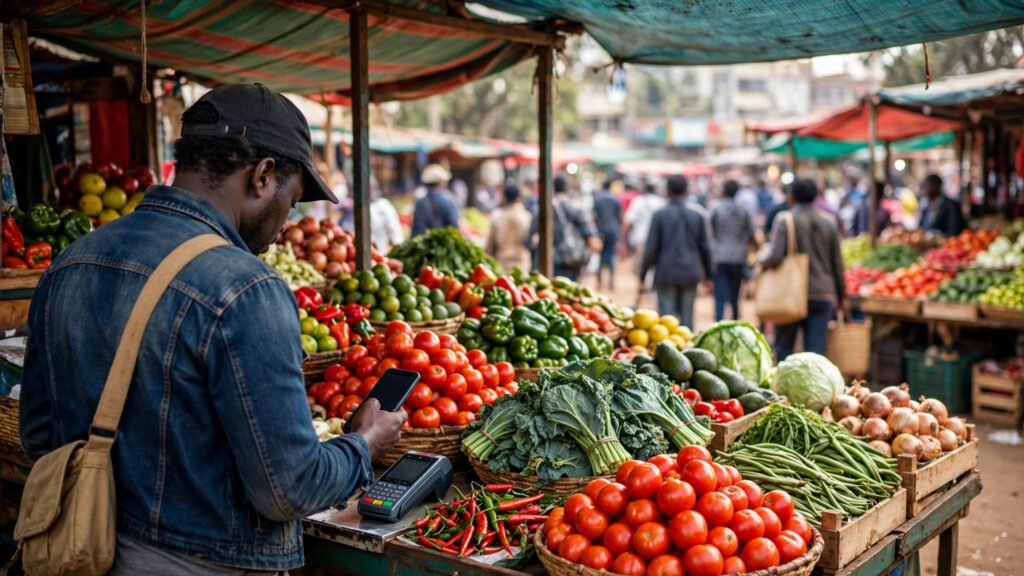
Explained: Why Kenyans Pay with M-Pesa Instead of Bank Cards
In Kenya, paying for groceries, a bus ride or a bill often starts with a phone, not a wallet full of cards. A buyer types a short code or opens an app, confirms the amount, and the payment is done. For visitors, it can look surprising: in a country with banks and card terminals, why did a phone-based system become the everyday way to pay?
The short answer is that M-Pesa reached people where they already were. It worked on the phones they already owned, in the markets they already visited, and for the amounts they actually spent each day. Bank cards, by contrast, asked many people to change their habits first: open and maintain an account, carry a card, and find a shop with a working terminal.
Key Takeaways
- M-Pesa fits daily Kenyan life because it works on basic phones as well as smartphones, without needing a bank card.
- A wide network of agents lets people turn cash into phone money and back again, close to home.
- Bank cards still have a place, especially for larger or online purchases, but for small everyday payments the phone is often faster and simpler.
How M-Pesa Works in Daily Life
M-Pesa is a mobile money service run in Kenya by Safaricom. In simple terms, it lets a phone hold and move money. A person loads money into their mobile money account, sends it to another phone number, pays a shop or a bill, and can later withdraw cash if needed. The recipient does not need a bank account to receive it, only a registered mobile money account.
One reason it spread so quickly is that it does not depend on having the newest phone. On a basic feature phone, payments run through simple on-screen menus. On a smartphone, the same service is available through an app. That matters in a country where many people upgraded to smartphones gradually, and where a payment system that only worked on expensive handsets would have left many people out.
For many Kenyans, the phone in their pocket is already the bank branch, the wallet and the receipt book in one.
For many Kenyans, the phone in their pocket is already the bank branch, the wallet and the receipt book in one.
Why It Beat the Bank Card for Many People
Bank cards work well when both sides of a payment are set up for them. The buyer needs a card, and the seller needs a terminal, a reliable connection and a bank account to receive the money. In a large supermarket, that setup is normal. At a roadside vegetable stall, a small kiosk or a rural market, it often is not. A phone payment needs far less equipment: the seller only needs a phone number that can receive money.
Small amounts are another big factor. Much of daily spending in Kenya happens in small steps: a single bus fare, a few vegetables, airtime, or a small household item. Tapping a card for every tiny purchase can feel slow or impractical, especially where terminals are rare. Sending a small amount from one phone to another feels natural, and both sides get a confirmation message straight away.
Trust also grew through everyday use. When a neighbour, a market trader and a bus conductor all accept the same system, a new user does not need a long explanation. They see it work, try it once for a small amount, and then use it again. Over time, that habit becomes the default, and the card stays in a drawer for the occasions when it is genuinely needed.
The Agent Network Makes the Difference
Mobile money still needs a bridge to cash, and in Kenya that bridge is the agent. Agents are small shops and kiosks where people can deposit cash into their mobile money account or withdraw it. Because agents are spread through towns, estates and rural trading centres, people rarely have to travel far to reach one. That closeness matters: a payment system is only useful if putting money in and taking money out is easy.
Agents also help people who are less confident with technology. A first-time user can ask an agent how a transaction works, or get help when a menu is confusing. That human help, repeated thousands of times in small shops, did a lot to build confidence in a system that might otherwise have felt abstract or risky.
This pattern is not unique to Kenya. Across Africa, phone-based payments have grown where bank branches and card terminals are thin on the ground, as readers can see in how Tanzanians pay with mobile money instead of bank cards and how Ethiopians pay with Telebirr instead of cash and cards.
What About Bank Cards Then?
None of this means bank cards have disappeared in Kenya. Cards remain common for larger purchases, for shopping in bigger stores, and for some online payments. Many Kenyans use both systems: the phone for daily spending and small transfers, and a bank account and card for savings, salaries and bigger transactions. The two systems overlap, and money can move between them.
The choice often comes down to the situation. In a supermarket with a working terminal, a card is quick. In a market, on a bus, or when sending money to family in another town, the phone usually wins because it works anywhere there is a mobile signal, without extra hardware. Zimbabweans paying with EcoCash instead of cash and cards show a similar logic: the tool that fits the place and the purchase tends to win.
- M-Pesa works on basic phones and smartphones, so it does not wait for everyone to own the same device.
- Agents in neighbourhoods and trading centres make cash deposits and withdrawals practical.
- Small, frequent payments suit phone-to-phone transfers better than card terminals in many small shops.
- Cards still matter for larger purchases, bigger stores and some online payments.
What to Watch Next
The question now is not whether phone payments will stay part of Kenyan life, but how they will sit alongside cards, bank apps and newer payment options. If card acceptance keeps spreading in smaller shops, some payments may shift back. If mobile money keeps adding services, the phone may stay the first choice for daily spending. Either way, the habit that made M-Pesa central in Kenya is clear: people choose the payment method that works in the shop in front of them, on the phone they already own, for the amount they actually need to pay.