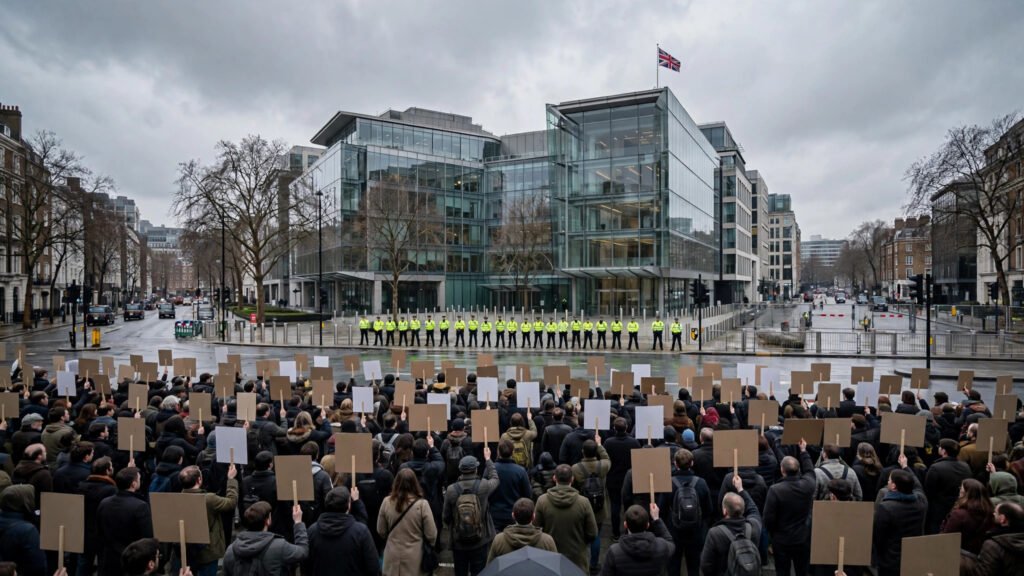
London police arrested 139 people on Saturday, October 31, 2026, at a protest outside the United States Embassy in London, after hundreds of demonstrators gathered to oppose the British government’s ban on the campaign group Palestine Action. The Metropolitan Police said most of those arrested were detained for expressing support for a proscribed organisation, and police said more arrests were expected while officers remained at the scene.
Key Takeaways
- London police arrested 139 people outside the US Embassy on October 31, most of them for expressing support for the banned group Palestine Action.
- The protest, organised by Defend Our Juries, came days before a UK Supreme Court appeal on November 4 challenging the group’s proscription.
- Organisers said more than 4,000 people have now been detained since the ban took effect in July 2025.
What Happened Outside the Embassy
The demonstration took place in Nine Elms, in south London, where the US Embassy stands. Hundreds of protesters gathered with placards reading “I oppose genocide, I support Palestine Action,” in a deliberate public show of support for a group whose backing is now a criminal offence in the United Kingdom. Police had warned in advance that people expressing support for the proscribed group faced arrest, and officers moved through the crowd detaining demonstrators one by one.
The arrest total rose sharply through the day. Police said 48 people had been detained earlier on Saturday, before updating the figure to 139 in the evening. The arrests turned a planned act of defiance into one of the largest single-day detention totals since the ban took effect. Organisers estimated that about 400 people attended the London demonstration, and a parallel gathering was held outside the US Consulate in Edinburgh, where no arrests were reported on Saturday.
The arrests turned a planned act of defiance into one of the largest single-day detention totals since the ban took effect.
- 139 people arrested outside the US Embassy in London on October 31, 2026
- Most arrests were for expressing support for a proscribed organisation
- About 400 people attended, according to the organisers, Defend Our Juries
- A parallel protest was held outside the US Consulate in Edinburgh
- The UK Supreme Court is due to hear an appeal against the ban on November 4
Why the Ban Is Being Challenged
Palestine Action was proscribed by the British government in July 2025, placing it on a list of banned organisations under UK terrorism law. Membership of, or support for, a proscribed organisation can carry a prison sentence of up to 14 years. The group, founded in 2020, campaigns to end British military support for Israel, and it accuses Israel of committing genocide against Palestinians, an accusation Israel strongly denies.
Critics of the ban argue that it criminalises peaceful protest and free expression, and that it sweeps a direct-action campaign group into the same legal category as armed extremist organisations. Supporters of the proscription argue that the group’s actions crossed the line from protest into activity that justified a ban. That dispute is now heading to the UK’s highest court: the Supreme Court is due to hear an appeal on November 4 challenging the group’s designation as a terrorist organisation.
The London rally was also the first major demonstration against the proscription since Andy Burnham became prime minister in July, according to reports of the protest, adding a political dimension to a case that has already divided opinion across Britain. The United States government announced sanctions against Palestine Action in August, which is one reason the London demonstration was staged outside the US Embassy rather than a British government building.
A Wider Weekend of Protest in Europe
The London arrests came on a weekend of large street protests across Europe. In France, youth-led rallies continued for a third weekend, while in Germany tens of thousands joined Halloween demonstrations and in Italy anti-government protests spread across 50 cities. The London protest differed from those gatherings in one important respect: the demonstrators there knew, before they arrived, that holding up a placard in support of Palestine Action could lead directly to arrest.
That knowledge shaped the character of the event. Many of those taking part were older protesters, including retirees, and the demonstration proceeded as a seated, placard-holding protest rather than a march. Defend Our Juries, the organisation behind the protest, said Saturday’s arrests took the total number of people detained for defying the ban to more than 4,000 since July 2025, a figure that reflects the campaign’s strategy of repeated, openly unlawful acts of support designed to test the ban in public.
What to Watch Next
What to watch next is the Supreme Court appeal on November 4, which will test whether the proscription of Palestine Action can survive legal challenge, and whether the arrest total from Saturday rises further as police review the demonstration. The Edinburgh gathering will also be watched for any follow-up police action, and the wider question remains whether repeated mass arrests will strengthen or weaken public support for the ban. For now, the 139 arrests in London stand as a measure of how far both sides are prepared to go: protesters willing to be detained for holding a placard, and police willing to detain them for it.