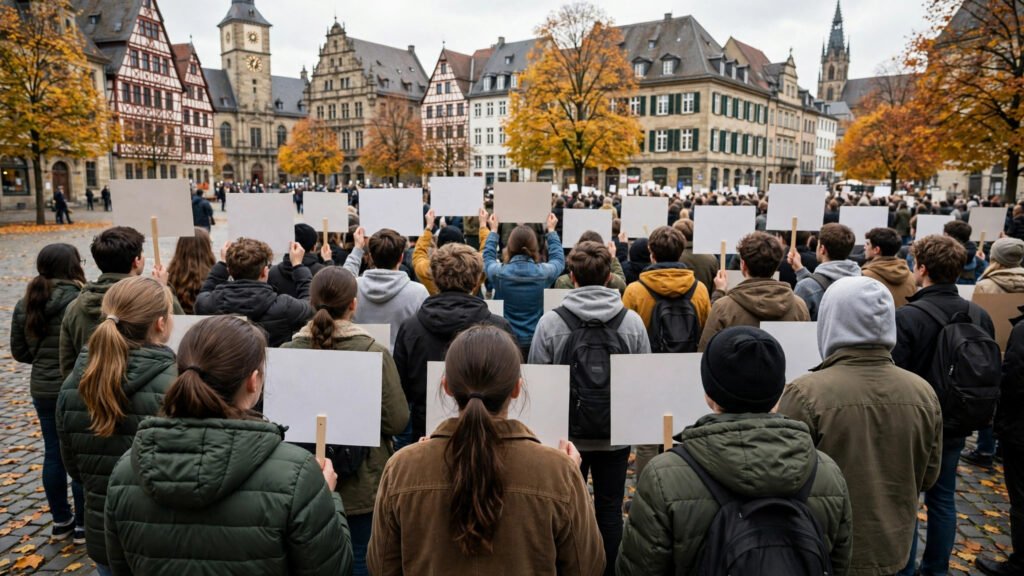
More than 160,000 people across Germany are expected to join demonstrations on Saturday, October 31, organisers say, as a youth-led movement inspired by protests elsewhere in Europe takes to the streets to demand better education and lower living costs. The rallies, planned in 34 cities including Berlin, Frankfurt and Munich, mark the arrival in Germany of a wave of Gen Z-led demonstrations that has already shaped politics across the continent this year.
The German protests are organised by the campaign group Gen Z regelt, which translates as Gen Z takes charge. The group says it opposes compulsory military service and wants greater investment in education, at a time when many young Germans are struggling with rising costs. The demonstrations coincide with Halloween festivities, and German authorities say they expect them to be largely peaceful, while warning that extremist groups could try to exploit the movement.
Key Takeaways
- More than 160,000 people are expected at Gen Z-led demonstrations in 34 German cities on Saturday, October 31, according to organisers.
- The rallies, organised by Gen Z regelt, demand better education and lower living costs and oppose compulsory military service.
- Authorities expect the protests to be largely peaceful but have warned that extremist groups could try to exploit the movement.
A European Wave Reaches Germany
The protests follow a wave of Gen Z-led demonstrations across Europe this year. In Serbia, student-led activism helped unseat the country’s long-time leader at the ballot box, while protests in France have descended into rioting and looting, according to Reuters. That contrast matters for how Saturday’s rallies are being watched: organisers present them as a peaceful demand for change, while officials are openly concerned that the scenes seen in France must not be repeated in Germany.
The connection to Serbia is direct. A student movement in Serbia won a major political breakthrough when its campaign helped bring about an election defeat for the country’s long-time leadership, showing how youth-led organising can move from street protests to electoral change. In France, the picture has been very different, with mass protests leading to nearly 1,000 arrests, and the French experience is now shaping the security debate around the German rallies.
The protests come as Germany struggles to revive economic growth while facing growing pressure on pensions and public services as baby boomers retire and the working-age population shrinks.
What the Protesters Want
For organisers, the focus is on what they see as the growing pressure on younger generations in Europe’s largest economy. “The government has offered no response to our concerns other than to continue making cuts and piling further burdens upon us,” said Steve, an 18-year-old due to speak at a rally in Munich, addressing Chancellor Friedrich Merz. “We will continue to exercise our fundamental right to assemble until you stop ignoring us.”
That message brings together several grievances at once: the state of education, the cost of living, and the prospect of compulsory military service. The education complaint is concrete for at least some of those planning to attend. Sean Baker, a student at the Technical University of Berlin, said he would join the protests on Saturday to call attention to the poor state of buildings on campus. “When you go inside and enter the rooms, it looks like an abandoned building,” he told Reuters. “Yet this is where we’re expected to study on a regular basis.”
The wider economic backdrop gives those complaints a broader setting. Germany is struggling to revive economic growth while facing growing pressure on pensions and public services as baby boomers retire and the working-age population shrinks. In that context, demands for greater investment in education and relief from living costs are not only about student life; they are about how a shrinking workforce and an ageing population share the costs of public services, and about whether younger people feel those costs are falling fairly on them.
- More than 160,000 people expected, according to organisers.
- Rallies planned in 34 cities, including Berlin, Frankfurt and Munich.
- Organised by Gen Z regelt, or Gen Z takes charge.
- Demands include better education, lower living costs, and opposition to compulsory military service.
- Authorities expect largely peaceful protests but warn of extremist exploitation.
- Germany’s national school student umbrella organisation, BSK, has distanced itself and plans a separate protest day on November 20.
Authorities Brace for a Peaceful Day, With Warnings
German authorities say they expect Saturday’s demonstrations to be largely peaceful but have warned of attempts by extremist groups to exploit the movement. Parts of Germany’s far-left extremist scene and some groups linked to foreign extremist movements have joined efforts to mobilise support, according to the federal interior ministry.
“We all have those images from France in our minds – looting, burning houses, burning police vehicles, and attacks on police officers,” said Roman Poseck, interior minister for the state of Hesse, whose capital is Germany’s financial hub, Frankfurt. “France must not be held up as a model in this regard.”
In Berlin, some businesses along the luxury Kurfuerstendamm shopping boulevard boarded up windows and planned early closures ahead of the demonstrations amid concerns about possible unrest. The precaution shows how the warning from officials is being felt on the ground, even as the official expectation remains that the day will pass peacefully.
Who Is Driving the Campaign?
Questions have been raised about who is driving the campaign and whether it is genuinely youth-led, given the broad mix of political and civil society groups involved. That question is not a side issue: it goes to how the rallies will be judged afterwards, and to whether they are seen as a student movement or as a broader coalition using a youth label.
Germany’s national school student umbrella organisation, BSK, has distanced itself from the initiative and plans to hold a separate day of protest on November 20. “We are distancing ourselves from ‘Gen Z regelt,’ but not from the students themselves, who have legitimate concerns,” said BSK secretary-general Amy Kirchhoff on Thursday. The distinction matters: the country’s main school student body is not backing the October 31 rallies, but it is also not dismissing the concerns behind them, and it is keeping its own protest date.
The pattern across Europe this year adds to that complexity. In Italy, anti-government protests spread across 50 cities in October, showing that large, decentralised street movements are not unique to Germany or to one country’s politics. What is different in Germany is the explicit generational framing: a campaign organised under a Gen Z banner, aimed at a chancellor by name, and timed for a single Saturday across dozens of cities at once.
What to Watch Next
What to watch next is whether the turnout matches the organisers’ expectation of more than 160,000 people, whether the rallies in Berlin, Frankfurt, Munich and the other 31 cities stay peaceful, and whether the authorities’ warnings about extremist exploitation prove to be a precaution or a real disruption. The other question is whether the government responds to the demands on education, living costs and compulsory military service, or whether the organisers’ promise to keep assembling until they are no longer ignored is tested in the weeks ahead. The BSK’s separate protest day on November 20 is another date to watch, as it will show whether student concerns continue on a separate track from the Gen Z regelt campaign, and whether the movement grows, splits, or fades after its Halloween debut.