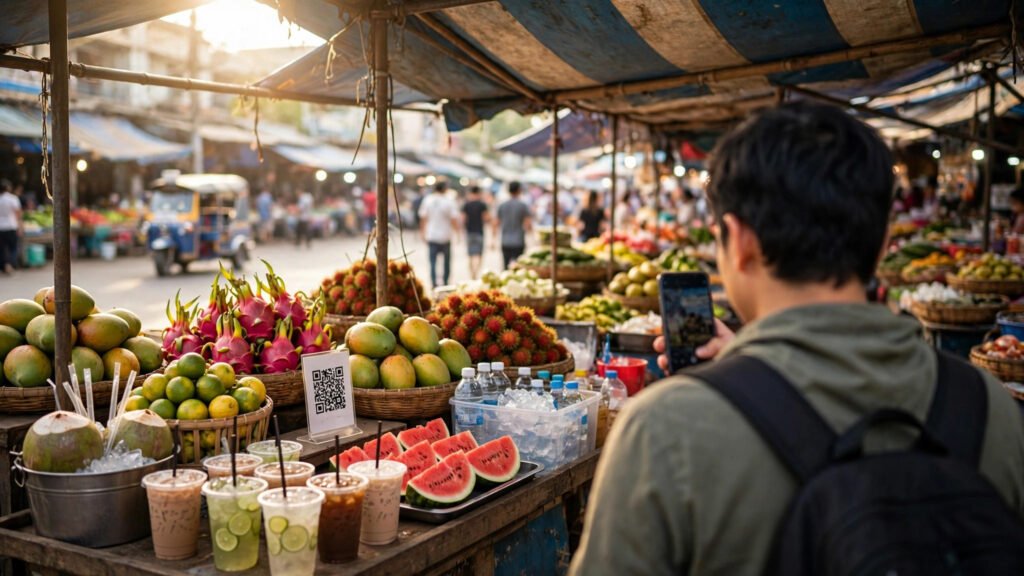
Walk into a shop in Phnom Penh, order a coffee, and you may never reach for your wallet. The seller points to a single printed square on the counter, you open your bank app, scan it, check the name on the screen, and the payment is done. That square is a KHQR code, and it has quietly changed how many Cambodians pay.
Cambodia has long run on cash, and in many places it still does. But carrying notes, counting change, and keeping two currencies straight is slow work for a busy seller. A standard QR code solves a practical problem: one code, on one sign, that works no matter which bank or payment app the customer uses.
Key Takeaways
- KHQR is Cambodia’s standard QR code for payments, so one printed code works across participating banks and payment apps.
- Shoppers like it because it is fast and avoids handling cash and change, while small sellers like it because sales are recorded in their account.
- Cash still matters in rural markets and for small everyday purchases, and a phone, battery, and connection are still needed to pay by QR.
What Is KHQR, Exactly?
KHQR is a national standard for QR code payments in Cambodia, promoted by the National Bank of Cambodia. Instead of every bank or payment provider printing its own code, merchants display a single KHQR code. A customer scans it with a participating bank app or mobile wallet, sees the merchant’s name, enters the amount if it is not already filled in, and confirms.
Behind the code sits Bakong, the payment backbone run by the central bank, which lets money move between participating banks and payment providers. For the person at the counter, none of that complexity is visible. The experience is simply: scan, check, confirm.
The idea is deliberately boring, and that is the point. A payment standard only works when nobody has to think about it. Shoppers do not need to ask which app the shop accepts, and sellers do not need a counter covered in competing QR stickers.
Why One Code Works for Every Bank
Before a shared standard, a shop that wanted to accept digital payments could end up juggling several codes, one for each provider its customers used. That is confusing for staff and for customers, and it discourages smaller sellers from offering digital payment at all.
A single standard removes that friction. The seller prints one code, and the customer’s own app does the rest. This is the same reason similar shared QR standards have caught on in other countries: the fewer decisions at the till, the faster the queue moves. In Senegal, for example, many people pay with mobile money services like Wave instead of cash or bank cards, because the phone-based option fits how people already live and trade.
A payment standard only works when nobody has to think about it.
Why Shoppers and Small Sellers Like It
For shoppers, the appeal is convenience. There is no need to carry a thick wallet, no counting of notes at a busy stall, and no worry about whether the seller has change. The payment leaves a record in the app, which makes it easier to keep track of spending than a pocket full of receipts.
For small sellers, the record matters even more. A market trader, a tuk-tuk driver, or a family-run cafe can see payments arrive in their account without handling cash all day. That reduces the risk of mistakes, lost notes, or theft, and it builds a simple sales history that a cash-only business never has.
- One KHQR code works across participating banks and payment apps, so sellers need only one sign at the counter.
- Payments are confirmed on the spot, with the merchant’s name shown on screen before the customer approves.
- Digital payments leave a record, helping small sellers track sales without counting cash at the end of the day.
- Cambodia’s everyday use of both riel and US dollars makes cash handling fiddly, which is one more reason a quick scan appeals.
- Similar phone-first payment habits are growing elsewhere, from people in Botswana banking and paying by phone across long distances to Jamaica’s own digital currency experiment, JAM-DEX.
Where Cash Still Wins
None of this means cash has disappeared. In rural markets, on remote roads, and for very small purchases, notes and coins remain the simplest option. A QR payment needs a charged phone, a working connection, and an app the customer trusts. If any of those is missing, cash still works.
Some people also simply prefer cash. It is immediate, it needs no device, and it leaves no digital trail. Older shoppers, in particular, may stick with what they know, and sellers are happy to take both. The realistic picture is not a cashless Cambodia, but a Cambodia where cash and QR codes sit side by side, and customers choose whichever fits the moment.
Paying Safely With a QR Code
QR payments are straightforward, but a few habits keep them safe. Always check the merchant name shown on screen before confirming, and make sure the amount matches what you agreed. Never share your app PIN or any one-time code with anyone, including someone claiming to help you pay. Keep your banking app updated, and if a code looks damaged, replaced, or suspicious, pay another way and tell the shop.
These are small steps, but they matter most for first-time users. Trust in a payment system is built one smooth, correct transaction at a time, and a single bad experience can send a new user back to cash.
What to Watch Next
KHQR’s future depends on the same things that made it useful in the first place: more banks and wallets joining the standard, more small sellers displaying a code, and more shoppers finding the scan faster than counting cash. Where phones, batteries, and connections are reliable, QR payments will keep spreading. Where they are not, cash will keep doing its job. The most likely outcome is not one replacing the other overnight, but both living side by side, with the QR code quietly taking a bigger share of everyday payments.